
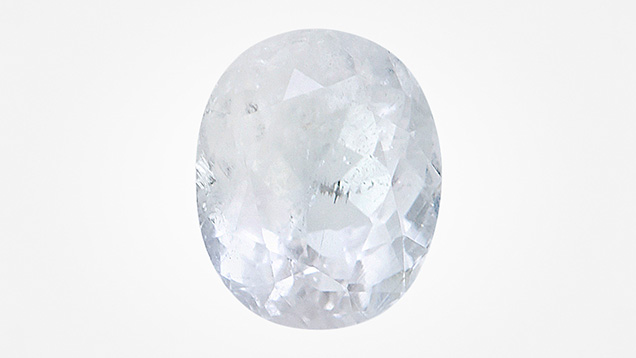
The 4.86 ct near-colorless faceted gemstone measuring 10.56 × 8.63 × 7.31 mm shown in figure 1 was submitted to GIA’s Bangkok laboratory for testing. The gemstone exhibited a refractive index ranging from 1.540 to 1.557, a biaxial negative optic nature, and a specific gravity of 3.10. When viewed in ultraviolet light, it displayed weak orange fluorescence under long-wave UV and strong yellow fluorescence under short-wave UV.
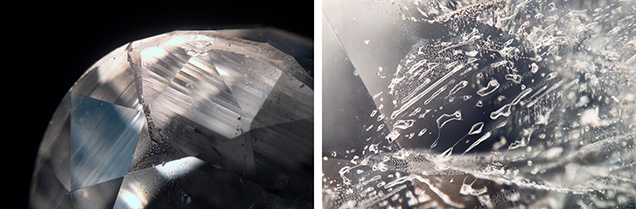
Raman spectroscopy confirmed the mineral’s identity as the rare phosphate mineral viitaniemiite Na(Ca, Mn2+)Al(PO4)(F,OH)3 (A. Pajunen and S.I. Lahti, “The crystal structure of viitaniemiite,” American Mineralogist, Vol. 69, 1984, pp. 961–966), with spectra matching the RRUFF viitaniemiite database entry (B. Lafuente et al., 2015, https://rruff.info/about/downloads/HMC1-30.pdf). Energy-dispersive X-ray fluorescence analysis detected high concentrations of phosphorus and calcium, along with aluminum and sodium, consistent with the phosphate composition of viitaniemiite. Microscopic examination revealed several notable internal features, including strong angular growth (figure 2, left), twinning, fingerprint inclusions, two-phase inclusions (figure 2, right), growth tubes, and tiny transparent crystals.
Viitaniemiite is known for its rarity and typically occurs in very small sizes in colorless, light blue, light green, and pale yellow hues within granitic pegmatites. The identification of viitaniemiite in a gemstone of this size was remarkable, given that the mineral is typically found in much smaller forms (S.I. Lahti, “On the granitic pegmatites of the Eräjärvi area in Orivesi, southern Finland,” Geological Survey of Finland, Bulletin 34, Vol. 314, 1981, pp. 51–56). This discovery expands the known occurrences of viitaniemiite in gem-quality specimens and contributes valuable data to the gemological community.
Vararut Weeramongkhonlert is a senior staff gemologist at GIA in Bangkok.
The 4.86 ct near-colorless faceted gemstone measuring 10.56 × 8.63 × 7.31 mm shown in figure 1 was submitted to GIA’s Bangkok laboratory for testing. The gemstone exhibited a refractive index ranging from 1.540 to 1.557, a biaxial negative optic nature, and a specific gravity of 3.10. When viewed in ultraviolet light, it displayed weak orange fluorescence under long-wave UV and strong yellow fluorescence under short-wave UV.
Raman spectroscopy confirmed the mineral’s identity as the rare phosphate mineral viitaniemiite Na(Ca, Mn2+)Al(PO4)(F,OH)3 (A. Pajunen and S.I. Lahti, “The crystal structure of viitaniemiite,” American Mineralogist, Vol. 69, 1984, pp. 961–966), with spectra matching the RRUFF viitaniemiite database entry (B. Lafuente et al., 2015, https://rruff.info/about/downloads/HMC1-30.pdf). Energy-dispersive X-ray fluorescence analysis detected high concentrations of phosphorus and calcium, along with aluminum and sodium, consistent with the phosphate composition of viitaniemiite. Microscopic examination revealed several notable internal features, including strong angular growth (figure 2, left), twinning, fingerprint inclusions, two-phase inclusions (figure 2, right), growth tubes, and tiny transparent crystals.
Viitaniemiite is known for its rarity and typically occurs in very small sizes in colorless, light blue, light green, and pale yellow hues within granitic pegmatites. The identification of viitaniemiite in a gemstone of this size was remarkable, given that the mineral is typically found in much smaller forms (S.I. Lahti, “On the granitic pegmatites of the Eräjärvi area in Orivesi, southern Finland,” Geological Survey of Finland, Bulletin 34, Vol. 314, 1981, pp. 51–56). This discovery expands the known occurrences of viitaniemiite in gem-quality specimens and contributes valuable data to the gemological community.
Vararut Weeramongkhonlert is a senior staff gemologist at GIA in Bangkok.