
In the jewelry world, innovation continuously drives the industry forward, with jewelry designers often at the forefront of the creative attempt. The author found two bangles exemplifying this astonishing innovation at the AGTA show, exhibited at the Somewhere in the Rainbow collection booth.
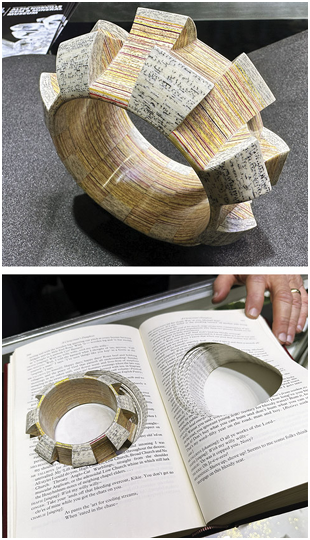
The first of the two bangles was designed and constructed by Jeremy May of London, who creates jewelry using pages from books (figure 1, left). May’s “literary jewel” design concept was born out of a gift idea for his wife to celebrate their first wedding anniversary, in which he crafted a ring literally made of paper. Debuted to the public in 2009, these reimagined paper jewels attract bookworms and those who value sustainability through repurposing from all over the world.
To make a literary jewelry piece, May begins by selecting a book that serves both as the material and in many cases, its inspiration as well, and then cuts the jewel’s shape out of the pages. Depending on the design, sometimes additional colored papers are used to add pops of color. Applying a proprietary laminating process, May turns the thick stack of cut-out paper into a compact solid piece that can be further processed and polished. Layers of varnish are applied to give the item a high gloss. From start to finish, the process often takes at least eight weeks for one piece. In addition to hololith-style jewelry cut directly from the book pages, May also constructs jewelry pieces by assembling various laminated paper components. Each creation comes with the original book to use as a “jewelry box,” adding to the significance of owning such a one-of-a-kind and distinctive jewelry piece (figure 1, right). To May, each book carries its own unique story, not only related to the content but also through its ownership history. Creating these pieces gives a second life to the words as they’re revealed on jewelry.
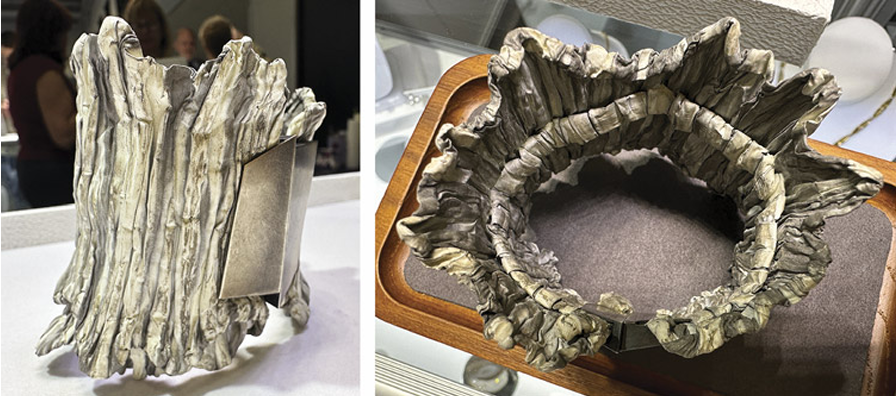
The second bangle was designed by Polish jewelry artist Pawel Kaczynski, who has been using jewelry as a means of artistic expression since the mid-1990s and is best known for his creative application of steel, silver, and gold. This bangle is a representative piece from his “Structure” collection, constructed with pleated and folded stainless steel mesh in a double-tiered configuration (figure 2). Using patinated stainless steel mesh, Kaczynski’s design mimics the appearance of tree bark. While the rigidity and hardness of stainless steel make it challenging to manipulate in jewelry making, the mesh used in this bangle leaves it soft to touch and flexible to wear. The bangle closes with a magnetic stainless steel clasp. The characteristic cream color patina coating adds to the realism of the piece. In addition to this piece, Kaczynski applies other colored patina to his stainless steel jewelry, shaping and folding the mesh to form endless interesting structures and surfaces.
Tao Hsu is technical editor for Gems & Gemology at GIA in Carlsbad, California.
In the jewelry world, innovation continuously drives the industry forward, with jewelry designers often at the forefront of the creative attempt. The author found two bangles exemplifying this astonishing innovation at the AGTA show, exhibited at the Somewhere in the Rainbow collection booth.
The first of the two bangles was designed and constructed by Jeremy May of London, who creates jewelry using pages from books (figure 1, left). May’s “literary jewel” design concept was born out of a gift idea for his wife to celebrate their first wedding anniversary, in which he crafted a ring literally made of paper. Debuted to the public in 2009, these reimagined paper jewels attract bookworms and those who value sustainability through repurposing from all over the world.
To make a literary jewelry piece, May begins by selecting a book that serves both as the material and in many cases, its inspiration as well, and then cuts the jewel’s shape out of the pages. Depending on the design, sometimes additional colored papers are used to add pops of color. Applying a proprietary laminating process, May turns the thick stack of cut-out paper into a compact solid piece that can be further processed and polished. Layers of varnish are applied to give the item a high gloss. From start to finish, the process often takes at least eight weeks for one piece. In addition to hololith-style jewelry cut directly from the book pages, May also constructs jewelry pieces by assembling various laminated paper components. Each creation comes with the original book to use as a “jewelry box,” adding to the significance of owning such a one-of-a-kind and distinctive jewelry piece (figure 1, right). To May, each book carries its own unique story, not only related to the content but also through its ownership history. Creating these pieces gives a second life to the words as they’re revealed on jewelry.
The second bangle was designed by Polish jewelry artist Pawel Kaczynski, who has been using jewelry as a means of artistic expression since the mid-1990s and is best known for his creative application of steel, silver, and gold. This bangle is a representative piece from his “Structure” collection, constructed with pleated and folded stainless steel mesh in a double-tiered configuration (figure 2). Using patinated stainless steel mesh, Kaczynski’s design mimics the appearance of tree bark. While the rigidity and hardness of stainless steel make it challenging to manipulate in jewelry making, the mesh used in this bangle leaves it soft to touch and flexible to wear. The bangle closes with a magnetic stainless steel clasp. The characteristic cream color patina coating adds to the realism of the piece. In addition to this piece, Kaczynski applies other colored patina to his stainless steel jewelry, shaping and folding the mesh to form endless interesting structures and surfaces.
Tao Hsu is technical editor for Gems & Gemology at GIA in Carlsbad, California.