
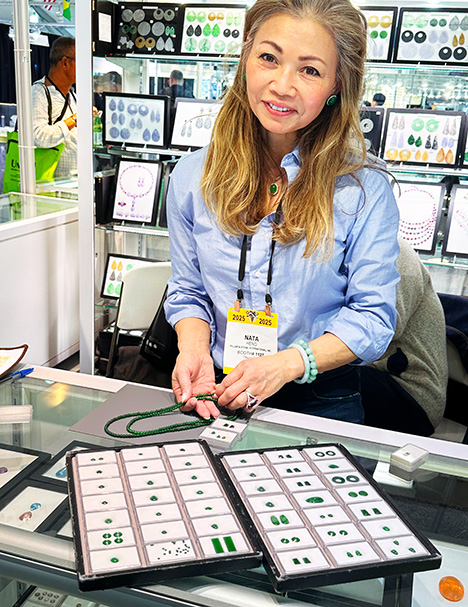
At the GJX show, Pillar & Stone (San Francisco, California) offered bright green jade from Guatemala, confirmed to range from jadeite to omphacite, that was highly translucent to nearly transparent. This was Pillar & Stone’s first year showing these pyroxene-dominant jades, known in the trade as fei cui. Nata Heng showed us many individual pieces, matched pairs, and beads in an intense green coupled with high translucency/near transparency similar to that of fine “imperial green” Burmese jadeite-omphacite jade (figure 1). This material was being sold as Guatemalan imperial green jade. Heng also presented an equivalent set of Burmese jade pieces for side-by-side comparison, noting that the Guatemalan material is considerably less expensive than that of the same color and size from Myanmar. S.I.E. Liu et al. recently reported on the similar appearances of this newer source of “imperial green” jade from Guatemala and the material from Myanmar (see figures 1 and 2 in S.I.E. Liu et al., “Geographic origin determination of high-quality green jadeite-omphacite jade (fei cui ) from Myanmar, Guatemala and Italy using statistical processing coupled with spectroscopic and chemical analyses,” Journal of Gemmology, Vol. 39, No. 2, 2024, pp. 124–144).
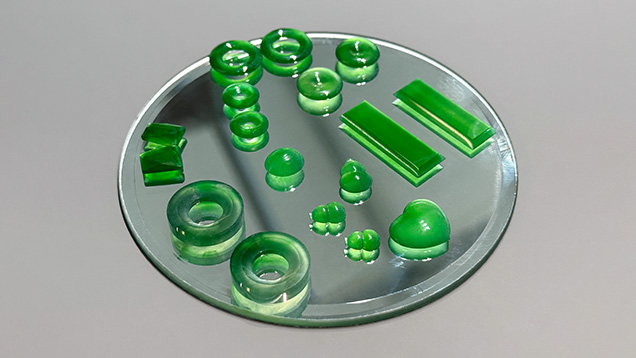
Having visited the Chinese markets processing and selling this Guatemalan material in Jieyang and Guangzhou, Heng reported that one of the largest miners was sending approximately 8 tons of rough each week for processing, with about 20% of the gem-grade material being green. As the green color is concentrated in veins up to 5.5 mm thick, Guatemalan green jade is generally much thinner than material from Myanmar when cut and used in jewelry. As this material can be quite iron-rich, resulting in a deep saturated green color, some choose to cut it relatively thin when used in jewelry to keep the color saturation from being too intense. To best demonstrate its incredible translucency/near transparency, Heng placed many of the pieces on a mirror (figure 2). At the AGTA show, Mason-Kay (Centennial, Colorado) was also selling green jade from Guatemala. To our knowledge, this is the first year that this bright green and nearly transparent jade from Guatemala has been offered in Tucson. With the lower price point, Heng predicts a growing trend toward more affordable top-quality green jadeite and omphacite (fei cui ) jade.
At the GJX show, Pillar & Stone (San Francisco, California) offered bright green jade from Guatemala, confirmed to range from jadeite to omphacite, that was highly translucent to nearly transparent. This was Pillar & Stone’s first year showing these pyroxene-dominant jades, known in the trade as fei cui. Nata Heng showed us many individual pieces, matched pairs, and beads in an intense green coupled with high translucency/near transparency similar to that of fine “imperial green” Burmese jadeite-omphacite jade (figure 1). This material was being sold as Guatemalan imperial green jade. Heng also presented an equivalent set of Burmese jade pieces for side-by-side comparison, noting that the Guatemalan material is considerably less expensive than that of the same color and size from Myanmar. S.I.E. Liu et al. recently reported on the similar appearances of this newer source of “imperial green” jade from Guatemala and the material from Myanmar (see figures 1 and 2 in S.I.E. Liu et al., “Geographic origin determination of high-quality green jadeite-omphacite jade (fei cui ) from Myanmar, Guatemala and Italy using statistical processing coupled with spectroscopic and chemical analyses,” Journal of Gemmology, Vol. 39, No. 2, 2024, pp. 124–144).
Having visited the Chinese markets processing and selling this Guatemalan material in Jieyang and Guangzhou, Heng reported that one of the largest miners was sending approximately 8 tons of rough each week for processing, with about 20% of the gem-grade material being green. As the green color is concentrated in veins up to 5.5 mm thick, Guatemalan green jade is generally much thinner than material from Myanmar when cut and used in jewelry. As this material can be quite iron-rich, resulting in a deep saturated green color, some choose to cut it relatively thin when used in jewelry to keep the color saturation from being too intense. To best demonstrate its incredible translucency/near transparency, Heng placed many of the pieces on a mirror (figure 2). At the AGTA show, Mason-Kay (Centennial, Colorado) was also selling green jade from Guatemala. To our knowledge, this is the first year that this bright green and nearly transparent jade from Guatemala has been offered in Tucson. With the lower price point, Heng predicts a growing trend toward more affordable top-quality green jadeite and omphacite (fei cui ) jade.