

Obsidian is a volcanic glass formed when silica-rich lava cools so fast that crystal formation is only visible with a microscope. The glassy and amorphous nature of obsidian makes it hard and brittle. Due to its highly conchoidal fracture, obsidian has been an ideal material for manufacturing cutting tools since the Neolithic era (ca. 7000–1700 BCE). In addition, obsidian is a popular ornamental gem due to its workability and the occurrence of attractive varieties.
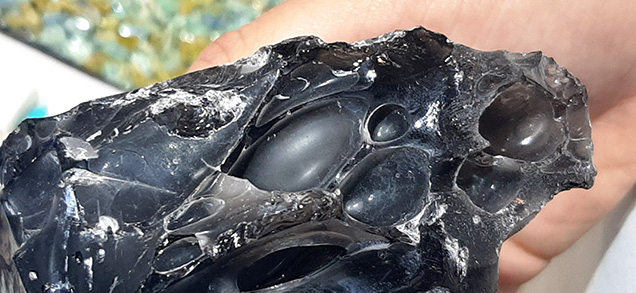
At the 22nd Street show, the author encountered an unusual type of obsidian characterized by an extremely vesicular, or “bubbly,” structure featuring large, often oriented degassing cavities (figure 1, left). In the specimens observed, the bubbles reached more than 2 inches in length, varied in size, and were separated by extremely thin and sharp septa (figure 1, right). Some specimens contained several intact bubbles (figure 2).
The specimens were presented by Bojo Jewelry & Minerals (Yerevan, Armenia), an exhibitor offering a wide range of gems and jewelry from Armenia, including obsidian and turquoise. The dealer, Artak Bojikyan, who named the material “bubble obsidian,” noted it was an unexpected find last year resulting from road construction on the Arteni Mountain in Armenia’s Aragatsotn region, one of the most significant obsidian occurrences in the Caucasus Mountains. Bojikyan noted that a few large boulders have been found so far, and more may be recovered in the upcoming months.
Armenian obsidian, also known as “mahogany” obsidian in the trade, is a high-quality compact stone, typically displaying distinctive reddish brown streaks against a black bodycolor. According to Bojikyan, this is the first time this type of highly vesicular obsidian from the Arteni Mountain deposit has been offered at a trade show, and it attracted the attention of scientists and collectors.
Obsidian is a volcanic glass formed when silica-rich lava cools so fast that crystal formation is only visible with a microscope. The glassy and amorphous nature of obsidian makes it hard and brittle. Due to its highly conchoidal fracture, obsidian has been an ideal material for manufacturing cutting tools since the Neolithic era (ca. 7000–1700 BCE). In addition, obsidian is a popular ornamental gem due to its workability and the occurrence of attractive varieties.
At the 22nd Street show, the author encountered an unusual type of obsidian characterized by an extremely vesicular, or “bubbly,” structure featuring large, often oriented degassing cavities (figure 1, left). In the specimens observed, the bubbles reached more than 2 inches in length, varied in size, and were separated by extremely thin and sharp septa (figure 1, right). Some specimens contained several intact bubbles (figure 2).
The specimens were presented by Bojo Jewelry & Minerals (Yerevan, Armenia), an exhibitor offering a wide range of gems and jewelry from Armenia, including obsidian and turquoise. The dealer, Artak Bojikyan, who named the material “bubble obsidian,” noted it was an unexpected find last year resulting from road construction on the Arteni Mountain in Armenia’s Aragatsotn region, one of the most significant obsidian occurrences in the Caucasus Mountains. Bojikyan noted that a few large boulders have been found so far, and more may be recovered in the upcoming months.
Armenian obsidian, also known as “mahogany” obsidian in the trade, is a high-quality compact stone, typically displaying distinctive reddish brown streaks against a black bodycolor. According to Bojikyan, this is the first time this type of highly vesicular obsidian from the Arteni Mountain deposit has been offered at a trade show, and it attracted the attention of scientists and collectors.