
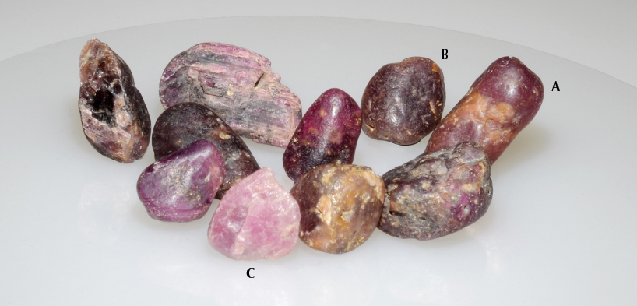
Liberian rubies were reported more than a decade ago (L. Kiefert and M. Douman, “Ruby from Liberia,” Summer 2011 G&G, p. 138). These rubies were found in two diamond mines located along the Mano River and in Nimba Province close to the Guinean border. GIA’s Tokyo laboratory recently received 10 Liberian corundum samples (figure 1) from the Japan-based NGO Diamonds for Peace. These samples were collected at Weasua, Liberia, the same locality recently reported in G&G (Spring 2023 GNI, pp. 149–150).
Most of the rough corundum pebbles recovered from Weasua showed weakly saturated purplish red, pink, pale yellow, and green colors; most fall in the color range of sapphire, except for a few red ones. Three of the ruby samples—11.65 ct purplish red (A), 6.52 ct dark purplish red (B), and 5.37 ct light purplish red (C)—were cut and polished for observation and advanced testing. Standard gemological testing yielded a refractive index of 1.762–1.770, a uniaxial interference pattern, and a hydrostatic specific gravity of 3.85–3.99. Except for the specific gravity, which is slightly low presumably due to the inclusions, the gemological characteristics were consistent with corundum.
The rounded surfaces of the rough stones suggested weathering. Most were semitransparent to translucent, heavily included, and displayed lamellar twinning structures in two orientations (figure 2). The twinning planes were filled with orange secondary minerals. Other internal features included irregularly shaped reflective particles aligned in three directions, iridescent small particles, and fine needles (figure 3). Sample A showed a less-included core and particle-rich rim, and sample B was heavily included with large whitish aggregate inclusions and some small black minerals along the twinning planes. These black minerals were identified by Raman spectroscopy as vonsenite (Fe2+2Fe3+(BO3)O2).
Laser ablation–inductively coupled plasma–mass spectrometry (LA-ICP-MS) was carried out to analyze trace element compositions. On sample A, we measured nine spots from center to edge. The rim area (spots 7–9) yielded higher iron and titanium, and similar levels of magnesium, vanadium, and gallium compared with the less-included core area (spots 1–6) (figure 2). We measured three spots on each of the remaining two samples. The results are presented in table 1, showing the wide range of concentrations of titanium, vanadium, iron, and gallium. (Spot 1 of sample B shows high titanium (84.3 ppma) with zirconium (0.054 ppma), likely caused by the contamination of small inclusions.)
Kongsomart et al. (Winter 2017 GNI, pp. 472–473) summarized the trace element concentrations in rubies from East African deposits. Samples A and C of the Liberian rubies in this study showed trace element concentrations similar to those from Mozambique. Sample B had a high gallium concentration, overlapping with rubies from the Zahamena deposit in Madagascar. Considering the wide range of trace element concentrations of Liberian rubies and those from East African deposits, these chemistry components are not helpful in separating the Liberian ruby from other origins. The ruby samples from these East African origins are less included than the Liberian samples in this study. For identification services, we are able to determine the origin not only by trace elements but also by microscopic observations (A.C. Palke et al., “Geographic origin determination of ruby,” Winter 2019 G&G, pp. 580–613). If it is necessary to separate Liberian rubies from other highly included low-quality rubies, comprehensive study on such included samples is needed.
Recently, some low-quality rubies reportedly mined from Guinea have been sold on the market. These materials are often heat treated and filled with lead glass, with some cabochons displaying six-rayed asterism after treatment. Both rough samples of Guinean ruby in the GIA colored stone reference collection and the studied Liberian rubies show a classic weathered “barrel” shape, semitransparent to translucent transparency, pinkish color, and most are heavily included. Given that the deposit of Guinea ruby is located upstream, north of Liberia, these rubies presumably originated from the same or closely related geological condition. With proper treatment, Liberian rubies could show asterism and be used as jewelry material.
Liberian rubies were reported more than a decade ago (L. Kiefert and M. Douman, “Ruby from Liberia,” Summer 2011 G&G, p. 138). These rubies were found in two diamond mines located along the Mano River and in Nimba Province close to the Guinean border. GIA’s Tokyo laboratory recently received 10 Liberian corundum samples (figure 1) from the Japan-based NGO Diamonds for Peace. These samples were collected at Weasua, Liberia, the same locality recently reported in G&G (Spring 2023 GNI, pp. 149–150).
Most of the rough corundum pebbles recovered from Weasua showed weakly saturated purplish red, pink, pale yellow, and green colors; most fall in the color range of sapphire, except for a few red ones. Three of the ruby samples—11.65 ct purplish red (A), 6.52 ct dark purplish red (B), and 5.37 ct light purplish red (C)—were cut and polished for observation and advanced testing. Standard gemological testing yielded a refractive index of 1.762–1.770, a uniaxial interference pattern, and a hydrostatic specific gravity of 3.85–3.99. Except for the specific gravity, which is slightly low presumably due to the inclusions, the gemological characteristics were consistent with corundum.
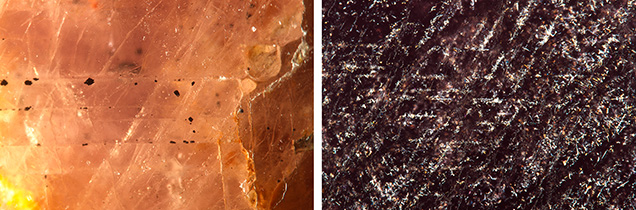
The rounded surfaces of the rough stones suggested weathering. Most were semitransparent to translucent, heavily included, and displayed lamellar twinning structures in two orientations (figure 2). The twinning planes were filled with orange secondary minerals. Other internal features included irregularly shaped reflective particles aligned in three directions, iridescent small particles, and fine needles (figure 3). Sample A showed a less-included core and particle-rich rim, and sample B was heavily included with large whitish aggregate inclusions and some small black minerals along the twinning planes. These black minerals were identified by Raman spectroscopy as vonsenite (Fe2+2Fe3+(BO3)O2).
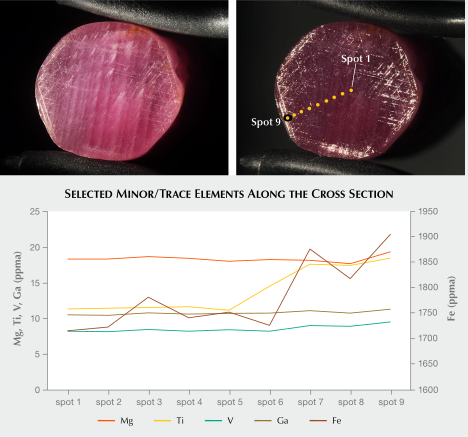
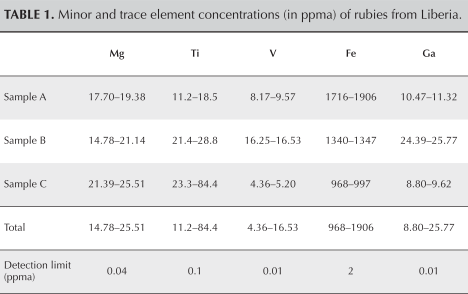
Laser ablation–inductively coupled plasma–mass spectrometry (LA-ICP-MS) was carried out to analyze trace element compositions. On sample A, we measured nine spots from center to edge. The rim area (spots 7–9) yielded higher iron and titanium, and similar levels of magnesium, vanadium, and gallium compared with the less-included core area (spots 1–6) (figure 2). We measured three spots on each of the remaining two samples. The results are presented in table 1, showing the wide range of concentrations of titanium, vanadium, iron, and gallium. (Spot 1 of sample B shows high titanium (84.3 ppma) with zirconium (0.054 ppma), likely caused by the contamination of small inclusions.)
Kongsomart et al. (Winter 2017 GNI, pp. 472–473) summarized the trace element concentrations in rubies from East African deposits. Samples A and C of the Liberian rubies in this study showed trace element concentrations similar to those from Mozambique. Sample B had a high gallium concentration, overlapping with rubies from the Zahamena deposit in Madagascar. Considering the wide range of trace element concentrations of Liberian rubies and those from East African deposits, these chemistry components are not helpful in separating the Liberian ruby from other origins. The ruby samples from these East African origins are less included than the Liberian samples in this study. For identification services, we are able to determine the origin not only by trace elements but also by microscopic observations (A.C. Palke et al., “Geographic origin determination of ruby,” Winter 2019 G&G, pp. 580–613). If it is necessary to separate Liberian rubies from other highly included low-quality rubies, comprehensive study on such included samples is needed.
Recently, some low-quality rubies reportedly mined from Guinea have been sold on the market. These materials are often heat treated and filled with lead glass, with some cabochons displaying six-rayed asterism after treatment. Both rough samples of Guinean ruby in the GIA colored stone reference collection and the studied Liberian rubies show a classic weathered “barrel” shape, semitransparent to translucent transparency, pinkish color, and most are heavily included. Given that the deposit of Guinea ruby is located upstream, north of Liberia, these rubies presumably originated from the same or closely related geological condition. With proper treatment, Liberian rubies could show asterism and be used as jewelry material.