
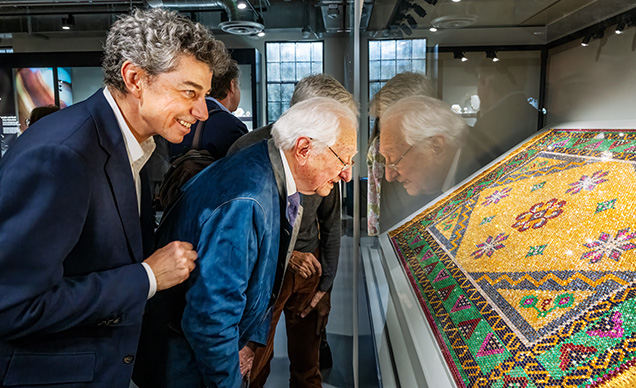
Three generations of the Piat family gathered at the University of Arizona Alfie Norville Gem & Mineral Museum in Tucson on February 1 to see “The Royal Tapestry” (see Spring 2022 GNI, pp. 110–111) for the first time. The tapestry (see above) was created by French master jewelry house Cristofol Paris more than thirty years ago, with Maison Piat (Paris) procuring the gemstones and facilitating their cutting. Prior to the gathering, Daniel Piat was the only family member who had seen the completed tapestry.
The tapestry contains almost 27,000 emeralds, diamonds, rubies, and blue and yellow sapphires as well as 37.5 lbs of 18K gold. Its 122 × 71 cm (42 × 24 in.) dimensions, the same as those of an Islamic prayer rug, were specified by the royal family in the Middle East who privately commissioned it. More than 25 cutters matched the stone sizes within one-tenth of a millimeter. Cristofol Paris artisans spent more than 16,000 hours crafting the tapestry. Manufacturing a work of jewels that moved and flowed like a carpet or woven cloth required a form of prong setting, new at the time, that involved fewer “shared” prongs. Throughout the process, in a time before the advent of mobile phones and digital images, materials were shipped back and forth between Paris, Bangkok, Jaipur, and the Jura region of France.
The tapestry remained with the unnamed royal family until the early 2000s, when it was sold to a private collector. Prior to its exhibition in Tucson, it had been exhibited only in Hong Kong and London for one day each.
At the Alfie Norville Museum reception, board member Shelly Sergent touched on the origin of the tapestry concept and the process of transporting it from Zurich to Tucson. Daniel Piat shared the story of the tapestry’s creation, describing the challenges presented by the design and the immense amount of work and detailed craftsmanship it required. Eric Piat noted the difficulty of sourcing the gems in a strict range of colors. Daniel said that after more than thirty years, all of the gems are still perfectly seated in more than 106,000 prongs and 26,649 seats, calling it “an engineering feat never duplicated in the jewelry world today.”
Three generations of the Piat family gathered at the University of Arizona Alfie Norville Gem & Mineral Museum in Tucson on February 1 to see “The Royal Tapestry” (see Spring 2022 GNI, pp. 110–111) for the first time. The tapestry (see above) was created by French master jewelry house Cristofol Paris more than thirty years ago, with Maison Piat (Paris) procuring the gemstones and facilitating their cutting. Prior to the gathering, Daniel Piat was the only family member who had seen the completed tapestry.
The tapestry contains almost 27,000 emeralds, diamonds, rubies, and blue and yellow sapphires as well as 37.5 lbs of 18K gold. Its 122 × 71 cm (42 × 24 in.) dimensions, the same as those of an Islamic prayer rug, were specified by the royal family in the Middle East who privately commissioned it. More than 25 cutters matched the stone sizes within one-tenth of a millimeter. Cristofol Paris artisans spent more than 16,000 hours crafting the tapestry. Manufacturing a work of jewels that moved and flowed like a carpet or woven cloth required a form of prong setting, new at the time, that involved fewer “shared” prongs. Throughout the process, in a time before the advent of mobile phones and digital images, materials were shipped back and forth between Paris, Bangkok, Jaipur, and the Jura region of France.
The tapestry remained with the unnamed royal family until the early 2000s, when it was sold to a private collector. Prior to its exhibition in Tucson, it had been exhibited only in Hong Kong and London for one day each.
At the Alfie Norville Museum reception, board member Shelly Sergent touched on the origin of the tapestry concept and the process of transporting it from Zurich to Tucson. Daniel Piat shared the story of the tapestry’s creation, describing the challenges presented by the design and the immense amount of work and detailed craftsmanship it required. Eric Piat noted the difficulty of sourcing the gems in a strict range of colors. Daniel said that after more than thirty years, all of the gems are still perfectly seated in more than 106,000 prongs and 26,649 seats, calling it “an engineering feat never duplicated in the jewelry world today.”