Brazilian Alexandrite Update
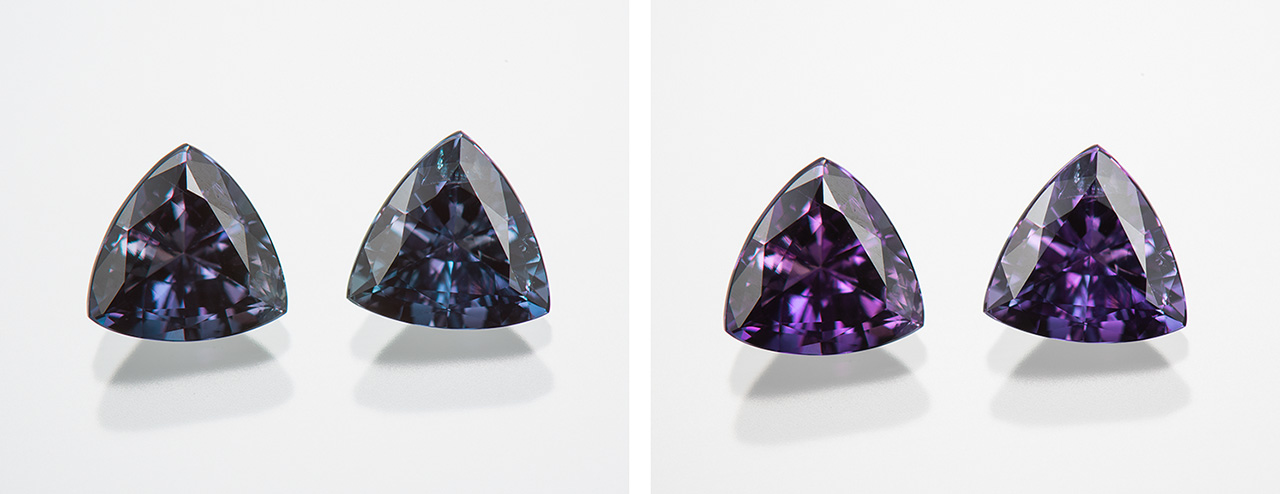
Gil International’s booth at the AGTA show featured something out of the ordinary: a display case with lighting selected to reveal the color change of their Brazilian alexandrites, from blue-green in daylight to reddish purple in incandescent light. Goel “Gil” Gul built the case himself, and he said it has drawn traffic to the booth over the years. Based in New York, Gil International began exhibiting in Tucson 30 years ago; 2019 was their 19th year at the AGTA show.
Gil International specializes in natural Brazilian alexandrite (see above), which exhibits a strong color change. Alexandrite was first found in Russia’s Ural Mountains in the 1830s. It wasn’t until the discovery of Brazilian sources in the late 1980s, most notably Lavra de Hematita (also called Nova Era or Itabira), that greater quantities became available, though alexandrite is still considered rare.
Alexandrite has been in greater demand over the last 15 years, Gul said, but business has been slow the last two. In the past decade, his sales to a company that caters to cruise ships have been particularly strong. He attributes this to people “always looking for something unusual” and having more time to look at jewelry while on vacation. When Gul entered the industry, aquamarine, tourmaline, and zircon were big. Sapphire has always been very strong, he said, but ruby has come down in the last five years. The demand for stones rises and falls over the decades based on jewelry house promotion, he said, citing Tiffany & Co.’s marketing campaign after the discovery of tanzanite in 1967. He added that more people are buying brown diamonds, previously considered undesirable, because of Le Vian’s branding and heavy advertising of “chocolate diamonds.”
Gul said that every source has different color; for example, Sri Lankan alexandrite is typically an olive green in daylight, while Brazilian stones are more blue-green. He acknowledged that only laboratory testing can definitively determine country of origin, but he can often make an educated guess based on color. He noted that alexandrites from India are sometimes reported as Brazilian, but he can tell that they are from India because the color change is not as strong and the green tends to be lighter.
Born in Afghanistan and educated in Israel and New York, Gul worked in accounting for a decade before being introduced to the gem and jewelry industry by his four older brothers. They were already selling ruby and sapphire, so they sent him to Brazil. On his first trip to Teófilo Otoni, Minas Gerais, in 1990, Gul bought emerald. He saw some alexandrite but didn’t buy any until his next visit. He later found out that the stones were from Lavra de Hematita.
“You buy one stone, but you’ve got three stones,” he said, referring to alexandrite’s color change. “I felt I could improve my life with this stone.”
Gul bought alexandrite from a broker in Teófilo Otoni for several years and contacted the miner directly about 15 years ago. The miner didn’t sell the rough; he had the stones cut in Hong Kong and Thailand, so he controlled the production entirely. Gul began to buy directly from him in Hong Kong.
Gul found that unlike many in the industry, the miner did not like to bargain. So he accepted the miner’s prices, and as Gul bought more stones, the miner gave him better deals. As Gil International became stronger in alexandrite, Gul and the miner became good friends. Gul has bought almost all of his alexandrite from him.
“The way to make a better business is to find a relationship with the miner,” Gul said. “If you have a good relationship, he can trust you; you can trust him. Sometimes even big companies with big money try to bargain, so they don’t find a relationship with the miner and can’t buy from him.”
Gul spoke of turning down the miner’s repeated offers to buy goods on memo—including an offer of $12 million of goods in 2010, when the miner closed seven stores in Greece after the 2008 market crash. “I buy what I can,” he said. “And he feels that I’m different [than other dealers] and gives me a chance to do more business.”