
Ethiopian opal was first discovered in the early 1990s and is capable of producing spectacular play-of-color in a variety of patterns and bodycolors. Some Ethiopian opals exhibit macroscopic finger-like structures called digit patterns: columnar zones of interpenetrating play-of-color within a network of common opal (B. Rondeau et al., “Play-of-color opal from Wegel Tena, Wollo Province, Ethiopia,” Summer 2010 G&G, pp. 90–105).
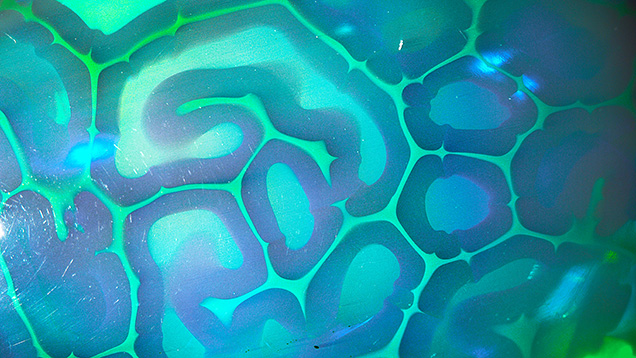
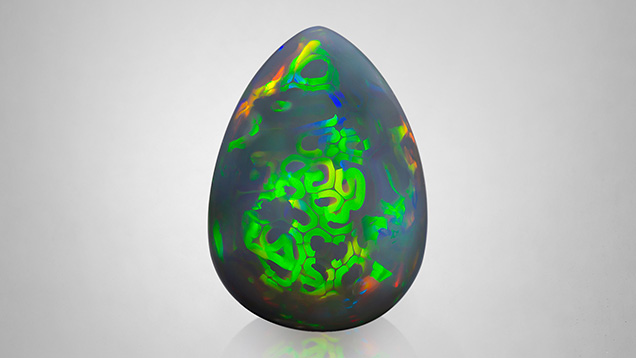
Recently, the author encountered a 47.77 ct gray Ethiopian opal displaying attractive play-of-color in an unusual pattern (figure 1). Basic gemological observation and properties confirmed that the stone was a natural non-hydrophane opal. Interestingly, the play-of-color pattern in this specimen was confined to distinct “cells” separated by greenish-colored opal, resembling a turtle-shell structure on the top of the cabochon (figure 2). This is one of the most extraordinary patterns in natural opal that the author has examined.
Ungkhana Atikarnsakul is a senior staff gemologist at GIA in Bangkok.
Ethiopian opal was first discovered in the early 1990s and is capable of producing spectacular play-of-color in a variety of patterns and bodycolors. Some Ethiopian opals exhibit macroscopic finger-like structures called digit patterns: columnar zones of interpenetrating play-of-color within a network of common opal (B. Rondeau et al., “Play-of-color opal from Wegel Tena, Wollo Province, Ethiopia,” Summer 2010 G&G, pp. 90–105).
Recently, the author encountered a 47.77 ct gray Ethiopian opal displaying attractive play-of-color in an unusual pattern (figure 1). Basic gemological observation and properties confirmed that the stone was a natural non-hydrophane opal. Interestingly, the play-of-color pattern in this specimen was confined to distinct “cells” separated by greenish-colored opal, resembling a turtle-shell structure on the top of the cabochon (figure 2). This is one of the most extraordinary patterns in natural opal that the author has examined.
Ungkhana Atikarnsakul is a senior staff gemologist at GIA in Bangkok.