
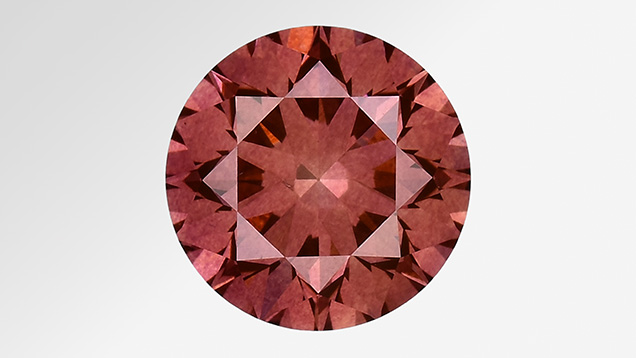
A 1.10 ct Fancy Deep brownish orangy pink round diamond was recently submitted to GIA’s New York laboratory for analysis (figure 1). This diamond was multi-treated—a combination of high-pressure, high-temperature (HPHT) annealing, irradiation, and subsequent moderate temperature heating—with the intent to create nitrogen vacancy (NV) centers and thus achieve the desirable pink color. Prior to treatment, we assume this diamond was probably a less desirable brownish color (this has not been verified).
When viewed face-up, the diamond exhibited a mottled appearance. Further examination with a gemological microscope revealed that these patterns extended from a shallow depth to the polished surface. An uneven distribution of pink color created the mottled appearance—a very unusual feature for a treated pink diamond.
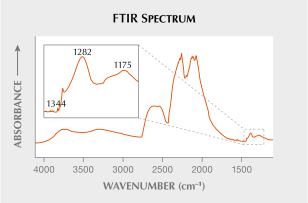
The mid-infrared spectrum of this diamond (figure 2) shows it is a type IaAB with A aggregated nitrogen at 1282 cm–1 and B aggregated nitrogen at 1175 cm–1 distributed throughout the diamond crystal structure. Isolated single nitrogen impurities were detected at 1344 cm–1 (likely the result of HPHT annealing). An uneven distribution of nitrogen aggregates may have resulted in a variable NV center distribution and thus the subtle color distribution.
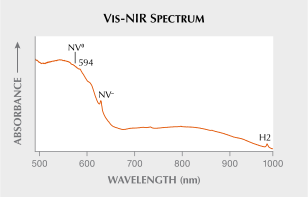
The visible/near-infrared (Vis-NIR) absorption spectrum obtained from this diamond has typical spectral features of a treated diamond exposed to laboratory irradiation and heat treatments. These features include the 594 nm peak indicative of irradiation, the NV0 and NV– centers causing the pink color, and the H2 center indicative of heat treatment (figure 3). Deep-UV fluorescence images, as observed using the DiamondView instrument, show a combination of yellow and orange fluorescence; both of these fluorescence colors can be created by NV centers and the observed color can vary based on the ratio of the negative to neutral NV center intensities. The NV center distribution and the variation in the ratio of the NV centers are assumed to be related to the nitrogen aggregate distribution, which could explain the mottled color distribution. However, no IR mapping to chronicle the nitrogen aggregate distribution and no photoluminescence mapping of the NV centers to confirm their distribution was performed.
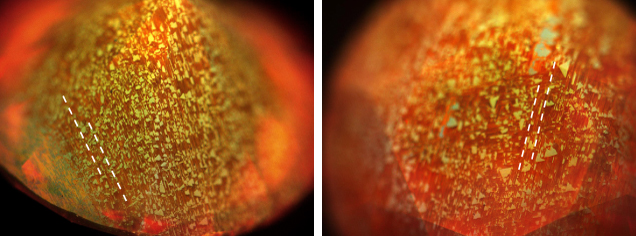
After formation within the earth, the crystal structure of a diamond can be subjected to plastic deformation, which can impart a brown color to the crystal. Such deformation, which is common in brown diamonds (R. Tappert and M.C. Tappert, Diamonds in Nature: A Guide to Rough Diamonds, Springer, 2011), appears to resemble the fluorescence patterns observed in the DiamondView images shown in figure 4. These DiamondView images also show a striking pattern in the diamond following the deformation lines on the octahedral crystal faces. Such plastic deformation may have contributed to the mottled pattern observed on the diamond, with the nitrogen vacancy centers created by treatment appearing to follow these deformation lines.
This is a notable example of treatments used to enhance the color of a natural diamond.
Dimitry Krugolets is a senior specialist of technical grading, and Paul Johnson is manager of analytics, at GIA in New York.
A 1.10 ct Fancy Deep brownish orangy pink round diamond was recently submitted to GIA’s New York laboratory for analysis (figure 1). This diamond was multi-treated—a combination of high-pressure, high-temperature (HPHT) annealing, irradiation, and subsequent moderate temperature heating—with the intent to create nitrogen vacancy (NV) centers and thus achieve the desirable pink color. Prior to treatment, we assume this diamond was probably a less desirable brownish color (this has not been verified).
When viewed face-up, the diamond exhibited a mottled appearance. Further examination with a gemological microscope revealed that these patterns extended from a shallow depth to the polished surface. An uneven distribution of pink color created the mottled appearance—a very unusual feature for a treated pink diamond.
The mid-infrared spectrum of this diamond (figure 2) shows it is a type IaAB with A aggregated nitrogen at 1282 cm–1 and B aggregated nitrogen at 1175 cm–1 distributed throughout the diamond crystal structure. Isolated single nitrogen impurities were detected at 1344 cm–1 (likely the result of HPHT annealing). An uneven distribution of nitrogen aggregates may have resulted in a variable NV center distribution and thus the subtle color distribution.
The visible/near-infrared (Vis-NIR) absorption spectrum obtained from this diamond has typical spectral features of a treated diamond exposed to laboratory irradiation and heat treatments. These features include the 594 nm peak indicative of irradiation, the NV0 and NV– centers causing the pink color, and the H2 center indicative of heat treatment (figure 3). Deep-UV fluorescence images, as observed using the DiamondView instrument, show a combination of yellow and orange fluorescence; both of these fluorescence colors can be created by NV centers and the observed color can vary based on the ratio of the negative to neutral NV center intensities. The NV center distribution and the variation in the ratio of the NV centers are assumed to be related to the nitrogen aggregate distribution, which could explain the mottled color distribution. However, no IR mapping to chronicle the nitrogen aggregate distribution and no photoluminescence mapping of the NV centers to confirm their distribution was performed.
After formation within the earth, the crystal structure of a diamond can be subjected to plastic deformation, which can impart a brown color to the crystal. Such deformation, which is common in brown diamonds (R. Tappert and M.C. Tappert, Diamonds in Nature: A Guide to Rough Diamonds, Springer, 2011), appears to resemble the fluorescence patterns observed in the DiamondView images shown in figure 4. These DiamondView images also show a striking pattern in the diamond following the deformation lines on the octahedral crystal faces. Such plastic deformation may have contributed to the mottled pattern observed on the diamond, with the nitrogen vacancy centers created by treatment appearing to follow these deformation lines.
This is a notable example of treatments used to enhance the color of a natural diamond.
Dimitry Krugolets is a senior specialist of technical grading, and Paul Johnson is manager of analytics, at GIA in New York.