

Peridot is the gemstone variety of the mineral olivine, a solid solution series with the end members forsterite (Mg2SiO4) and fayalite (Fe2SiO4). Peridot crystallizes in the orthorhombic system. Its main commercial sources include the Mogok region in Myanmar, the San Carlos area in the U.S. state of Arizona, and, more recently, the Yanbian Chaoxianzu area in China’s Jilin Province.
Star peridot is rare and mostly occurs with a four-rayed star (L.B. Benson, Jr., “Highlights at the Gem Trade Lab in Los Angeles,” Spring 1960 G&G, p. 3), though extremely rare six-rayed (R.T. Liddicoat, Jr., “Highlights at the Gem Trade Lab in Los Angeles: Rare star peridot,” Spring 1970 G&G, p. 150) and eight-rayed (M.P. Steinbach, Asterism: Gems with a Star, MPS Publishing and Media, 2016; M.P. Steinbach, Star Gems: A Fascinating World, MPS Publishing and Media, 2023) star peridots have been identified. In the case of the apparent eight-rayed star, it was proposed that the phenomenon was caused by diasterism, in which the star is viewed in transmitted light.
During the 2023 Hong Kong Gem and Jewellery Fair, author MPS purchased an eight-rayed star peridot reportedly from Myanmar weighing 34.16 ct (figure 1). The oval cabochon measured 17.61 × 15.48 × 13.82 mm and exhibited eye-visible dark inclusions. The stone was identified as peridot by Raman spectroscopy. Compared to the eight-rayed star mentioned above (examined in transmitted light), this star was readily visible in reflected light, a phenomenon called epiasterism. To our knowledge, eight-rayed star peridots exhibiting epiasterism have not been previously described.
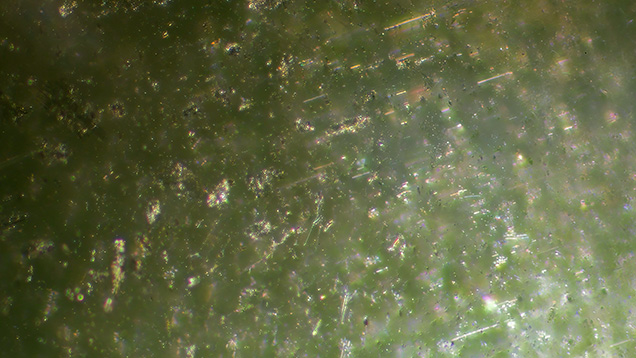
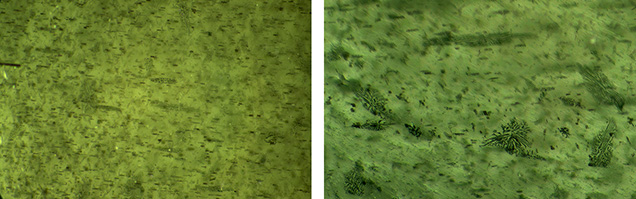
Microscopic analysis revealed two sets of inclusions, each creating a four-rayed star oriented 45-degrees apart, forming an eight-rayed star. The first set consisted of short light-colored reflective needles (figure 2) (see Spring 2020 GNI, pp. 159–160). The second set was comprised of thicker black acicular inclusions and elongated clouds of dark particles (figure 3, left). Such needles and dendritic inclusions were previously described in a four-rayed star peridot from Myanmar and identified as magnetite by Raman spectroscopy (Fall 2020 Lab Notes, pp. 422–423). Several of these inclusions were observed in this studied stone as well and are most likely skeletal magnetite (figure 3, right).
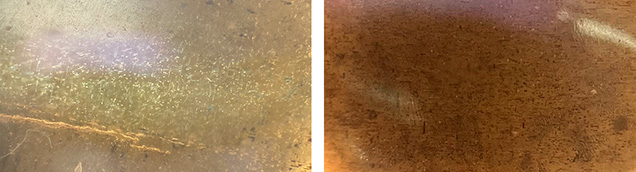
The eight-rayed star, made up of light- and dark-colored needle-like inclusions, resembles a combination of the four-rayed stars observed in two smaller stones studied for comparison (figure 4). A 2.89 ct lighter colored star peridot with sharp reflective needles and a 3.56 ct darker colored star peridot with dark cloud-like particles showed nearly identical inclusions to those described in the eight-rayed sample, and the colors of the stones are similar.
To the authors’ knowledge, an eight-rayed star peridot with a star system made up of two different sets of inclusions has not been described before, and the authors feel privileged to report on this rarity.
Peridot is the gemstone variety of the mineral olivine, a solid solution series with the end members forsterite (Mg2SiO4) and fayalite (Fe2SiO4). Peridot crystallizes in the orthorhombic system. Its main commercial sources include the Mogok region in Myanmar, the San Carlos area in the U.S. state of Arizona, and, more recently, the Yanbian Chaoxianzu area in China’s Jilin Province.
Star peridot is rare and mostly occurs with a four-rayed star (L.B. Benson, Jr., “Highlights at the Gem Trade Lab in Los Angeles,” Spring 1960 G&G, p. 3), though extremely rare six-rayed (R.T. Liddicoat, Jr., “Highlights at the Gem Trade Lab in Los Angeles: Rare star peridot,” Spring 1970 G&G, p. 150) and eight-rayed (M.P. Steinbach, Asterism: Gems with a Star, MPS Publishing and Media, 2016; M.P. Steinbach, Star Gems: A Fascinating World, MPS Publishing and Media, 2023) star peridots have been identified. In the case of the apparent eight-rayed star, it was proposed that the phenomenon was caused by diasterism, in which the star is viewed in transmitted light.
During the 2023 Hong Kong Gem and Jewellery Fair, author MPS purchased an eight-rayed star peridot reportedly from Myanmar weighing 34.16 ct (figure 1). The oval cabochon measured 17.61 × 15.48 × 13.82 mm and exhibited eye-visible dark inclusions. The stone was identified as peridot by Raman spectroscopy. Compared to the eight-rayed star mentioned above (examined in transmitted light), this star was readily visible in reflected light, a phenomenon called epiasterism. To our knowledge, eight-rayed star peridots exhibiting epiasterism have not been previously described.
Microscopic analysis revealed two sets of inclusions, each creating a four-rayed star oriented 45-degrees apart, forming an eight-rayed star. The first set consisted of short light-colored reflective needles (figure 2) (see Spring 2020 GNI, pp. 159–160). The second set was comprised of thicker black acicular inclusions and elongated clouds of dark particles (figure 3, left). Such needles and dendritic inclusions were previously described in a four-rayed star peridot from Myanmar and identified as magnetite by Raman spectroscopy (Fall 2020 Lab Notes, pp. 422–423). Several of these inclusions were observed in this studied stone as well and are most likely skeletal magnetite (figure 3, right).
The eight-rayed star, made up of light- and dark-colored needle-like inclusions, resembles a combination of the four-rayed stars observed in two smaller stones studied for comparison (figure 4). A 2.89 ct lighter colored star peridot with sharp reflective needles and a 3.56 ct darker colored star peridot with dark cloud-like particles showed nearly identical inclusions to those described in the eight-rayed sample, and the colors of the stones are similar.
To the authors’ knowledge, an eight-rayed star peridot with a star system made up of two different sets of inclusions has not been described before, and the authors feel privileged to report on this rarity.