
The 3161 cm–1 infrared (IR) band can be observed in variously colored natural corundum, most commonly in yellow sapphire. The presence of this feature is used frequently as supporting evidence to conclude that a sapphire has not been heat treated (C.M. Breeding and N.J. Ahline, “Infrared spectroscopy and its use in gemology,” Winter 2024 G&G, pp. 474–492). This 3161 cm–1 band is often present with other less intense side bands known as the “3161 cm–1 series” and includes features at ~3355, 3242, 3100 (shoulder), 2460, and 2420 cm–1 (C.P. Smith and C. van der Bogert, “Infrared spectra of gem corundum,” Fall 2006 G&G, pp. 92–93). The exact origin of the 3161 cm–1 band is not well understood, although it is thought to be related to stretching vibrations of hydroxyl groups caused by interstitial H+ ions present as charge compensation for Fe2+ substituting for Al3+ in the corundum structure (M.C. Jollands et al., “Vibrational properties of OH groups associated with divalent cations in corundum (α-Al2O3),” European Journal of Mineralogy, Vol. 35, No. 5, 2023, pp. 873–890).
As previously reported by Atikarnsakul and Emmett (Fall 2021 GNI, pp. 286–288), the intensity of the 3161 cm–1 band does not change after heating at 700°C in air, but it disappears or significantly decreases in intensity after heating at 900°C and above. Additionally, the prominent broad band at around 3000 cm–1 together with the 2625 cm–1 band, or the so-called “3000 cm–1 band series,” can be created in some heated yellow sapphires containing low iron concentrations after heating at 900°C and higher. This series is related to stretching modes of hydroxyl groups in corundum doped with Mg2+ (N. Fukatsu et al., “Incorporation of hydrogen into magnesium-doped α-alumina,” Solid State Ionics, Vol. 162–163, 2003, pp. 147–159). The 3000 cm–1 band series can also be observed in high iron yellow sapphires from basalt-related deposits without artificial heat treatment (Fall 2016 GNI, pp. 325–327). Moreover, a combination of the 3161 cm–1 series and the 3000 cm–1 series has been reported in a few untreated Rock Creek sapphires from the state of Montana (J.L. Emmett et al., “Yellow sapphire: Natural, heat-treated, beryllium-diffused, and synthetic,” Fall 2023 G&G, pp. 268–297).
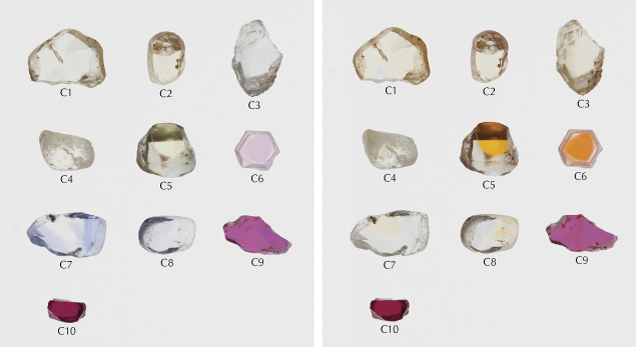
In this study, 10 natural corundum samples of various colors from GIA’s colored stone reference collection were selected to analyze the thermal behavior of the 3161 cm–1 IR feature starting with its strong intensity prior to any heating (figure 1). These untreated stones were from various deposits: Madagascar (samples C1, C2, C5, C6, and C7), Myanmar (sample C3), Sri Lanka (samples C4 and C8), and Mozambique (samples C9 and C10). The stones were heated in air to 650°, 700°, 750°, 800°, 850°, and 900°C for 5 hours at each temperature. At the end of each heating session, the samples were rapidly cooled to room temperature, and color-calibrated photos and Fourier-transform infrared absorption (FTIR) spectra were collected. The light yellow zones exhibited a stronger yellow color after heating at 800°–850°C (samples C1 to C8). Additionally, when present, blue color zones became less saturated after heating at 800°C (samples C7 and C8).
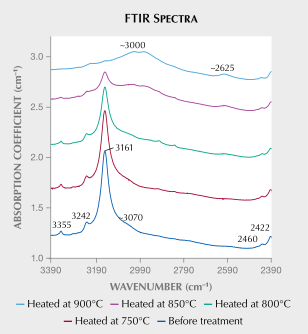
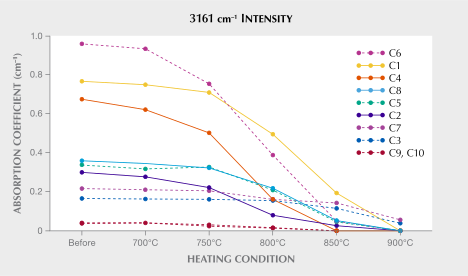
For comparison, unpolarized FTIR spectra were recorded at the identical sample area after heating at each experimental temperature. Figure 2 shows FTIR spectra of sample C1 before heating and after heating at 750°, 800°, 850°, and 900°C. An insignificant to slight decrease in the 3161 cm–1 band intensity was observed after heating at 750°C or lower (figure 3). When heating between 800° and 850°C, the 3161 cm–1 intensity reduced significantly in all samples (figure 3), and the 3000 cm–1 band series was created in some samples, resulting in a combination of the 3161 cm–1 and the 3000 cm–1 band in the same spectrum (figure 2, purple line). After heating at 900°C, the 3161 cm–1 band either disappeared entirely or was still present but at a much lower intensity.
These experimental results and the previous work cited above indicate that natural corundum from different deposits possibly formed under various growth conditions such as temperature. Geological origin should also be taken into consideration when using the 3161 cm–1 and/or the 3000 cm–1 IR band to identify the presence of heat treatment.
Wasura Soonthorntantikul is a research scientist at GIA in Bangkok. Aaron Palke is senior manager of research at GIA in Carlsbad, California.
The 3161 cm–1 infrared (IR) band can be observed in variously colored natural corundum, most commonly in yellow sapphire. The presence of this feature is used frequently as supporting evidence to conclude that a sapphire has not been heat treated (C.M. Breeding and N.J. Ahline, “Infrared spectroscopy and its use in gemology,” Winter 2024 G&G, pp. 474–492). This 3161 cm–1 band is often present with other less intense side bands known as the “3161 cm–1 series” and includes features at ~3355, 3242, 3100 (shoulder), 2460, and 2420 cm–1 (C.P. Smith and C. van der Bogert, “Infrared spectra of gem corundum,” Fall 2006 G&G, pp. 92–93). The exact origin of the 3161 cm–1 band is not well understood, although it is thought to be related to stretching vibrations of hydroxyl groups caused by interstitial H+ ions present as charge compensation for Fe2+ substituting for Al3+ in the corundum structure (M.C. Jollands et al., “Vibrational properties of OH groups associated with divalent cations in corundum (α-Al2O3),” European Journal of Mineralogy, Vol. 35, No. 5, 2023, pp. 873–890).
As previously reported by Atikarnsakul and Emmett (Fall 2021 GNI, pp. 286–288), the intensity of the 3161 cm–1 band does not change after heating at 700°C in air, but it disappears or significantly decreases in intensity after heating at 900°C and above. Additionally, the prominent broad band at around 3000 cm–1 together with the 2625 cm–1 band, or the so-called “3000 cm–1 band series,” can be created in some heated yellow sapphires containing low iron concentrations after heating at 900°C and higher. This series is related to stretching modes of hydroxyl groups in corundum doped with Mg2+ (N. Fukatsu et al., “Incorporation of hydrogen into magnesium-doped α-alumina,” Solid State Ionics, Vol. 162–163, 2003, pp. 147–159). The 3000 cm–1 band series can also be observed in high iron yellow sapphires from basalt-related deposits without artificial heat treatment (Fall 2016 GNI, pp. 325–327). Moreover, a combination of the 3161 cm–1 series and the 3000 cm–1 series has been reported in a few untreated Rock Creek sapphires from the state of Montana (J.L. Emmett et al., “Yellow sapphire: Natural, heat-treated, beryllium-diffused, and synthetic,” Fall 2023 G&G, pp. 268–297).
In this study, 10 natural corundum samples of various colors from GIA’s colored stone reference collection were selected to analyze the thermal behavior of the 3161 cm–1 IR feature starting with its strong intensity prior to any heating (figure 1). These untreated stones were from various deposits: Madagascar (samples C1, C2, C5, C6, and C7), Myanmar (sample C3), Sri Lanka (samples C4 and C8), and Mozambique (samples C9 and C10). The stones were heated in air to 650°, 700°, 750°, 800°, 850°, and 900°C for 5 hours at each temperature. At the end of each heating session, the samples were rapidly cooled to room temperature, and color-calibrated photos and Fourier-transform infrared absorption (FTIR) spectra were collected. The light yellow zones exhibited a stronger yellow color after heating at 800°–850°C (samples C1 to C8). Additionally, when present, blue color zones became less saturated after heating at 800°C (samples C7 and C8).
For comparison, unpolarized FTIR spectra were recorded at the identical sample area after heating at each experimental temperature. Figure 2 shows FTIR spectra of sample C1 before heating and after heating at 750°, 800°, 850°, and 900°C. An insignificant to slight decrease in the 3161 cm–1 band intensity was observed after heating at 750°C or lower (figure 3). When heating between 800° and 850°C, the 3161 cm–1 intensity reduced significantly in all samples (figure 3), and the 3000 cm–1 band series was created in some samples, resulting in a combination of the 3161 cm–1 and the 3000 cm–1 band in the same spectrum (figure 2, purple line). After heating at 900°C, the 3161 cm–1 band either disappeared entirely or was still present but at a much lower intensity.
These experimental results and the previous work cited above indicate that natural corundum from different deposits possibly formed under various growth conditions such as temperature. Geological origin should also be taken into consideration when using the 3161 cm–1 and/or the 3000 cm–1 IR band to identify the presence of heat treatment.
Wasura Soonthorntantikul is a research scientist at GIA in Bangkok. Aaron Palke is senior manager of research at GIA in Carlsbad, California.