
Biological inclusions represent an extraordinary and scientifically valuable aspect of amber. Beyond an aesthetic and commercial appeal, these inclusions provide significant insights into ancient ecosystems. Among global amber sources, Burmese amber is particularly renowned for its abundance and diversity of biological inclusions. These inclusions encompass a wide range of organisms, including fauna (ants, bees, beetles, scorpions, lizards, small birds, and snails), flora (leaves, bark, and stems), and fungi.
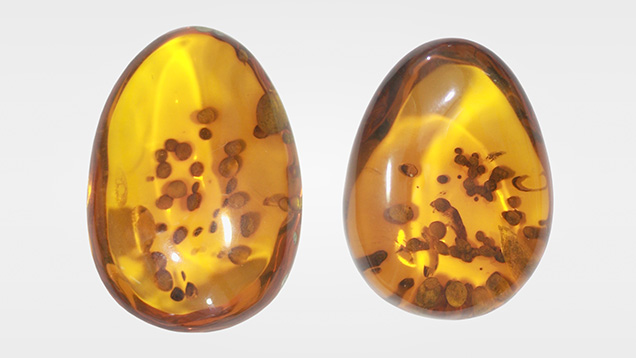
Recently, during a visit to the Mandalay Gem Market in Myanmar, the authors encountered several high-quality amber specimens containing fossilized fungi and acquired two amber cabochons weighing 131.85 and 130.37 ct and measuring 59.04–39.91 × 21.97 mm and 53.73–40.35 × 21.08 mm, respectively (figure 1). Both specimens displayed a transparent yellow-orange bodycolor.
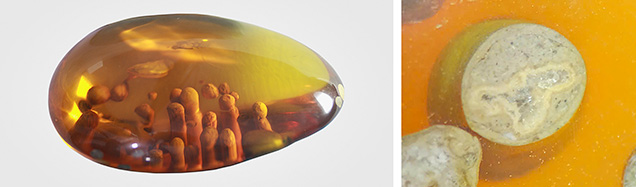
Standard gemological testing revealed specific gravity values of 1.05 and 1.04, with a spot refractive index of 1.50 for both. Neither sample reacted with acetone. Fourier-transform infrared (FTIR) spectroscopy exhibited characteristic absorption peaks at approximately 2923, 2852, 1720, 1450, 1150, 1030, and 813 cm–1, with the notable absence of the 887 cm–1 peak typical of copal. These findings confirmed that the specimens were natural amber, exhibiting diagnostic features consistent with Burmese amber (L.N. Nang et al., “Characteristics of newly discovered amber from Phu Quoc, Vietnam,” Summer 2022 G&G, pp. 184–194). Each piece contained a cluster of approximately 20–25 fungal fruiting bodies. Based on morphological characteristics, these inclusions were identified as Palaeoclavaria burmitis—an extinct fungal species observed only in Burmese amber (G.O. Poinar and A.E. Brown, “A non-gilled hymenomycete in Cretaceous amber,” Mycological Research, Vol. 107, No. 6, 2003, pp. 763–768) (figure 2, left).
Within the amber, the Palaeoclavaria burmitis inclusions were preserved with a granular gray outer surface and an interior ranging in color from light gray to black (figure 2, right). The fruiting bodies measured ~1–3 mm in diameter and reached heights of ~2–4 mm. Notably, nearly colorless siliceous crystalline structures were observed within the fungal tissues—a diagnostic feature indicative of fossilization through silicification replacement. These crystalline clusters exhibited a higher degree of crystallinity than the surrounding material, forming microcrystalline quartz or chalcedony—types of silica crystallization commonly found in siliceous fossils as well as in silica precipitates from magmatic sources (especially within chalcedony masses).
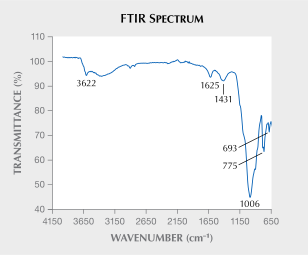
FTIR spectroscopy of the fungal interior confirmed the presence of silica, indicated by absorption peaks at 1006, 775, and 693 cm–1 (B.C. Smith, “Inorganics III: Even more spectra, and the grand finale,” Spectroscopy, Vol. 39. No. 3, 2024, pp. 11–15), along with organic compound bands at 1431 and 1625 cm–1 and water at a peak of 3622 cm–1 (figure 3) (R.H. Ellerbrock and H.H. Gerke, “FTIR spectral band shifts explained by OM–cation interactions,” Journal of Plant Nutrition and Soil Science, Vol. 184, No. 3, 2021, pp. 388–397). These data suggest that the fungi underwent siliceous replacement fossilization—a separate process from the surrounding amber’s polymerization.
Fungi belong to a unique biological kingdom, distinct from both plants and animals, and are rarely fossilized outside of the amber environment. According to a comprehensive study by Poinar Jr. (G. Poinar Jr., “Fossil fleshy fungi (‘mushrooms’) in amber,” Fungal Genomics & Biology, Vol. 6, No. 2, 2016, article no. 1000142), each amber deposit contains a unique assemblage of fungal taxa. Fungi identified in Dominican amber include Aureofungus yaniguaensis, Protomycena electra, Coprinites dominicana, Favolaschia sp., Xylaria antiqua, Ganoderma sp., and Paleomorchella dominicana sp. nov.; Gerontomyces lepidotus in Baltic amber; and Palaeoagaracites antiquus, Palaeogaster micromorpha, and Palaeoclavaria burmitis in Burmese amber. These fungal taxa differ markedly in geological age, geographic distribution, and morphology. As such, they serve as reliable paleobiological markers for determining the provenance and geological age of amber specimens with high accuracy.
Le Ngoc Nang is CEO of Liu Gemological Research and Application Center (LIULAB) in Ho Chi Minh City, Vietnam. Ta Quan Ngoc is affiliated with Bong Cam Thach Myanmar in Ho Chi Minh City, Vietnam.
Biological inclusions represent an extraordinary and scientifically valuable aspect of amber. Beyond an aesthetic and commercial appeal, these inclusions provide significant insights into ancient ecosystems. Among global amber sources, Burmese amber is particularly renowned for its abundance and diversity of biological inclusions. These inclusions encompass a wide range of organisms, including fauna (ants, bees, beetles, scorpions, lizards, small birds, and snails), flora (leaves, bark, and stems), and fungi.
Recently, during a visit to the Mandalay Gem Market in Myanmar, the authors encountered several high-quality amber specimens containing fossilized fungi and acquired two amber cabochons weighing 131.85 and 130.37 ct and measuring 59.04–39.91 × 21.97 mm and 53.73–40.35 × 21.08 mm, respectively (figure 1). Both specimens displayed a transparent yellow-orange bodycolor.
Standard gemological testing revealed specific gravity values of 1.05 and 1.04, with a spot refractive index of 1.50 for both. Neither sample reacted with acetone. Fourier-transform infrared (FTIR) spectroscopy exhibited characteristic absorption peaks at approximately 2923, 2852, 1720, 1450, 1150, 1030, and 813 cm–1, with the notable absence of the 887 cm–1 peak typical of copal. These findings confirmed that the specimens were natural amber, exhibiting diagnostic features consistent with Burmese amber (L.N. Nang et al., “Characteristics of newly discovered amber from Phu Quoc, Vietnam,” Summer 2022 G&G, pp. 184–194). Each piece contained a cluster of approximately 20–25 fungal fruiting bodies. Based on morphological characteristics, these inclusions were identified as Palaeoclavaria burmitis—an extinct fungal species observed only in Burmese amber (G.O. Poinar and A.E. Brown, “A non-gilled hymenomycete in Cretaceous amber,” Mycological Research, Vol. 107, No. 6, 2003, pp. 763–768) (figure 2, left).
Within the amber, the Palaeoclavaria burmitis inclusions were preserved with a granular gray outer surface and an interior ranging in color from light gray to black (figure 2, right). The fruiting bodies measured ~1–3 mm in diameter and reached heights of ~2–4 mm. Notably, nearly colorless siliceous crystalline structures were observed within the fungal tissues—a diagnostic feature indicative of fossilization through silicification replacement. These crystalline clusters exhibited a higher degree of crystallinity than the surrounding material, forming microcrystalline quartz or chalcedony—types of silica crystallization commonly found in siliceous fossils as well as in silica precipitates from magmatic sources (especially within chalcedony masses).
FTIR spectroscopy of the fungal interior confirmed the presence of silica, indicated by absorption peaks at 1006, 775, and 693 cm–1 (B.C. Smith, “Inorganics III: Even more spectra, and the grand finale,” Spectroscopy, Vol. 39. No. 3, 2024, pp. 11–15), along with organic compound bands at 1431 and 1625 cm–1 and water at a peak of 3622 cm–1 (figure 3) (R.H. Ellerbrock and H.H. Gerke, “FTIR spectral band shifts explained by OM–cation interactions,” Journal of Plant Nutrition and Soil Science, Vol. 184, No. 3, 2021, pp. 388–397). These data suggest that the fungi underwent siliceous replacement fossilization—a separate process from the surrounding amber’s polymerization.
Fungi belong to a unique biological kingdom, distinct from both plants and animals, and are rarely fossilized outside of the amber environment. According to a comprehensive study by Poinar Jr. (G. Poinar Jr., “Fossil fleshy fungi (‘mushrooms’) in amber,” Fungal Genomics & Biology, Vol. 6, No. 2, 2016, article no. 1000142), each amber deposit contains a unique assemblage of fungal taxa. Fungi identified in Dominican amber include Aureofungus yaniguaensis, Protomycena electra, Coprinites dominicana, Favolaschia sp., Xylaria antiqua, Ganoderma sp., and Paleomorchella dominicana sp. nov.; Gerontomyces lepidotus in Baltic amber; and Palaeoagaracites antiquus, Palaeogaster micromorpha, and Palaeoclavaria burmitis in Burmese amber. These fungal taxa differ markedly in geological age, geographic distribution, and morphology. As such, they serve as reliable paleobiological markers for determining the provenance and geological age of amber specimens with high accuracy.
Le Ngoc Nang is CEO of Liu Gemological Research and Application Center (LIULAB) in Ho Chi Minh City, Vietnam. Ta Quan Ngoc is affiliated with Bong Cam Thach Myanmar in Ho Chi Minh City, Vietnam.