Shell Blister on an Isognomon isognomon Shell
Theoretically, all mollusks are capable of producing pearls, but only a small number of them actually produce commercially traded nacreous pearls. Most come from the Pinctada and Pteria genera belonging to the Pteridae family. Species that produce the nacreous pearls regularly seen in the market, such as Pinctada maxima, Pinctada radiata, Pteria sterna, and Pteria penguin, are well known to aficionados. However, some unusual bivalve species can also produce pearls or shell blisters, and one example was recently submitted to GIA’s Mumbai laboratory for scientific examination.
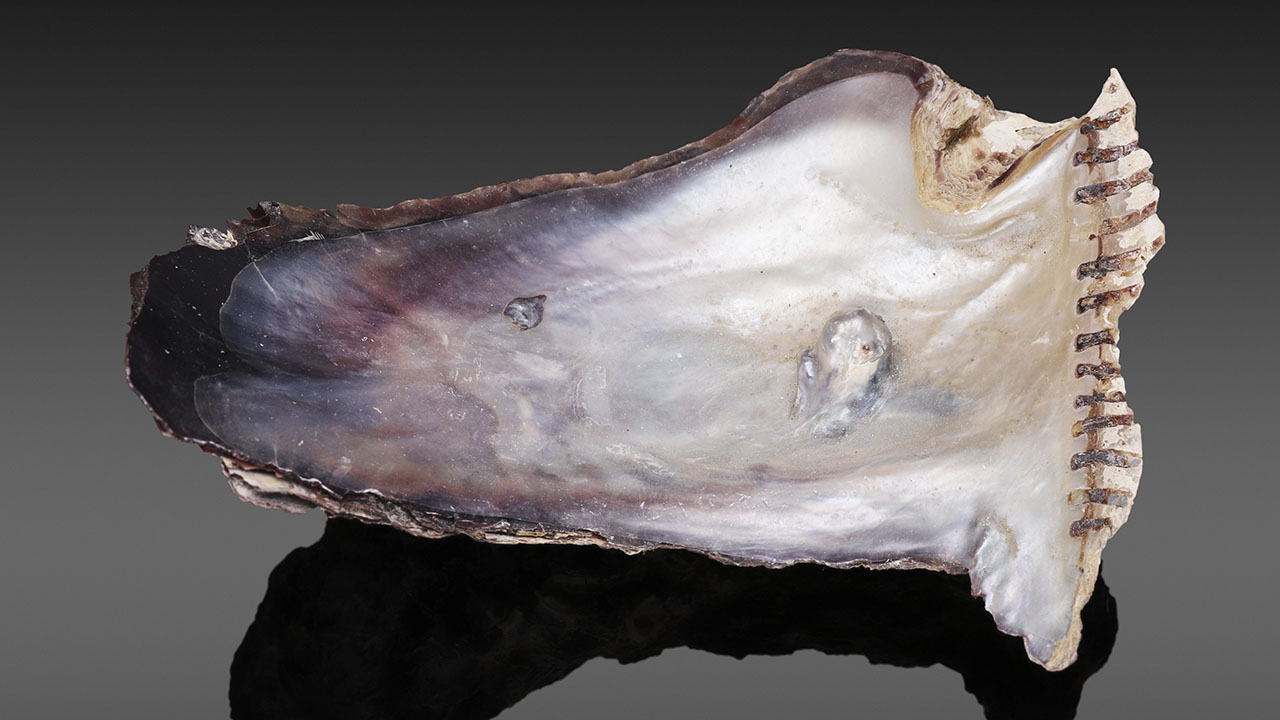
The shell was from the Isognomon isognomon species, belonging to the Isognomonidae family and commonly known as the Pacific toothed oyster. It exhibited a blister feature that appeared as a folded section of nacre, located near the center, close to the posterior muscle scar and the hinge (figure 1). The shell weighed 46.88 g and measured approximately 107.76 × 72.39 mm, while the baroque-shaped silver to light gray blister measured approximately 8.80 × 4.21 mm. Not all instances of nacre growth on a shell are classified as pearls. While cyst pearls or whole pearls develop independently from the shell, blisters are nacreous concretions that appear to protrude from the shell (K. Lawanwong et al., “Natural shell blisters and blister pearls: What’s the difference?” GIA Research News, August 26, 2019). According to the pearl classification established by CIBJO, the concretion observed on the shell in question would be categorized as a shell blister.
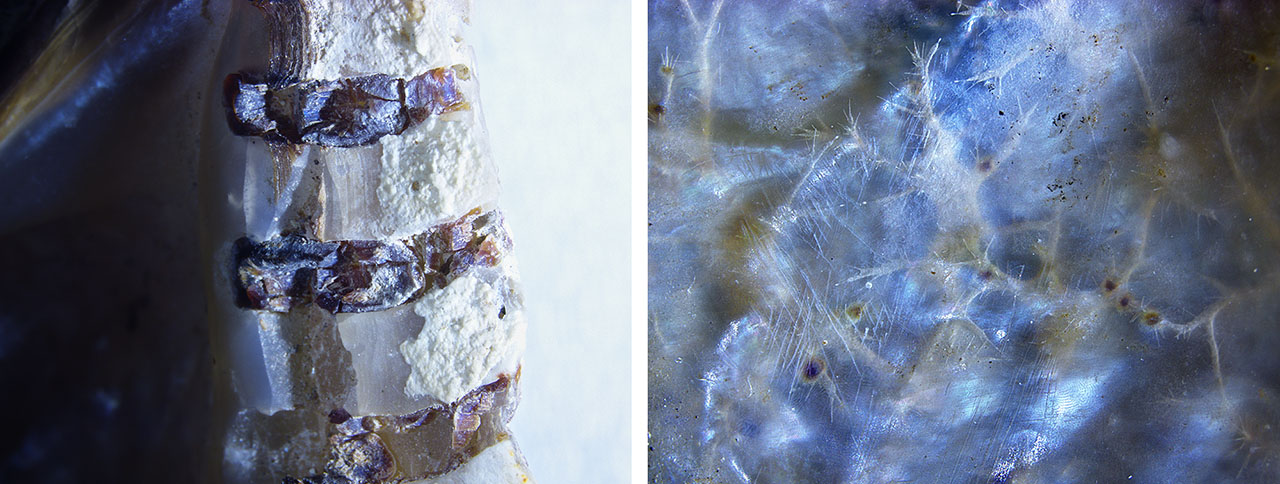
The shell itself displayed a narrow, elongated shape, featuring a straight hinge with distinct equidistant dark brown notches along its length (figure 2, left). These notches, also known as resilifers or ligament pits, resemble teeth, giving the species its common name; see I. Temkin and C. Printrakoon, “Morphology and taxonomy of Isognomon spathulatus (Reeve, 1858), a cryptic bivalve from the mangroves of Thailand,” Zootaxa, Vol. 4107, No. 2, 2016, pp. 141–174.
The interior of the shell exhibited a predominantly nacreous aragonite surface, characterized by a discernible spiral platelet structure visible under microscopic examination. This nacreous region was bordered by a non-nacreous shell margin. The central nacre displayed a light gray coloration, transitioning to a darker purplish gray toward the margin. The center of the shell had a more translucent appearance, revealing a subsurface dendritic network of parasitic channels surrounding the blister (figure 2, right).
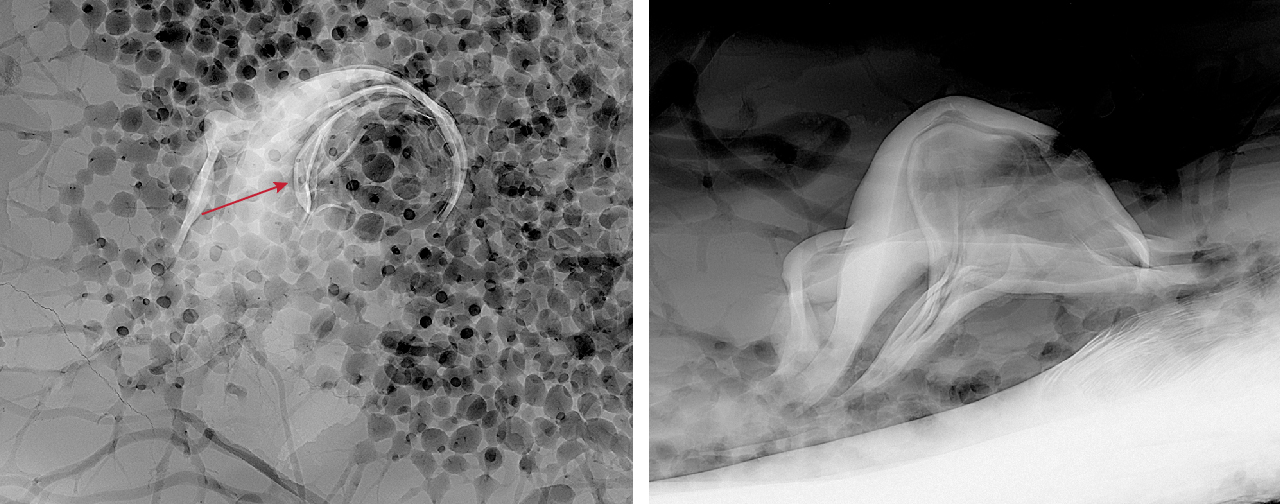
Real-time microradiography (RTX) revealed a network of fine channels beneath the blister and throughout the shell itself (figure 3, left). These features corresponded to the parasitic channels observed within the translucent layer on the shell’s interior. RTX imaging of the blister revealed a void (figure 3, right), potentially linked to parasitic activity that may have initiated the blister formation.
X-ray fluorescence (XRF) imaging of both the shell and the blister yielded an inert reaction. Energy-dispersive X-ray fluorescence spectrometry of the blister indicated a manganese level below the instrument’s detection limit and a strontium level of 1135 ppm. The inert XRF reaction, along with the chemical composition, proved the mollusk formed in a saltwater environment. Under long-wave UV radiation, the shell displayed a greenish yellow fluorescence reaction, while short-wave UV radiation yielded an inert response. Raman analysis using a 514 nm ion/argon laser excitation revealed peaks at 701/704 cm–1 and 1085 cm–1, indicative of aragonite. Photoluminescence spectra collected from both the shell and the blister showed three broad peaks centered at 620, 650, and 680 nm, which is observed in some naturally colored pearls.
Although the Isognomonidae family and the Pteridae family belong to the Pteroidae superfamily, pearls from oysters such as the Pacific toothed oyster (Isognomon isognomon) are rarely seen. Therefore, it was intriguing to examine this blister. Perhaps we will someday encounter a natural pearl from this mollusk species.