
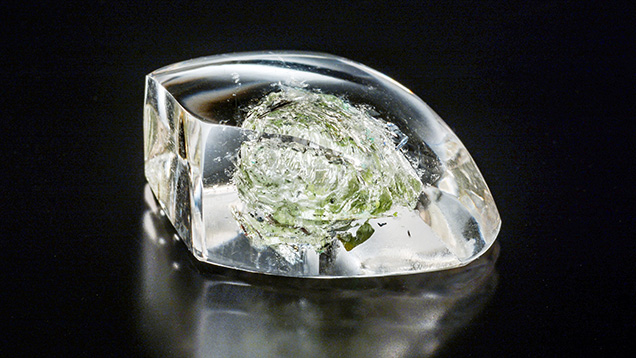
The authors recently had the opportunity to examine a 28.61 ct transparent freeform custom-cut study block of colorless topaz (figure 1) from Jos in Plateau State, Nigeria, that hosted a very large forest green inclusion of chlorite with an intricate stepped surface structure.
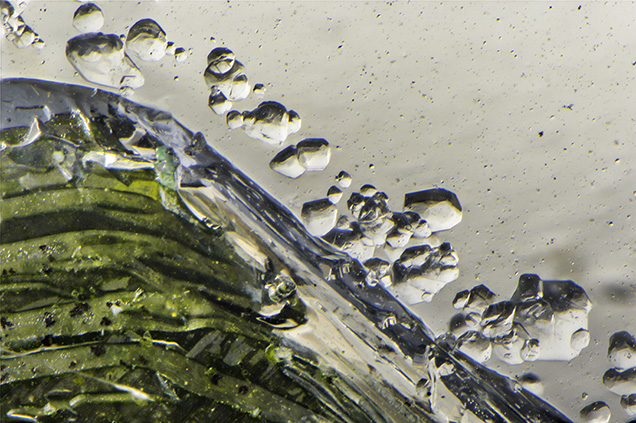
Magnification showed that the chlorite inclusion was partially rimmed by transparent near-colorless crystals (figure 2) identified by laser Raman microspectrometry as willemite (Zn2SiO4), a trigonal zinc silicate.
The willemite crystals in this topaz fluoresced bright yellow-green to short-wave ultraviolet radiation, giving the chlorite a partial fluorescent halo. This is the only known example of the mineral willemite as inclusions in topaz from any locality.
In addition to the willemite, bright bluish green patches of color on the chlorite might be the microcline feldspar amazonite, but Raman analysis could not identify them. There were also some tiny rounded opaque inclusions with metallic luster that resembled metal sulfides. Bright red epigenetic hematite was found in one surface-reaching cleavage crack, and a few tiny transparent brownish yellow high-relief crystals of sphalerite were also present with the willemite.
John Koivula is analytical microscopist, and Nathan Renfro is manager of colored stone identification, at GIA in Carlsbad, California.
The authors recently had the opportunity to examine a 28.61 ct transparent freeform custom-cut study block of colorless topaz (figure 1) from Jos in Plateau State, Nigeria, that hosted a very large forest green inclusion of chlorite with an intricate stepped surface structure.
Magnification showed that the chlorite inclusion was partially rimmed by transparent near-colorless crystals (figure 2) identified by laser Raman microspectrometry as willemite (Zn2SiO4), a trigonal zinc silicate.
The willemite crystals in this topaz fluoresced bright yellow-green to short-wave ultraviolet radiation, giving the chlorite a partial fluorescent halo. This is the only known example of the mineral willemite as inclusions in topaz from any locality.
In addition to the willemite, bright bluish green patches of color on the chlorite might be the microcline feldspar amazonite, but Raman analysis could not identify them. There were also some tiny rounded opaque inclusions with metallic luster that resembled metal sulfides. Bright red epigenetic hematite was found in one surface-reaching cleavage crack, and a few tiny transparent brownish yellow high-relief crystals of sphalerite were also present with the willemite.
John Koivula is analytical microscopist, and Nathan Renfro is manager of colored stone identification, at GIA in Carlsbad, California.