
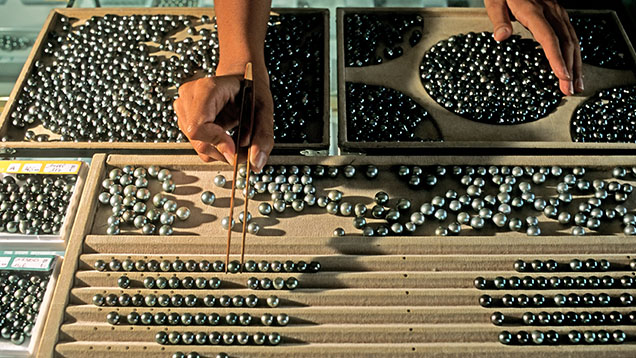
When you purchase a pearl with a GIA report, you're choosing the global standard in pearl identification and quality evaluation. GIA is a trusted authority known for its rigorous, objective analysis of both natural and cultured pearls—from popular Akoya, South Sea, Tahitian and freshwater varieties to rare melo, conch and abalone pearls.
As a pioneer in pearl research and reporting, GIA developed the GIA 7 Pearl Value Factors™—which evaluate pearl quality based on set standards of size, shape, color, luster, surface, nacre and matching. This system brings clarity and consistency to pearl classification, empowering consumers and professionals alike to make informed decisions in their purchasing journey.
Here’s a clear, step-by-step look at how GIA evaluates pearls once they arrive at the lab.
STEP 1: PEARL INTAKE
Once a pearl is submitted:
- Your name or store info is removed so grading is completely unbiased. Every pearl or pearl strand, whether from a local jeweler or a globally recognized brand, is evaluated using the same rigorous, objective standards.
- GIA photographs and records the pearl’s basic measurements, including weight, size, shape, color and whether it is loose, mounted or part of a strand.
STEP 2: SURFACE EXAMINATION AND BASIC GEMOLOGICAL TESTING
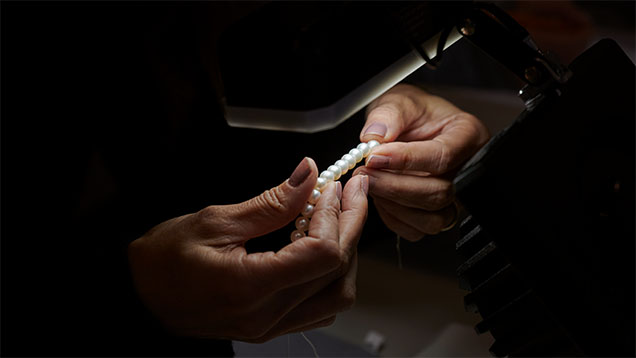
GIA gemologists begin by examining the pearl’s surface to determine whether it is nacreous—showing layers of glowing nacre composed of calcium carbonate and protein—or non-nacreous, like the porcelaneous surfaces of conch or melo pearls. They also assess whether the pearl requires further testing for common treatments such as dyeing or bleaching. Nacreous pearls exhibit a distinctive glow and iridescence, caused by the diffraction of light through the microscopic layers of calcium carbonate.
Foundational tools include X-ray Radiography and Short-wave and Long-wave Fluorescence Spectroscopy.
X-ray Radiography (RTX)
- How it works: X-rays penetrate the pearl to reveal its internal structure.
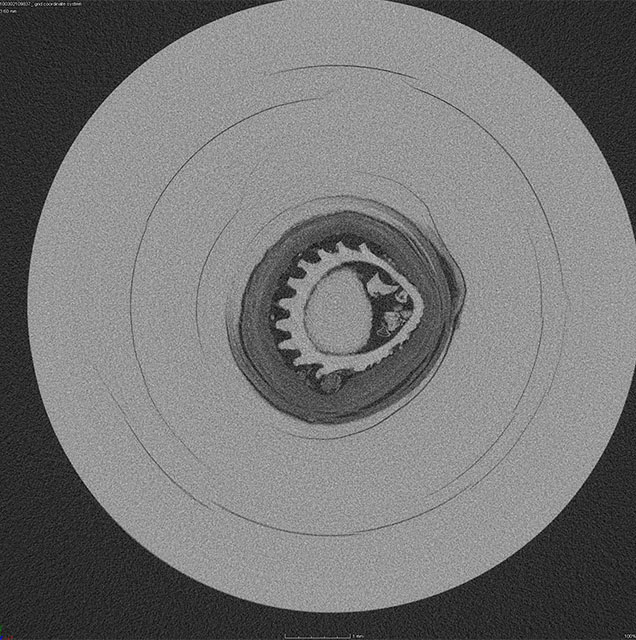
- What it shows: Whether the pearl is natural, bead cultured or non-bead cultured. Natural pearls typically display concentric ring structures with no solid nucleus. Bead cultured pearls reveal a central core and surrounding nacre. Non-bead cultured pearls usually contain irregular, linear or other abnormal growth patterns, or a void.
If needed, micro-computed tomography (μ-CT) provides 3D scans with exceptional detail to visualize growth layers and structural anomalies—especially useful in borderline cases.
Short-Wave (SWUV) and Long-Wave (LWUV) Fluorescence Spectroscopy
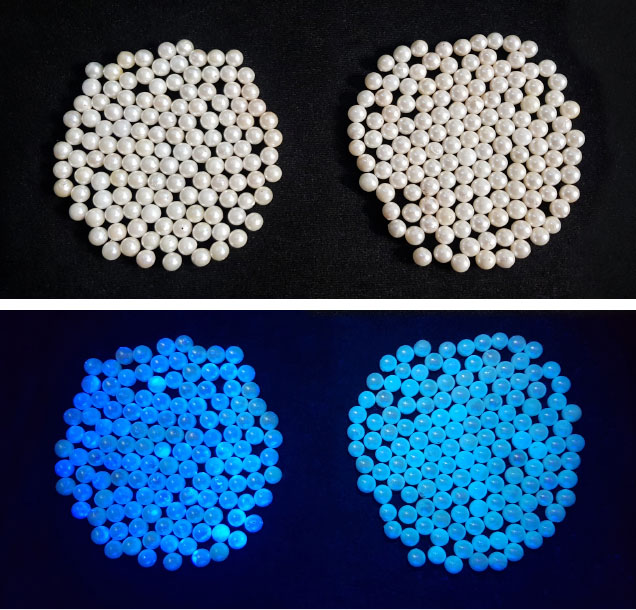
- How it works: Exposes the pearl to UV light and examines the fluorescence response of the gem.
- What it shows: Detects whether pearls have undergone chemical processing to enhance brightness or whiteness. For example, bleached and, especially, optically brightened pearls, may show strong fluorescence.
STEP 3: ADVANCED ANALYTICAL TESTING
GIA often uses advanced techniques to back up visual and radiographic findings:
Energy Dispersive X-ray Fluorescence (EDXRF)
- How it works: X-rays excite the pearl, causing it to emit secondary (fluorescent) X-rays that reveal its elemental composition.
- What it shows: The levels of key trace elements:
- Manganese (Mn): Typically higher in freshwater pearls
- Strontium (Sr): Typically higher in saltwater pearls
This chemical fingerprint helps distinguish freshwater vs. saltwater origin and contributes to mollusk species identification.
X-ray Fluorescence Imaging (XRF)
- How it works: Exposes the pearl to X-rays and records its fluorescence response.
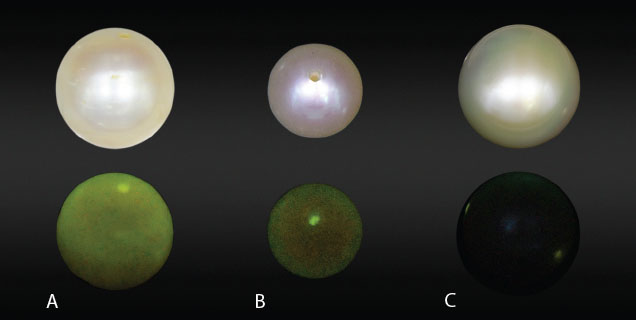
- What it shows: Freshwater pearls often exhibit moderate to strong greenish-yellow fluorescence. Saltwater pearls generally show weak or no fluorescence (inert), although some bead cultured saltwater pearls can also show weak to strong greenish yellow fluorescence if they contain freshwater shell bead nuclei.
This visual response helps support conclusions about origin and pearl type.
Raman, Raman Photoluminescence (PL) and UV-Vis-NIR Reflectance Spectroscopy
- How it works: Uses laser or broad-spectrum light to analyze how the pearl reflects or emits light across the ultraviolet (UV), visible (Vis) and near-infrared (NIR) regions.
- What it shows: Helps determine whether a pearl’s color is natural or modified (e.g., dyed or irradiated).
Also used to identify mineral content and detect subtle surface treatments or coatings.
Laser Ablation–Inductively Coupled Plasma–Mass Spectrometry (LA-ICP-MS)
- How it works: A minimally invasive technique that vaporizes a microscopic spot on the pearl’s surface to analyzes its trace element composition.
- What it shows: Helps identify the mollusk species and distinguish freshwater vs. saltwater pearls, detect treatments or unusual additives.
Also helps support determination of natural vs. cultured origin, especially in complex cases.
STEP 4: QUALITY CLASSIFICATION (FOR CULTURED PEARLS)
If a pearl is submitted for a GIA Pearl Identification and Classification Report or the Cultured Pearl Classification Report, GIA also evaluates it using the GIA 7 Pearl Value Factors™:
- Size
- Shape
- Color
- Luster
- Surface
- Nacre
- Matching (for multi-pearl pieces)
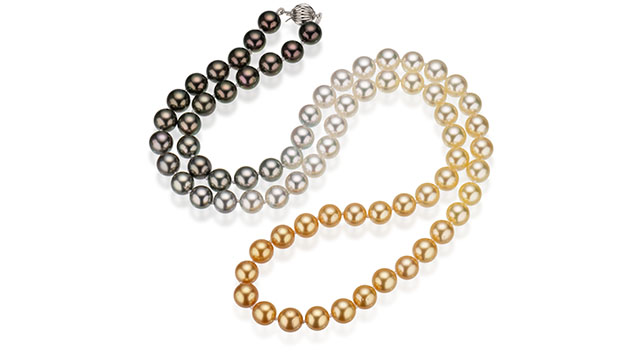
STEP 5: THE RETURN HOME
Your pearl is carefully repackaged and returned to you along with its official GIA report—offering you confidence in its identity and quality.
Depending on the service requested, this report may include:
- Whether the pearl is natural or cultured
- Whether it is saltwater or freshwater
- Whether it is nacreous or non-nacreous
- Mollusk species (when determinable)
- Any treatments detected
- Quality classification based on the GIA 7 Pearl Value Factors™ (for applicable reports)
- Special trade terms, such as “hanadama” or “peacock” for qualifying pearls, highlighting their exceptional quality, rarity, and market desirability
GIA gemologists study and research natural and cultured pearls from around the world. Their expertise is trusted by collectors, retailers and museums to evaluate some of the most valuable and historically significant pearls ever discovered—from the renowned Empress Eugénie pearls to the extraordinary Saffron Dragon melo pearl. With decades of experience and advanced technology, GIA continues to set the global standard for pearl identification and evaluation.
READY TO SUBMIT YOUR PEARL?
Get started online and submit your pearl today using GIA's Memo Creator. You'll learn how to package, ship and track your pearl's journey through GIA's rigorous evaluation process.
When you purchase a pearl with a GIA report, you're choosing the global standard in pearl identification and quality evaluation. GIA is a trusted authority known for its rigorous, objective analysis of both natural and cultured pearls—from popular Akoya, South Sea, Tahitian and freshwater varieties to rare melo, conch and abalone pearls.
As a pioneer in pearl research and reporting, GIA developed the GIA 7 Pearl Value Factors™—which evaluate pearl quality based on set standards of size, shape, color, luster, surface, nacre and matching. This system brings clarity and consistency to pearl classification, empowering consumers and professionals alike to make informed decisions in their purchasing journey.
Here’s a clear, step-by-step look at how GIA evaluates pearls once they arrive at the lab.
STEP 1: PEARL INTAKE
Once a pearl is submitted:
- Your name or store info is removed so grading is completely unbiased. Every pearl or pearl strand, whether from a local jeweler or a globally recognized brand, is evaluated using the same rigorous, objective standards.
- GIA photographs and records the pearl’s basic measurements, including weight, size, shape, color and whether it is loose, mounted or part of a strand.
STEP 2: SURFACE EXAMINATION AND BASIC GEMOLOGICAL TESTING
GIA gemologists begin by examining the pearl’s surface to determine whether it is nacreous—showing layers of glowing nacre composed of calcium carbonate and protein—or non-nacreous, like the porcelaneous surfaces of conch or melo pearls. They also assess whether the pearl requires further testing for common treatments such as dyeing or bleaching. Nacreous pearls exhibit a distinctive glow and iridescence, caused by the diffraction of light through the microscopic layers of calcium carbonate.
Foundational tools include X-ray Radiography and Short-wave and Long-wave Fluorescence Spectroscopy.
X-ray Radiography (RTX)
- How it works: X-rays penetrate the pearl to reveal its internal structure.
- What it shows: Whether the pearl is natural, bead cultured or non-bead cultured. Natural pearls typically display concentric ring structures with no solid nucleus. Bead cultured pearls reveal a central core and surrounding nacre. Non-bead cultured pearls usually contain irregular, linear or other abnormal growth patterns, or a void.
If needed, micro-computed tomography (μ-CT) provides 3D scans with exceptional detail to visualize growth layers and structural anomalies—especially useful in borderline cases.
Short-Wave (SWUV) and Long-Wave (LWUV) Fluorescence Spectroscopy
- How it works: Exposes the pearl to UV light and examines the fluorescence response of the gem.
- What it shows: Detects whether pearls have undergone chemical processing to enhance brightness or whiteness. For example, bleached and, especially, optically brightened pearls, may show strong fluorescence.
STEP 3: ADVANCED ANALYTICAL TESTING
GIA often uses advanced techniques to back up visual and radiographic findings:
Energy Dispersive X-ray Fluorescence (EDXRF)
- How it works: X-rays excite the pearl, causing it to emit secondary (fluorescent) X-rays that reveal its elemental composition.
- What it shows: The levels of key trace elements:
- Manganese (Mn): Typically higher in freshwater pearls
- Strontium (Sr): Typically higher in saltwater pearls
This chemical fingerprint helps distinguish freshwater vs. saltwater origin and contributes to mollusk species identification.
X-ray Fluorescence Imaging (XRF)
- How it works: Exposes the pearl to X-rays and records its fluorescence response.
- What it shows: Freshwater pearls often exhibit moderate to strong greenish-yellow fluorescence. Saltwater pearls generally show weak or no fluorescence (inert), although some bead cultured saltwater pearls can also show weak to strong greenish yellow fluorescence if they contain freshwater shell bead nuclei.
This visual response helps support conclusions about origin and pearl type.
Raman, Raman Photoluminescence (PL) and UV-Vis-NIR Reflectance Spectroscopy
- How it works: Uses laser or broad-spectrum light to analyze how the pearl reflects or emits light across the ultraviolet (UV), visible (Vis) and near-infrared (NIR) regions.
- What it shows: Helps determine whether a pearl’s color is natural or modified (e.g., dyed or irradiated).
Also used to identify mineral content and detect subtle surface treatments or coatings.
Laser Ablation–Inductively Coupled Plasma–Mass Spectrometry (LA-ICP-MS)
- How it works: A minimally invasive technique that vaporizes a microscopic spot on the pearl’s surface to analyzes its trace element composition.
- What it shows: Helps identify the mollusk species and distinguish freshwater vs. saltwater pearls, detect treatments or unusual additives.
Also helps support determination of natural vs. cultured origin, especially in complex cases.
STEP 4: QUALITY CLASSIFICATION (FOR CULTURED PEARLS)
If a pearl is submitted for a GIA Pearl Identification and Classification Report or the Cultured Pearl Classification Report, GIA also evaluates it using the GIA 7 Pearl Value Factors™:
- Size
- Shape
- Color
- Luster
- Surface
- Nacre
- Matching (for multi-pearl pieces)
STEP 5: THE RETURN HOME
Your pearl is carefully repackaged and returned to you along with its official GIA report—offering you confidence in its identity and quality.
Depending on the service requested, this report may include:
- Whether the pearl is natural or cultured
- Whether it is saltwater or freshwater
- Whether it is nacreous or non-nacreous
- Mollusk species (when determinable)
- Any treatments detected
- Quality classification based on the GIA 7 Pearl Value Factors™ (for applicable reports)
- Special trade terms, such as “hanadama” or “peacock” for qualifying pearls, highlighting their exceptional quality, rarity, and market desirability
GIA gemologists study and research natural and cultured pearls from around the world. Their expertise is trusted by collectors, retailers and museums to evaluate some of the most valuable and historically significant pearls ever discovered—from the renowned Empress Eugénie pearls to the extraordinary Saffron Dragon melo pearl. With decades of experience and advanced technology, GIA continues to set the global standard for pearl identification and evaluation.
READY TO SUBMIT YOUR PEARL?
Get started online and submit your pearl today using GIA's Memo Creator. You'll learn how to package, ship and track your pearl's journey through GIA's rigorous evaluation process.