

Since the introduction of GIA’s Jewelry Analysis Service at the India International Jewellery Show (IIJS) Premiere in August 2025, the Mumbai laboratory has received several intriguing submissions. Among them was a set of mounted items: a pair of earrings and a necklace. The necklace featured 14 round brilliants with a stated weight of 15.27 carats total. The earrings were set with a combination of pear-, oval-, and marquise-shaped stones with a stated weight of 10.84 carats total.
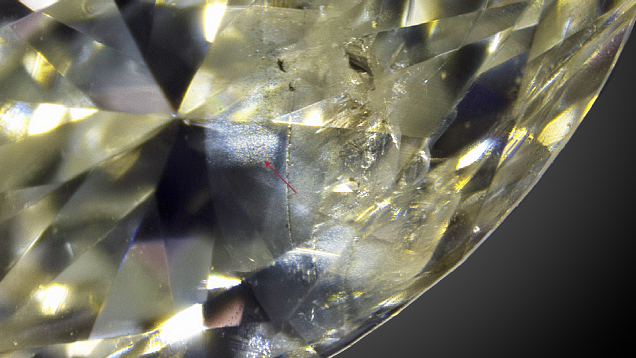
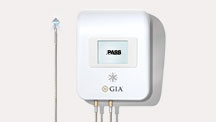
In both the necklace and earrings, the prongs limited access to the pavilion areas and restricted a full view of clarity features. Spectroscopic analysis using the GIA iD100 confirmed that all mounted stones were diamonds and ruled out a laboratory-grown origin. During clarity assessment, bright rainbow-like reflections were observed in two round diamonds from the necklace and in one marquise-shaped diamond from an earring. These features were visible face-up under 10× magnification. At 40× magnification under darkfield and fiber-optic illumination, the phenomenon was identified as the flash effect (figure 1), a visual characteristic typically associated with fracture-filled diamonds (Spring 2018 Lab Notes, pp. 56–57). Flash effects can be challenging to detect, as surface-reaching fractures may show iridescence. Viewing angle is critical for accurate identification; iridescence is typically visible when viewed nearly perpendicular to the fracture plane, whereas the flash effect appears most clearly when viewed parallel to the plane. In addition to the flash effect, a cloudy, milky area was observed across crown facets of the marquise-shaped diamond, further supporting the presence of a filler material within the fracture (figure 2).
Fracture filling is a clarity enhancement treatment used to improve the visual appearance of diamonds by filling surface-reaching fractures with a glass-like substance. The filler material (typically a lead-containing glass) has a refractive index close to that of diamond, reducing the visibility of the fractures and thus giving an appearance of improved clarity (S.F. McClure and C.P. Smith, “Gemstone enhancement and detection in the 1990s,” Winter 2000 G&G, pp. 336–359). Unlike some clarity treatments that are stable and long-lasting, fracture filling is not permanent; the filler may degrade or become discolored over time, particularly when exposed to ultraviolet light, heat, ultrasonic cleaning, or certain chemicals. The presence of such unstable treatments significantly impacts a diamond’s value, durability, and required care. Because of the unstable nature of the filler, GIA does not issue grading reports for diamonds that have undergone fracture filling. Therefore, thorough testing, especially of mounted stones, remains essential for accurate grading and identification. Full disclosure of such treatments is crucial to uphold consumer confidence and ensure market transparency.
Sumit Vardawat and Ashok Prajapati are diamond grader specialists, and Roxane Bhot Jain is manager of pearl, melee, and AGSI technical and market development, at GIA in Mumbai.
Since the introduction of GIA’s Jewelry Analysis Service at the India International Jewellery Show (IIJS) Premiere in August 2025, the Mumbai laboratory has received several intriguing submissions. Among them was a set of mounted items: a pair of earrings and a necklace. The necklace featured 14 round brilliants with a stated weight of 15.27 carats total. The earrings were set with a combination of pear-, oval-, and marquise-shaped stones with a stated weight of 10.84 carats total.
In both the necklace and earrings, the prongs limited access to the pavilion areas and restricted a full view of clarity features. Spectroscopic analysis using the GIA iD100 confirmed that all mounted stones were diamonds and ruled out a laboratory-grown origin. During clarity assessment, bright rainbow-like reflections were observed in two round diamonds from the necklace and in one marquise-shaped diamond from an earring. These features were visible face-up under 10× magnification. At 40× magnification under darkfield and fiber-optic illumination, the phenomenon was identified as the flash effect (figure 1), a visual characteristic typically associated with fracture-filled diamonds (Spring 2018 Lab Notes, pp. 56–57). Flash effects can be challenging to detect, as surface-reaching fractures may show iridescence. Viewing angle is critical for accurate identification; iridescence is typically visible when viewed nearly perpendicular to the fracture plane, whereas the flash effect appears most clearly when viewed parallel to the plane. In addition to the flash effect, a cloudy, milky area was observed across crown facets of the marquise-shaped diamond, further supporting the presence of a filler material within the fracture (figure 2).
Fracture filling is a clarity enhancement treatment used to improve the visual appearance of diamonds by filling surface-reaching fractures with a glass-like substance. The filler material (typically a lead-containing glass) has a refractive index close to that of diamond, reducing the visibility of the fractures and thus giving an appearance of improved clarity (S.F. McClure and C.P. Smith, “Gemstone enhancement and detection in the 1990s,” Winter 2000 G&G, pp. 336–359). Unlike some clarity treatments that are stable and long-lasting, fracture filling is not permanent; the filler may degrade or become discolored over time, particularly when exposed to ultraviolet light, heat, ultrasonic cleaning, or certain chemicals. The presence of such unstable treatments significantly impacts a diamond’s value, durability, and required care. Because of the unstable nature of the filler, GIA does not issue grading reports for diamonds that have undergone fracture filling. Therefore, thorough testing, especially of mounted stones, remains essential for accurate grading and identification. Full disclosure of such treatments is crucial to uphold consumer confidence and ensure market transparency.
Sumit Vardawat and Ashok Prajapati are diamond grader specialists, and Roxane Bhot Jain is manager of pearl, melee, and AGSI technical and market development, at GIA in Mumbai.