
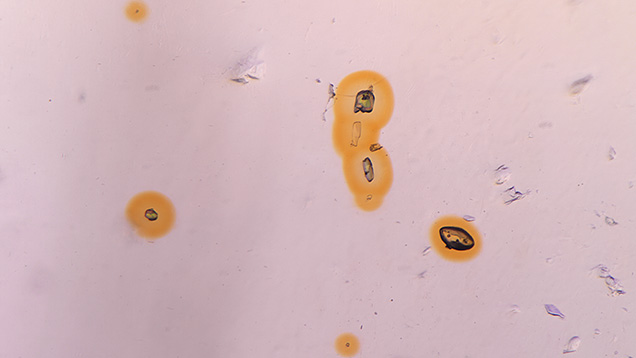
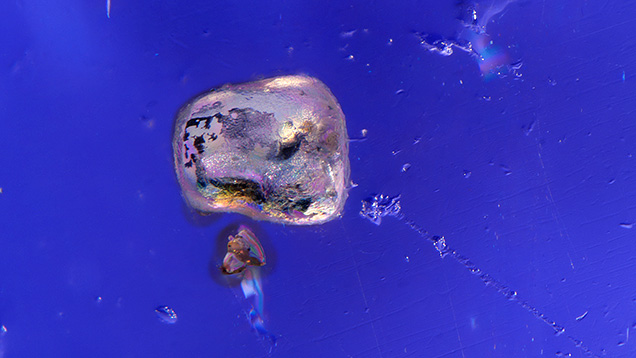
A mounted violet oval cabochon was recently examined by the authors. The stone was identified as iolite through standard gemological testing and confirmed by Raman spectroscopy. Iolite, the gem-quality variety of the mineral cordierite, (Mg,Fe)2Al3(AlSi5O18), is known for its vibrant coloration and dramatic pleochroism but is rarely the subject of photomicrography because of its tendency to be either clean or heavily fissured. Under the microscope, small colorless and yellow crystal inclusions were observed, most of which were surrounded by yellow halos (figures 1 and 2) reminiscent of blue internal diffusion observed in heat-treated sapphire. Some of the inclusions were identified via Raman spectroscopy as zircon, monazite, and apatite, although not all were reachable due to their size or depth.
Interestingly, the size of the yellow halos varied across the species. For example, the large apatite shown in figure 2 possessed a much thinner halo than the relatively smaller monazites, likely due to the relative concentrations of radioactive trace elements in the inclusions. Alpha particles are known to cause yellow radiation damage in cordierite, both naturally and artificially (R. Krickl et al., “Radio-induced alteration in cordierite—Implications for petrology, gemmology and material science,” Geophysical Research Abstracts, Vol. 11, 2009). This yellow coloration fades at higher levels of radiation, perhaps due to degradation of the crystal structure through a process known as metamictization, which could explain the colorless core displayed by some of the inclusions (figure 1). Inclusions are often used to detect color-altering treatments, making it quite ironic that these inclusions were the source of the alteration.
A mounted violet oval cabochon was recently examined by the authors. The stone was identified as iolite through standard gemological testing and confirmed by Raman spectroscopy. Iolite, the gem-quality variety of the mineral cordierite, (Mg,Fe)2Al3(AlSi5O18), is known for its vibrant coloration and dramatic pleochroism but is rarely the subject of photomicrography because of its tendency to be either clean or heavily fissured. Under the microscope, small colorless and yellow crystal inclusions were observed, most of which were surrounded by yellow halos (figures 1 and 2) reminiscent of blue internal diffusion observed in heat-treated sapphire. Some of the inclusions were identified via Raman spectroscopy as zircon, monazite, and apatite, although not all were reachable due to their size or depth.
Interestingly, the size of the yellow halos varied across the species. For example, the large apatite shown in figure 2 possessed a much thinner halo than the relatively smaller monazites, likely due to the relative concentrations of radioactive trace elements in the inclusions. Alpha particles are known to cause yellow radiation damage in cordierite, both naturally and artificially (R. Krickl et al., “Radio-induced alteration in cordierite—Implications for petrology, gemmology and material science,” Geophysical Research Abstracts, Vol. 11, 2009). This yellow coloration fades at higher levels of radiation, perhaps due to degradation of the crystal structure through a process known as metamictization, which could explain the colorless core displayed by some of the inclusions (figure 1). Inclusions are often used to detect color-altering treatments, making it quite ironic that these inclusions were the source of the alteration.