
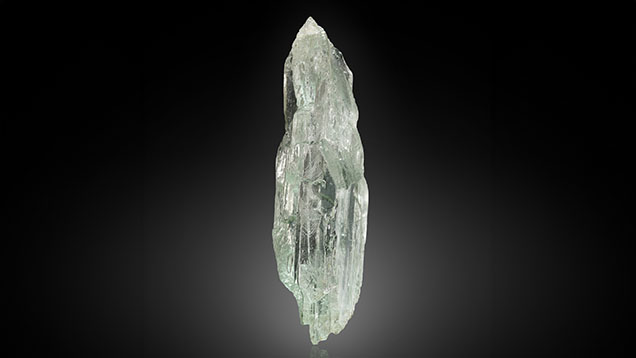
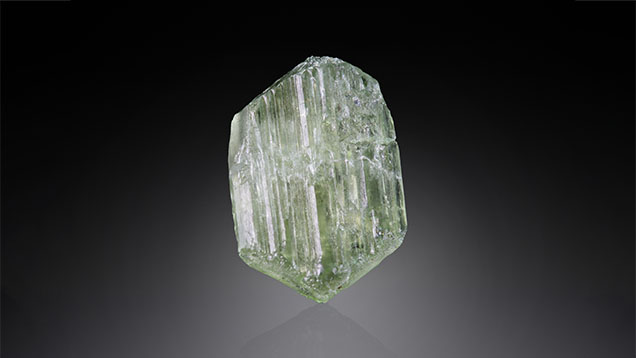
Not every day do we encounter a known but rare gem mineral from a previously unknown locality for the species. But that is exactly what happened when we examined the doubly terminated, heavily etched green crystal shown in figure 1. This slightly yellowish green crystal, weighing 20.57 ct and measuring 37.10 × 10.00 × 8.50 mm, is from Sawtooth National Forest in Elmore County, Idaho. It came to us from the mineral collection of Jack Lowell of Tempe, Arizona.
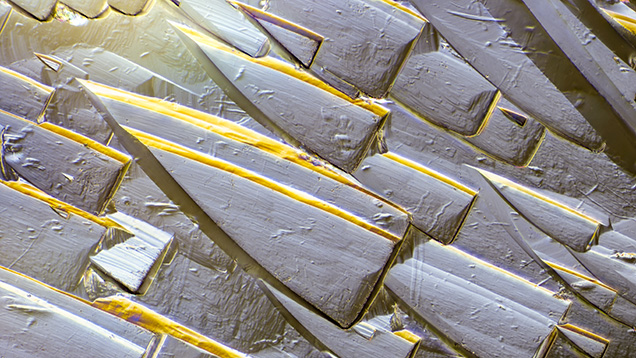
Mined by Geary Murdoch in the 1990s, the crystal was sold to Lowell as an etched aquamarine. Lowell suspected that it was a spodumene crystal due to the very distinctive and diagnostic etching on its surfaces (figure 2). The authors examined the crystal with Raman analysis to confirm its identity as spodumene. Energy-dispersive X-ray fluorescence identified its chromophore as chromium, indicating the specimen was the rare green variety known as hiddenite.
Idaho is only the second known hiddenite source. The first to yield gem crystals (figure 3) was the Adams hiddenite and emerald mine in Alexander County, North Carolina.
Not every day do we encounter a known but rare gem mineral from a previously unknown locality for the species. But that is exactly what happened when we examined the doubly terminated, heavily etched green crystal shown in figure 1. This slightly yellowish green crystal, weighing 20.57 ct and measuring 37.10 × 10.00 × 8.50 mm, is from Sawtooth National Forest in Elmore County, Idaho. It came to us from the mineral collection of Jack Lowell of Tempe, Arizona.
Mined by Geary Murdoch in the 1990s, the crystal was sold to Lowell as an etched aquamarine. Lowell suspected that it was a spodumene crystal due to the very distinctive and diagnostic etching on its surfaces (figure 2). The authors examined the crystal with Raman analysis to confirm its identity as spodumene. Energy-dispersive X-ray fluorescence identified its chromophore as chromium, indicating the specimen was the rare green variety known as hiddenite.
Idaho is only the second known hiddenite source. The first to yield gem crystals (figure 3) was the Adams hiddenite and emerald mine in Alexander County, North Carolina.