

The garnet group contains the most gem-quality species for jewelry manufacturing. Phenomenal garnets such as almandine and pyrope species are also known for their four- and six-rayed asterism. Nevertheless, the trapiche structure found in emerald, ruby, sapphire, tourmaline, and quartz is extremely rare in garnet. This structure can be considered an immobile star phenomenon. Inclusions and color zoning are responsible for the formation of two-, four-, or six-arm trapiche patterns.
Recently, the authors received a garnet sample originating from Thac Ba Lake in the Yen Bai province of Vietnam, obtained by a local miner. The 3.57 ct polished gem was pinkish white and reddish brown, translucent to opaque, and measured 7.11 × 6.90 × 6.40 mm. The diamond-shaped pinkish white portions were surrounded by reddish brown color zones, creating three-arm and four-arm trapiche patterns (see the video below).
Gemological testing revealed the sample’s specific gravity of 4.16 and refractive index of 1.78. The stone displayed absorption spectra with distinct bands at 504, 520, and 573 nm, and it was inert under ultraviolet light for both long-wave and short-wave. All the data confirmed the almandine garnet species.
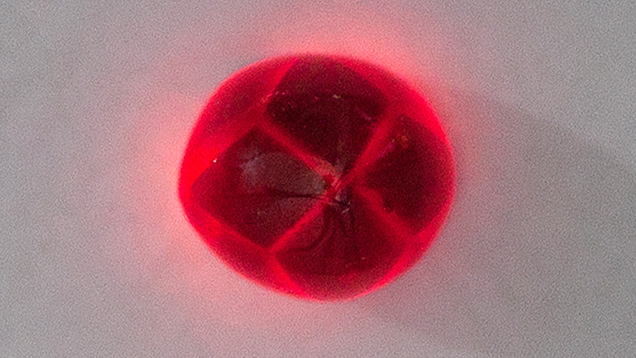
Observing all sides of the stone, we identified 14 trapiche patterns, including 6 four-arm and 8 three-arm patterns, surrounding 12 diagonal faces (figure 1). The arms grew outward from the center of the four-arm trapiches and inward for the three-arm trapiches. While the reddish brown portions extended along the edges of the garnet crystal, the diagonal lines formed the faces of the rhombic dodecahedron crystal, a typical crystal habit of almandine originating from metamorphic rock. Interestingly, when illuminated with a flashlight, the trapiche patterns glowed a fascinating vivid red and outlined the diamond-shaped portions in sharp contrast (figure 2).
Using the gemological microscope, we found that the reddish brown color zones were not colored by inclusions. In contrast, we hypothesized that the reddish hue might be induced by the dispersion of metal ions—in this case, iron (E. Fritsch and G.R. Rossman, “An update on color in gems. Part 1: Introduction and colors caused by dispersed metal ions,” Fall 1987 G&G, pp. 126–139). The position of the color zoning along the edges of the crystal might be explained by the concentration of coloration elements in the crystal’s symmetrical planes. The reddish brown zones had higher transparency than the crystal planes, producing a “glowing net” when shining a light through the stone.
Although the trapiche pattern has been observed in several gems, it is rarely seen in garnet. The 14 trapiche patterns together in one specimen make this garnet unique.
Trapiche Patterns in Vietnamese Garnet
Le Ngoc Nang is a postgraduate in the Faculty of Geology at the University of Science, Vietnam National University in Ho Chi Minh City, and CEO of Liu Gemological Research and Application Center (LIULAB). Ho Nguyen Tri Man is a lecturer in the Faculty of Geology and Petroleum Engineering at the University of Technology, Vietnam National University. Pham Minh Tien is a technical specialist at LIULAB.
The garnet group contains the most gem-quality species for jewelry manufacturing. Phenomenal garnets such as almandine and pyrope species are also known for their four- and six-rayed asterism. Nevertheless, the trapiche structure found in emerald, ruby, sapphire, tourmaline, and quartz is extremely rare in garnet. This structure can be considered an immobile star phenomenon. Inclusions and color zoning are responsible for the formation of two-, four-, or six-arm trapiche patterns.
Recently, the authors received a garnet sample originating from Thac Ba Lake in the Yen Bai province of Vietnam, obtained by a local miner. The 3.57 ct polished gem was pinkish white and reddish brown, translucent to opaque, and measured 7.11 × 6.90 × 6.40 mm. The diamond-shaped pinkish white portions were surrounded by reddish brown color zones, creating three-arm and four-arm trapiche patterns (see the video below).
Gemological testing revealed the sample’s specific gravity of 4.16 and refractive index of 1.78. The stone displayed absorption spectra with distinct bands at 504, 520, and 573 nm, and it was inert under ultraviolet light for both long-wave and short-wave. All the data confirmed the almandine garnet species.
Observing all sides of the stone, we identified 14 trapiche patterns, including 6 four-arm and 8 three-arm patterns, surrounding 12 diagonal faces (figure 1). The arms grew outward from the center of the four-arm trapiches and inward for the three-arm trapiches. While the reddish brown portions extended along the edges of the garnet crystal, the diagonal lines formed the faces of the rhombic dodecahedron crystal, a typical crystal habit of almandine originating from metamorphic rock. Interestingly, when illuminated with a flashlight, the trapiche patterns glowed a fascinating vivid red and outlined the diamond-shaped portions in sharp contrast (figure 2).
Using the gemological microscope, we found that the reddish brown color zones were not colored by inclusions. In contrast, we hypothesized that the reddish hue might be induced by the dispersion of metal ions—in this case, iron (E. Fritsch and G.R. Rossman, “An update on color in gems. Part 1: Introduction and colors caused by dispersed metal ions,” Fall 1987 G&G, pp. 126–139). The position of the color zoning along the edges of the crystal might be explained by the concentration of coloration elements in the crystal’s symmetrical planes. The reddish brown zones had higher transparency than the crystal planes, producing a “glowing net” when shining a light through the stone.
Although the trapiche pattern has been observed in several gems, it is rarely seen in garnet. The 14 trapiche patterns together in one specimen make this garnet unique.
Trapiche Patterns in Vietnamese Garnet
Le Ngoc Nang is a postgraduate in the Faculty of Geology at the University of Science, Vietnam National University in Ho Chi Minh City, and CEO of Liu Gemological Research and Application Center (LIULAB). Ho Nguyen Tri Man is a lecturer in the Faculty of Geology and Petroleum Engineering at the University of Technology, Vietnam National University. Pham Minh Tien is a technical specialist at LIULAB.