
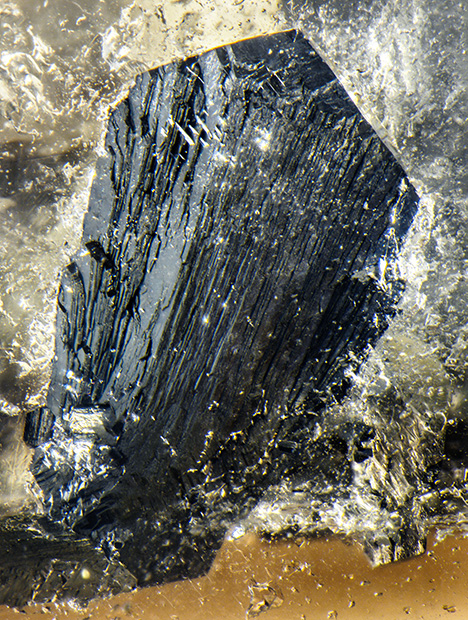
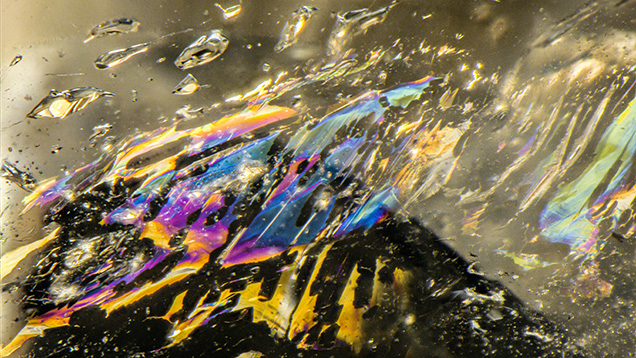
The authors recently examined a smoky quartz gem with interesting bladed inclusions of arsenopyrite (FeAsS), an iron arsenic sulfide mineral. The inclusions generally occurred as thick blades with striated faces in a dark gray color (figure 1). One such inclusion that was exposed to the surface and polished through showed a silvery gray coloration. Energy-dispersive X-ray fluorescence testing revealed significant amounts of iron and arsenic, consistent with the mineral arsenopyrite. The stone was reportedly from the Huanggang mine in Inner Mongolia, China. It was also reported that this stone was cut from a single large crystal that yielded approximately 20 such gems with arsenopyrite inclusions. Also present were numerous fluid inclusions, some of which showed vibrant thin-film interference colors in reflected light (figure 2). These are the first arsenopyrite inclusions the authors have examined in Mongolian quartz.
The authors recently examined a smoky quartz gem with interesting bladed inclusions of arsenopyrite (FeAsS), an iron arsenic sulfide mineral. The inclusions generally occurred as thick blades with striated faces in a dark gray color (figure 1). One such inclusion that was exposed to the surface and polished through showed a silvery gray coloration. Energy-dispersive X-ray fluorescence testing revealed significant amounts of iron and arsenic, consistent with the mineral arsenopyrite. The stone was reportedly from the Huanggang mine in Inner Mongolia, China. It was also reported that this stone was cut from a single large crystal that yielded approximately 20 such gems with arsenopyrite inclusions. Also present were numerous fluid inclusions, some of which showed vibrant thin-film interference colors in reflected light (figure 2). These are the first arsenopyrite inclusions the authors have examined in Mongolian quartz.