
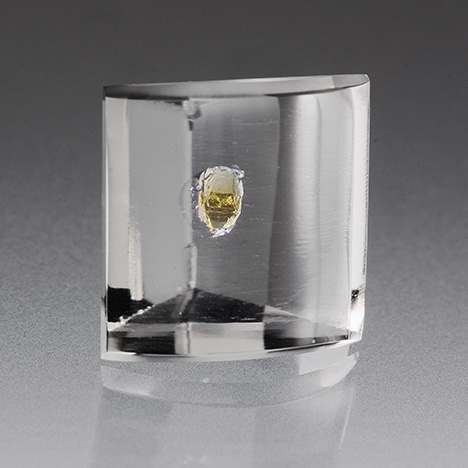
We recently examined an interesting 10.54 ct transparent, colorless, square modified step cut with a slightly convex table facet (figure 1). The faceted rock crystal quartz host, measuring 11.82 × 11.77 × 9.57 mm, is from Itinga in Minas Gerais, Brazil, and came to us from Luciana Barbosa at the Gemological Center in Asheville, North Carolina.
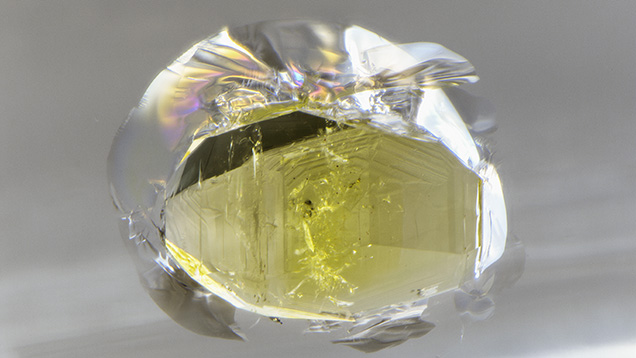
The gem played host to an eye-visible transparent yellow crystal located near its center, which was visible from several directions. On examination with a gemological microscope, we observed a transparent yellow angular crystal of what appeared to be monazite, with a skirt of small stress cracks, suspended in the quartz (figure 2).
Laser Raman microspectrometry was not able to identify the inclusion because it was too deep in the host; all it returned were quartz peaks. Energy-dispersive X-ray fluorescence (EDXRF) also failed to produce hints of unusual chemistry on the inclusion. After several attempts at Raman and EDXRF, we realized that destructive analysis would be needed to clearly identify the yellow crystal, but destructive analysis was not possible.
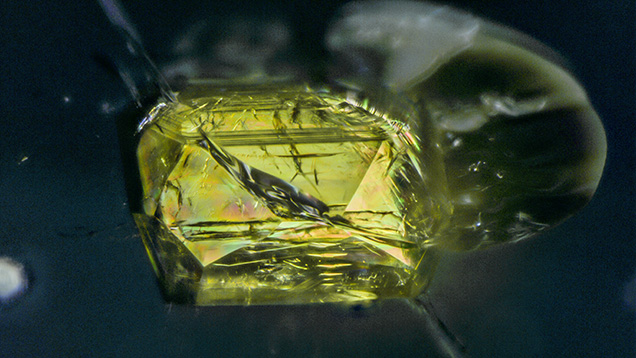
As a result, we turned to optical mineralogy and the crystal habit shown by the well-formed inclusion. Morphologically, the inclusion looked like monazite crystals we have encountered in the past, and it appeared to be monoclinic. The yellow color also suggested monazite. The inclusion showed its birefringent (anisotropic) nature with bright interference colors in polarized light (figure 3). A small condensing lens was used to pull a partial biaxial interference figure from the inclusion. The crystal had weak pleochroism, and a Becke line test showed that the inclusion had a higher refractive index than the surrounding host quartz. All of these findings could lead to its identification as monazite. But there is still a nagging uncertainty, so we are left with “monazite (?).”
John Koivula is an analytical microscopist, and Nathan Renfro is manager of colored stone identification, at GIA in Carlsbad, California.
We recently examined an interesting 10.54 ct transparent, colorless, square modified step cut with a slightly convex table facet (figure 1). The faceted rock crystal quartz host, measuring 11.82 × 11.77 × 9.57 mm, is from Itinga in Minas Gerais, Brazil, and came to us from Luciana Barbosa at the Gemological Center in Asheville, North Carolina.
The gem played host to an eye-visible transparent yellow crystal located near its center, which was visible from several directions. On examination with a gemological microscope, we observed a transparent yellow angular crystal of what appeared to be monazite, with a skirt of small stress cracks, suspended in the quartz (figure 2).
Laser Raman microspectrometry was not able to identify the inclusion because it was too deep in the host; all it returned were quartz peaks. Energy-dispersive X-ray fluorescence (EDXRF) also failed to produce hints of unusual chemistry on the inclusion. After several attempts at Raman and EDXRF, we realized that destructive analysis would be needed to clearly identify the yellow crystal, but destructive analysis was not possible.
As a result, we turned to optical mineralogy and the crystal habit shown by the well-formed inclusion. Morphologically, the inclusion looked like monazite crystals we have encountered in the past, and it appeared to be monoclinic. The yellow color also suggested monazite. The inclusion showed its birefringent (anisotropic) nature with bright interference colors in polarized light (figure 3). A small condensing lens was used to pull a partial biaxial interference figure from the inclusion. The crystal had weak pleochroism, and a Becke line test showed that the inclusion had a higher refractive index than the surrounding host quartz. All of these findings could lead to its identification as monazite. But there is still a nagging uncertainty, so we are left with “monazite (?).”
John Koivula is an analytical microscopist, and Nathan Renfro is manager of colored stone identification, at GIA in Carlsbad, California.