
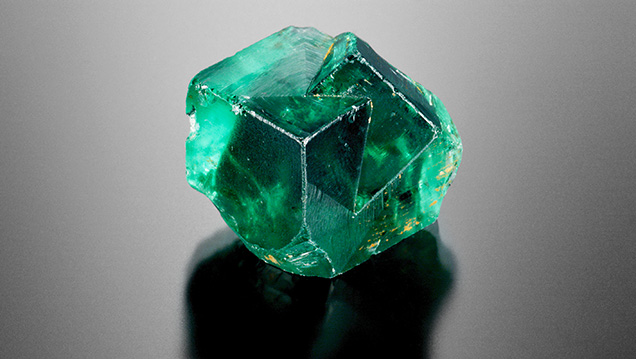
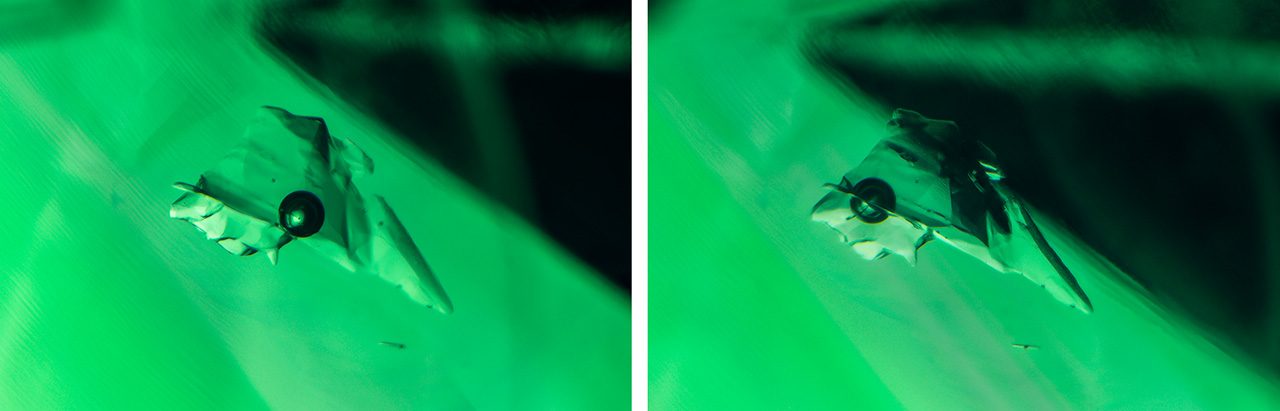
The Rogerley fluorite specimen shown in figure 1 measures 17.68 × 17.38 × 13.50 mm and weighs 41.98 ct. What makes this specimen the subject of this issue’s “Quarterly Crystal” is the presence of an eye-visible primary fluid inclusion with a moving gas phase. Along the interface, where the two growing crystals came together, negative space was created. This form of primary fluid inclusion hosts fluid remnants that were present when the fluorite was growing. When comparing the two photomicrographs in figure 2, the movement of the gas phase can be clearly seen. Fluid inclusions like this are not at all common in fluorite.
John I. Koivula is analytical microscopist at GIA in Carlsbad, California.
The Rogerley fluorite specimen shown in figure 1 measures 17.68 × 17.38 × 13.50 mm and weighs 41.98 ct. What makes this specimen the subject of this issue’s “Quarterly Crystal” is the presence of an eye-visible primary fluid inclusion with a moving gas phase. Along the interface, where the two growing crystals came together, negative space was created. This form of primary fluid inclusion hosts fluid remnants that were present when the fluorite was growing. When comparing the two photomicrographs in figure 2, the movement of the gas phase can be clearly seen. Fluid inclusions like this are not at all common in fluorite.
John I. Koivula is analytical microscopist at GIA in Carlsbad, California.