
The authors recently examined a batch of aquamarine samples from the Xinjiang autonomous territory of China. Microscopic observation revealed rich and colorful features.
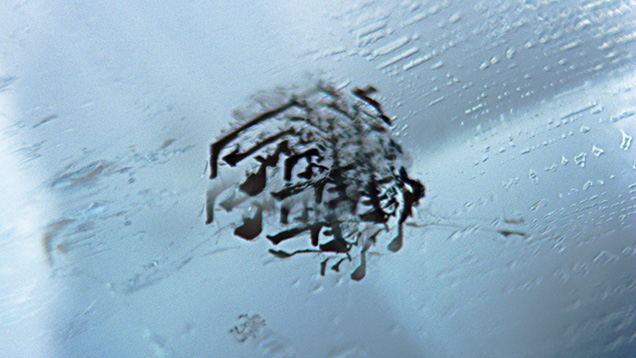
The aquamarines contained yellow-brown to black-brown inclusions. Microscopic observation and further Raman analysis confirmed that these dot-like, flaky, and dendritic yellow-brown to black-brown inclusions were hematite. Interestingly, when observed with a microscope using LED white light illumination, the hematite inclusions appeared to extend from the center to the periphery, and the overall hexagonal shape resembled a rose floating on a calm sea (figure 1).
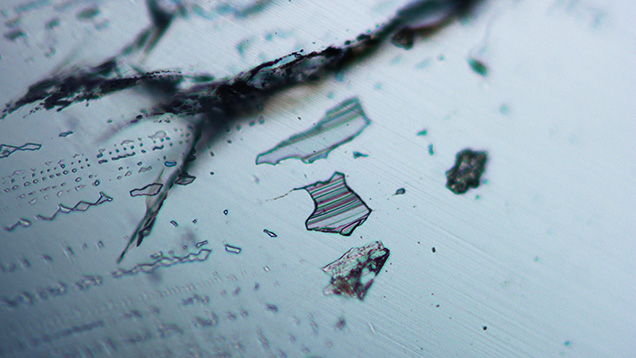
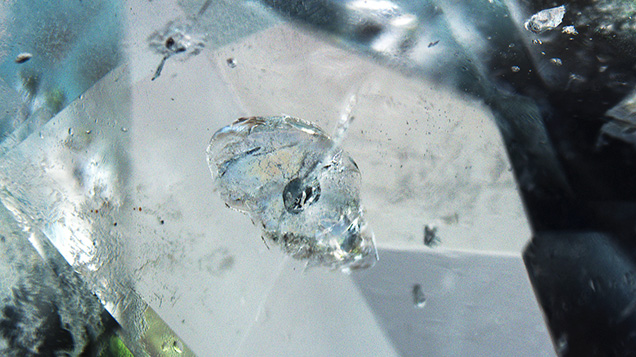
Colors generated by interference phenomena are very common in gemstones. A number of thin-film liquid inclusions were seen in the aquamarines, along with the spectral interference color phenomenon parallel to the c-axis (figure 2). Many disk-shaped inclusions (figure 3) were also found. Stress fractures were caused by solid inclusions in the middle to the surrounding areas, and tubular fractures extended in the direction perpendicular to the disk-shaped fractures. The disks were filled with thin films of liquid, and the interference phenomenon could be seen under the microscope using oblique fiber-optic illumination. The entire disk-shaped inclusion resembled a jellyfish floating in the sea.
The authors recently examined a batch of aquamarine samples from the Xinjiang autonomous territory of China. Microscopic observation revealed rich and colorful features.
The aquamarines contained yellow-brown to black-brown inclusions. Microscopic observation and further Raman analysis confirmed that these dot-like, flaky, and dendritic yellow-brown to black-brown inclusions were hematite. Interestingly, when observed with a microscope using LED white light illumination, the hematite inclusions appeared to extend from the center to the periphery, and the overall hexagonal shape resembled a rose floating on a calm sea (figure 1).
Colors generated by interference phenomena are very common in gemstones. A number of thin-film liquid inclusions were seen in the aquamarines, along with the spectral interference color phenomenon parallel to the c-axis (figure 2). Many disk-shaped inclusions (figure 3) were also found. Stress fractures were caused by solid inclusions in the middle to the surrounding areas, and tubular fractures extended in the direction perpendicular to the disk-shaped fractures. The disks were filled with thin films of liquid, and the interference phenomenon could be seen under the microscope using oblique fiber-optic illumination. The entire disk-shaped inclusion resembled a jellyfish floating in the sea.