
In early 2020, a parcel of stones representing some unique material found in early 2020 from the island of Nusa Kambangan, Central Java, Indonesia, was sent to Taiwan Union Lab of Gem Research (TULAB) for certification service. At the beginning, wholesalers claimed that the gemstone was thomsonite. Because its texture was very similar to the green-blue pectolite variety Larimar produced in the Dominican Republic, the stone was also misrepresented with the trade name “pink Larimar.”
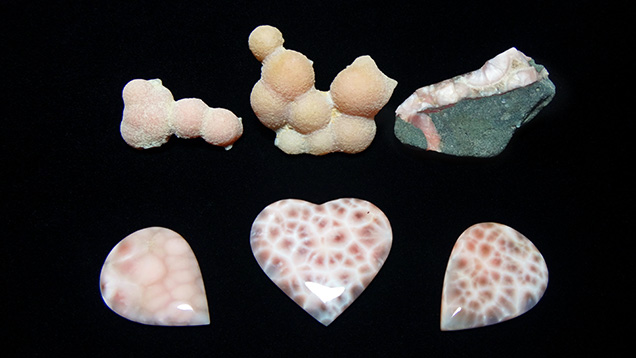
By observing the rough stones with host rocks provided by the supplier, the occurrence was found to be vein-filling or cavity-filling within basalt. These stones had orange-pink to brownish pink color with white zoning and showed a botryoidal or radial crystal habit (figure 1).
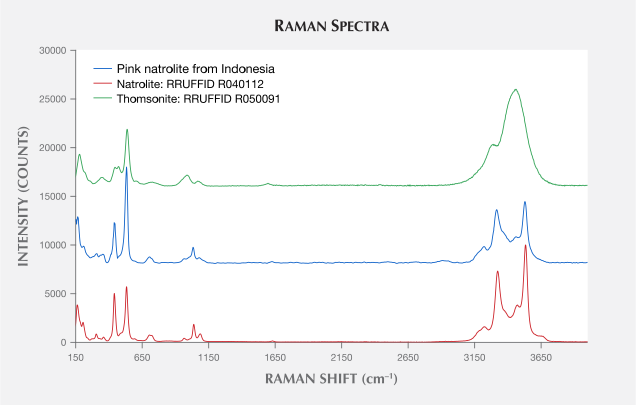
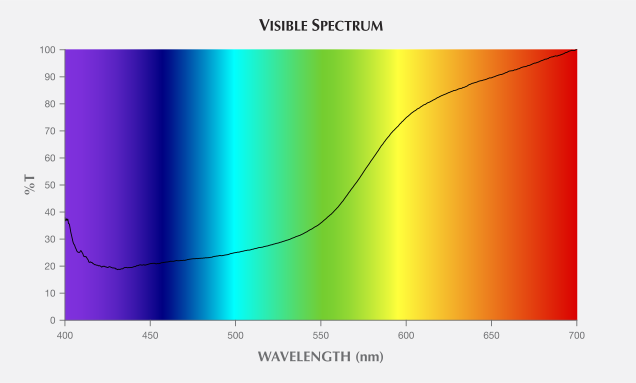
The average specific gravity of this parcel of gemstones was 2.24, and the spot RI was 1.49. With the owner’s consent, the parcel of polycrystalline material was tested with a Vickers hardness tester. The values were converted to Mohs hardness and ranged from 4.4 to 4.6. The samples’ Raman spectra were analyzed and compared to the RRUFF mineral spectral database; unexpectedly, the results were consistent with published spectra of natrolite (Na2Al2Si3O10·2H2O) instead of thomsonite (NaCa2Al5Si5O20·6H2O) (figure 2). The UV-Vis spectra revealed that the pink natrolite stones had a wide absorption band at 400–570 nm (figure 3). The EDXRF results also indicated that the pink gemstone was natrolite and contained a trace iron component. On the basis of EDXRF and UV-Vis results, the orange-pink to brownish pink color appeared to have been caused by Fe3+; however, this presumption still needs further verification.
This natrolite from Indonesia has a unique rose pink color and Larimar-like texture on polished surfaces, which is not common in natrolite from other localities. Although initially misrepresented by the merchant as thomsonite or pink Larimar, its beautiful appearance and durability are indeed comparable to Larimar. Subsequently, a new trade name “rhodatrolite,” meaning “rose natrolite,” was developed by the merchant for marketing this gemstone because of its color and texture. With enough mine production, pink natrolite from Indonesia has the potential to become a popular gemstone on the market.
Yu-Ho Li is with the Institute of Earth Sciences at National Taiwan Ocean University in Keelung. Huei-Fen Chen is with the Institute of Earth Sciences and Center of Excellence for Oceans at National Taiwan Ocean University. Shu-Hong Lin is with the Institute of Earth Sciences at National Taiwan Ocean University and Taiwan Union Lab of Gem Research in Taipei.
In early 2020, a parcel of stones representing some unique material found in early 2020 from the island of Nusa Kambangan, Central Java, Indonesia, was sent to Taiwan Union Lab of Gem Research (TULAB) for certification service. At the beginning, wholesalers claimed that the gemstone was thomsonite. Because its texture was very similar to the green-blue pectolite variety Larimar produced in the Dominican Republic, the stone was also misrepresented with the trade name “pink Larimar.”
By observing the rough stones with host rocks provided by the supplier, the occurrence was found to be vein-filling or cavity-filling within basalt. These stones had orange-pink to brownish pink color with white zoning and showed a botryoidal or radial crystal habit (figure 1).
The average specific gravity of this parcel of gemstones was 2.24, and the spot RI was 1.49. With the owner’s consent, the parcel of polycrystalline material was tested with a Vickers hardness tester. The values were converted to Mohs hardness and ranged from 4.4 to 4.6. The samples’ Raman spectra were analyzed and compared to the RRUFF mineral spectral database; unexpectedly, the results were consistent with published spectra of natrolite (Na2Al2Si3O10·2H2O) instead of thomsonite (NaCa2Al5Si5O20·6H2O) (figure 2). The UV-Vis spectra revealed that the pink natrolite stones had a wide absorption band at 400–570 nm (figure 3). The EDXRF results also indicated that the pink gemstone was natrolite and contained a trace iron component. On the basis of EDXRF and UV-Vis results, the orange-pink to brownish pink color appeared to have been caused by Fe3+; however, this presumption still needs further verification.
This natrolite from Indonesia has a unique rose pink color and Larimar-like texture on polished surfaces, which is not common in natrolite from other localities. Although initially misrepresented by the merchant as thomsonite or pink Larimar, its beautiful appearance and durability are indeed comparable to Larimar. Subsequently, a new trade name “rhodatrolite,” meaning “rose natrolite,” was developed by the merchant for marketing this gemstone because of its color and texture. With enough mine production, pink natrolite from Indonesia has the potential to become a popular gemstone on the market.
Yu-Ho Li is with the Institute of Earth Sciences at National Taiwan Ocean University in Keelung. Huei-Fen Chen is with the Institute of Earth Sciences and Center of Excellence for Oceans at National Taiwan Ocean University. Shu-Hong Lin is with the Institute of Earth Sciences at National Taiwan Ocean University and Taiwan Union Lab of Gem Research in Taipei.