
The Carlsbad laboratory recently examined unusual exsolved flux particles in a flux-grown pink synthetic sapphire. The specimen, mounted in a ring, had an estimated weight of 13.07 ct and a refractive index of 1.760–1.770. It displayed a typical pink sapphire spectrum with a handheld spectroscope. Strong red fluorescence was seen under both long-wave and short-wave UV. Laser ablation–inductively coupled plasma–mass spectrometry (LA-ICP-MS) detected high levels of platinum; the concentrations of iron, beryllium, titanium, vanadium, and gallium were either below the detection or quantification limit.
Microscopic examination revealed further evidence of a synthetic origin: a single reflective platinum platelet with negative hexagonal growth through the center (figure 1, left). Also observed were interconnected channels of exsolved flux creating fingerprints (figure 1, right).
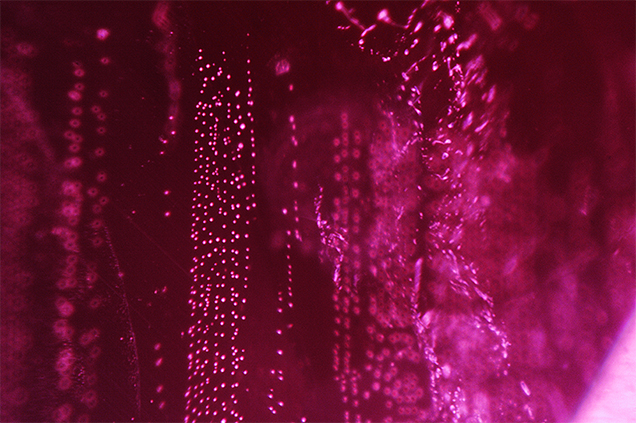
A potentially challenging inclusion was seen in the form of minute rounded flux particles aligned in organized linear rows (figure 2), which displayed a striking resemblance to fingerprints and silk clouds commonly seen within natural corundum. These particles were observed in relative abundance at varying depths. Grid-like exsolved solid inclusions have been mentioned in the literature as possible properties of synthetic corundum (R.W. Hughes et al., Ruby & Sapphire: A Gemologist’s Guide , Lotus RWH Publishing, Bangkok, 2017). It has not been stated how abundant these natural-looking fingerprints are within flux-grown synthetic material, but this type of inclusion is rarely seen at the Carlsbad laboratory. Identifying the natural or synthetic origin of a stone with this type of natural-looking inclusion can be challenging. If a gem material is suspected of being synthetic, it is advisable to submit it to a gemological laboratory.
The Carlsbad laboratory recently examined unusual exsolved flux particles in a flux-grown pink synthetic sapphire. The specimen, mounted in a ring, had an estimated weight of 13.07 ct and a refractive index of 1.760–1.770. It displayed a typical pink sapphire spectrum with a handheld spectroscope. Strong red fluorescence was seen under both long-wave and short-wave UV. Laser ablation–inductively coupled plasma–mass spectrometry (LA-ICP-MS) detected high levels of platinum; the concentrations of iron, beryllium, titanium, vanadium, and gallium were either below the detection or quantification limit.
Microscopic examination revealed further evidence of a synthetic origin: a single reflective platinum platelet with negative hexagonal growth through the center (figure 1, left). Also observed were interconnected channels of exsolved flux creating fingerprints (figure 1, right).
A potentially challenging inclusion was seen in the form of minute rounded flux particles aligned in organized linear rows (figure 2), which displayed a striking resemblance to fingerprints and silk clouds commonly seen within natural corundum. These particles were observed in relative abundance at varying depths. Grid-like exsolved solid inclusions have been mentioned in the literature as possible properties of synthetic corundum (R.W. Hughes et al., Ruby & Sapphire: A Gemologist’s Guide , Lotus RWH Publishing, Bangkok, 2017). It has not been stated how abundant these natural-looking fingerprints are within flux-grown synthetic material, but this type of inclusion is rarely seen at the Carlsbad laboratory. Identifying the natural or synthetic origin of a stone with this type of natural-looking inclusion can be challenging. If a gem material is suspected of being synthetic, it is advisable to submit it to a gemological laboratory.