CVD Synthetic Diamond Mimicking Natural Stone

A 0.51 ct round brilliant (figure 1) was recently submitted to GIA’s Hong Kong laboratory for update service to verify the results from a diamond grading report issued in 2014. Investigation showed that its properties were much different from the diamond in the original report and that it was actually a CVD synthetic diamond.
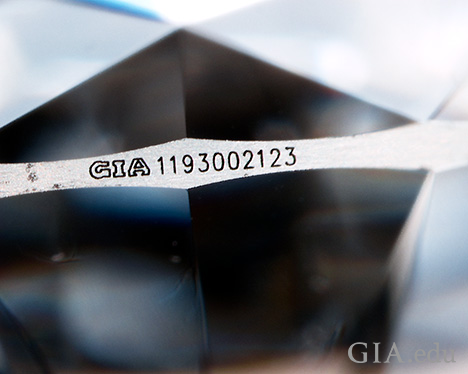
The round brilliant submitted (5.18–5.20 × 3.11 mm) had H-equivalent color grade, much lower than the D color of the diamond submitted in 2014 (5.07–5.09 × 3.15 mm). Its IF-equivalent clarity was better than the VVS1 clarity of the original stone, however. Only pinpoints and blemishes observable with greater than 10× magnification were found in this specimen. A GIA report number inscribed on the girdle was easily identified as a fake (figure 2). A minor difference in weight was also observed: an “increase” from 0.50335 ct to 0.51444 ct.
Infrared absorption spectroscopy identified the synthetic as type IIa and led to further spectroscopic testing. Photoluminescence (PL) spectroscopy was performed at liquid nitrogen temperature, and spectra were collected with various excitation wavelengths. A very strong SiV– doublet observed at 736.6 and 736.9 nm indicated a synthetic diamond. Under the short-wave UV radiation of the DiamondView, the sample showed green fluorescence but, interestingly, none of the obvious layered growth structures that CVD synthetics usually display. All gemological and spectroscopic features confirmed that the stone was CVD synthetic with post-growth HPHT annealing. This is another example of the importance of using a combination of tests and data to identify a stone. GIA’s laboratories continue to develop and implement various measures to identify possible fraud.