Tremolite and Diopside Bead with Unusual Texture and Color
In recent years, Buddhist prayer beads have become increasingly popular in Chinese jewelry. These beads are made into a variety of shapes from many kinds of gem materials.
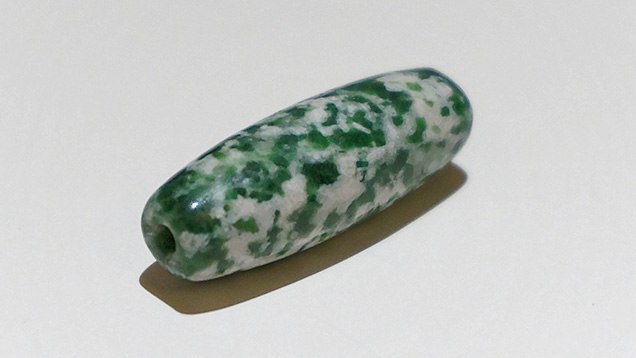
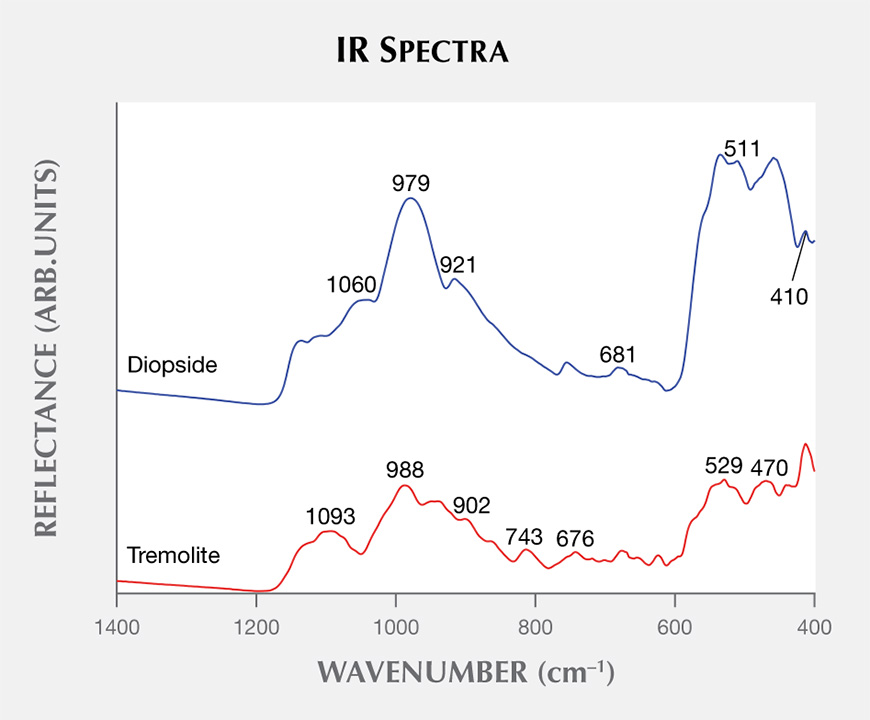
At the 2015 China International Jewelry Fair in Beijing, a barrel-shaped bead with unusual green and white color (figure 1) attracted our interest. The bead weighed 6.39 g and measured approximately 30.5 × 10.8 × 10.5 mm. The hydrostatic specific gravity (SG) was 3.05, but it was difficult to obtain individual spot RIs from the white and green areas. The entire sample was inert to both long-wave and short-wave UV. The infrared reflectance spectrum (figure 2) of the whitish mineral indicated tremolite, with characteristic peaks at 1093, 988, 902, 743, 676, 529, and 470 cm–1, while the greenish mineral’s spectrum matched that of diopside, with peaks at 1060, 979, 921, 681, 511, and 410 cm–1.
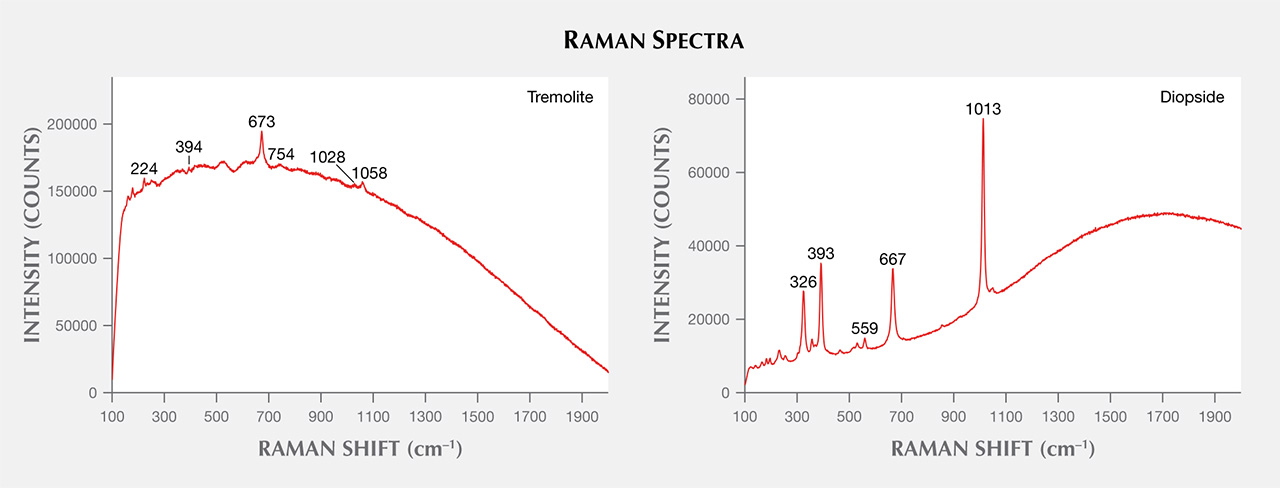
Raman spectra of the white and green areas (figure 3) were obtained using 785 and 532 nm laser excitation, respectively. Peaks at about 1058, 1028, 754, 673, 394, and 224 cm–1 indicated tremolite, while those at 1013, 667, 559, 393, and 326 cm–1 were consistent with diopside.
Tremolite and diopside are common gem materials in the jewelry trade. Both occur in nephrite, where tremolite is the main mineral and diopside is an accessory mineral. This was the first time we had encountered diopside rather than tremolite as the major mineral when both occurred within the same sample.