
Granulation, an ancient goldsmithing technique dating back nearly five millennia to Mesopotamia, involves the joining of tiny high-karat gold or other precious metal spheres (“granules”) to a metal base to create a decorative pattern (J. Wolters, “The ancient craft of granulation,” Gold Bulletin, Vol. 14, No. 3, 1981, pp. 119–129). These patterns can be very complex, and the granulation process is one that requires a high level of precision.
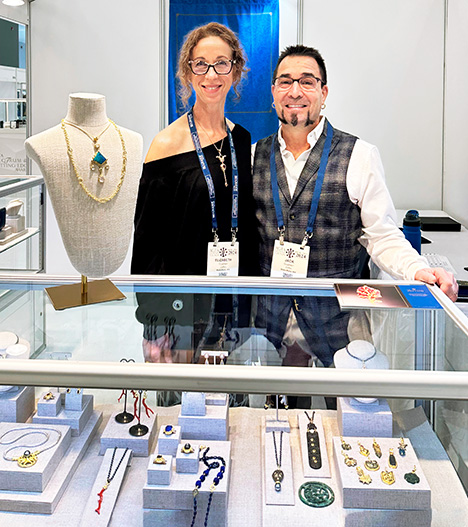
In the AGTA designer showroom, we spoke with Jack and Elizabeth Gualtieri of Zaffiro (Walla Walla, Washington; figure 1), who specialize in 22K gold granulation. They occasionally incorporate platinum as well. They find the granulation technique very rewarding and meditative, as it demands extraordinary focus.
The Gualtieris formed Zaffiro in 1996 in Portland, Oregon, after meeting at the University of Kansas several years earlier. Their focus on granulation was inspired by a seminar at the university and by Elizabeth’s study abroad in Florence. They chose the name “Zaffiro,” which translates to sapphire in Italian. The business was a part-time venture until they could dedicate themselves to it full-time starting in 2003. They have sold their pieces through galleries, retail shows, and private clients. In 2019, they moved to Walla Walla.
Jack and Elizabeth design and construct each piece from start to finish and consult with each other on their individual designs. They alloy their own 22K yellow, white, and rose gold and also create their own gold sheet, wire, and granulation balls. After clipping snippets of wire onto charcoal blocks, the blocks are heated to bead the metal into tiny balls of gold, which are then sorted by size through sieving. (See video below showing the process of making granulation balls).
Loading video player...
Granulation Process
The Gualtieris find inspiration in the stones they purchase, the natural world around them, and architecture. In fact, they sometimes have to negotiate over who will get to use a particular stone, as both artists may simultaneously envision designs for it.
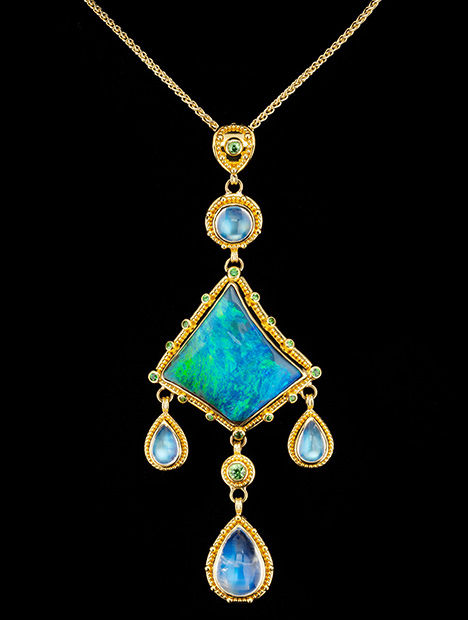
Jack’s opal, moonstone, and tsavorite garnet pendant design (figure 2) began with the Australian boulder opal. The moonstones inspired him to go larger with the design and add some movement to the piece. He said the use of green tsavorite garnet accent stones around the opal instead of blue stones was a riskier option but ultimately the right choice.
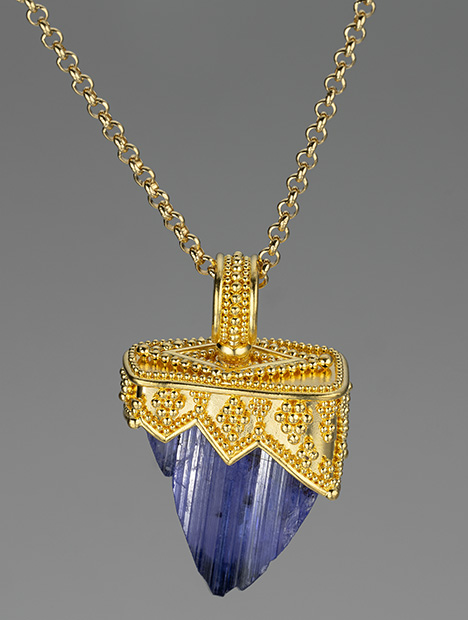
A heated rough tanzanite crystal inspired the pendant designed and built by Elizabeth in figure 3. This piece represents a signature style the Gualtieris describe as “talismans,” signifying the way in which collectors of the pieces connect with them. This jewelry collection features rough crystals or baroque pearls and represents some of Zaffiro’s most personal pieces. The intricate caps allow for a more expressive use of granulation and accent stones.
The fusion of this ancient technique with contemporary jewelry designs is a testament to the timelessness of granulation and its endless design possibilities.
Granulation, an ancient goldsmithing technique dating back nearly five millennia to Mesopotamia, involves the joining of tiny high-karat gold or other precious metal spheres (“granules”) to a metal base to create a decorative pattern (J. Wolters, “The ancient craft of granulation,” Gold Bulletin, Vol. 14, No. 3, 1981, pp. 119–129). These patterns can be very complex, and the granulation process is one that requires a high level of precision.
In the AGTA designer showroom, we spoke with Jack and Elizabeth Gualtieri of Zaffiro (Walla Walla, Washington; figure 1), who specialize in 22K gold granulation. They occasionally incorporate platinum as well. They find the granulation technique very rewarding and meditative, as it demands extraordinary focus.
The Gualtieris formed Zaffiro in 1996 in Portland, Oregon, after meeting at the University of Kansas several years earlier. Their focus on granulation was inspired by a seminar at the university and by Elizabeth’s study abroad in Florence. They chose the name “Zaffiro,” which translates to sapphire in Italian. The business was a part-time venture until they could dedicate themselves to it full-time starting in 2003. They have sold their pieces through galleries, retail shows, and private clients. In 2019, they moved to Walla Walla.
Jack and Elizabeth design and construct each piece from start to finish and consult with each other on their individual designs. They alloy their own 22K yellow, white, and rose gold and also create their own gold sheet, wire, and granulation balls. After clipping snippets of wire onto charcoal blocks, the blocks are heated to bead the metal into tiny balls of gold, which are then sorted by size through sieving. (See video below showing the process of making granulation balls).
Loading video player...
Granulation Process
The Gualtieris find inspiration in the stones they purchase, the natural world around them, and architecture. In fact, they sometimes have to negotiate over who will get to use a particular stone, as both artists may simultaneously envision designs for it.
Jack’s opal, moonstone, and tsavorite garnet pendant design (figure 2) began with the Australian boulder opal. The moonstones inspired him to go larger with the design and add some movement to the piece. He said the use of green tsavorite garnet accent stones around the opal instead of blue stones was a riskier option but ultimately the right choice.
A heated rough tanzanite crystal inspired the pendant designed and built by Elizabeth in figure 3. This piece represents a signature style the Gualtieris describe as “talismans,” signifying the way in which collectors of the pieces connect with them. This jewelry collection features rough crystals or baroque pearls and represents some of Zaffiro’s most personal pieces. The intricate caps allow for a more expressive use of granulation and accent stones.
The fusion of this ancient technique with contemporary jewelry designs is a testament to the timelessness of granulation and its endless design possibilities.