
An interesting iridescent pattern was recently observed in a blue sapphire. Gemological properties and inclusions indicated a natural sapphire, and the UV-Vis-NIR spectrum suggested basalt-related origin (e.g., A.A. Levinson and F.A. Cook, “Gem corundum in alkali basalt: Origin and occurrence,” Winter 1994 G&G, pp. 253–262). The characteristic inclusions of blue color concentrations surrounding exsolution particles of rutile and numerous partially dissolved needles provide evidence of heat treatment (J.I. Koivula, “Internal diffusion,” Journal of Gemmology, Vol. 20, No. 7/8, 1987, pp. 474–477).

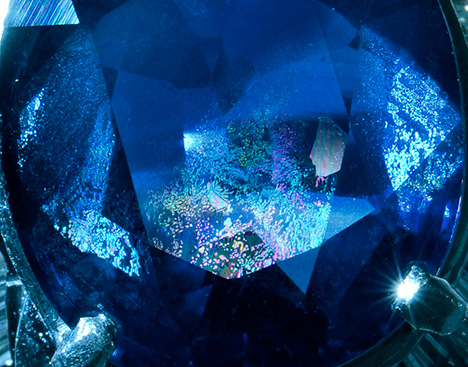
Notably, this sapphire included unique large partially healed fissures showing attractive iridescence (figure 1). Similar iridescent healed fissures in sapphires and rubies from basaltic deposits have been previously documented (e.g., E.J. Gübelin and J.I. Koivula, Photoatlas of Inclusions in Gemstones, Vol. 3, Opinio Verlag, Basel, Switzerland, 2008, pp. 110 and 216–220); however, the healed fissures in this sapphire were remarkably large and visible to the unaided eye (figure 1). The fissures nearly parallel to the table facet showed variously colored iridescence with dendritic patterns (figure 2). Trapped air in a cemented plane of a doublet can also show such patterns (see Spring 2019 Lab Notes, p. 92), but this stone has no assembly feature. These attractive iridescent colors, resembling the “play-of-color” of precious opal, result from thin-film interference. This is a unique visual effect created by internal features in heat-treated corundum.
Makoto Miura is a staff gemologist, and Yusuke Katsurada is a senior staff gemologist, at GIA in Tokyo.
An interesting iridescent pattern was recently observed in a blue sapphire. Gemological properties and inclusions indicated a natural sapphire, and the UV-Vis-NIR spectrum suggested basalt-related origin (e.g., A.A. Levinson and F.A. Cook, “Gem corundum in alkali basalt: Origin and occurrence,” Winter 1994 G&G, pp. 253–262). The characteristic inclusions of blue color concentrations surrounding exsolution particles of rutile and numerous partially dissolved needles provide evidence of heat treatment (J.I. Koivula, “Internal diffusion,” Journal of Gemmology, Vol. 20, No. 7/8, 1987, pp. 474–477).
Notably, this sapphire included unique large partially healed fissures showing attractive iridescence (figure 1). Similar iridescent healed fissures in sapphires and rubies from basaltic deposits have been previously documented (e.g., E.J. Gübelin and J.I. Koivula, Photoatlas of Inclusions in Gemstones, Vol. 3, Opinio Verlag, Basel, Switzerland, 2008, pp. 110 and 216–220); however, the healed fissures in this sapphire were remarkably large and visible to the unaided eye (figure 1). The fissures nearly parallel to the table facet showed variously colored iridescence with dendritic patterns (figure 2). Trapped air in a cemented plane of a doublet can also show such patterns (see Spring 2019 Lab Notes, p. 92), but this stone has no assembly feature. These attractive iridescent colors, resembling the “play-of-color” of precious opal, result from thin-film interference. This is a unique visual effect created by internal features in heat-treated corundum.
Makoto Miura is a staff gemologist, and Yusuke Katsurada is a senior staff gemologist, at GIA in Tokyo.