Accredited Gemologists Association (AGA) Conference
The AGA conference, held February 6 in Tucson, was attended by 138 participants from 11 countries. The program was diverse and engaging, as evidenced by the audience questions after each presentation. During the break, participants were invited to a hands-on demonstration of traditional gemological and advanced spectroscopy equipment.
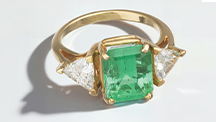
The first talk was by Jeffery Bergman of Primagem, who detailed the mine-to-market effort for emeralds from the Shakiso mine in southern Ethiopia. He described some of the material as similar to Muzo’s in color, and some as having a “Paraíba-like glow.” To ensure that the finest material can receive grades of “no clarity enhancement,” mineral oil is never used on the rough. For material that warrants clarity enhancement, only high-grade cedarwood oil is used. A variety of inclusions have been identified, most commonly biotite mica. Other inclusions are growth tubes, blocky two- and three-phase inclusions, horsetails, dendritic magnesium oxide, chromite, and tourmaline. Color zoning in this material can be very strong.
Gina Latendresse of the American Pearl Company gave a fascinating overview of natural pearls from the Western Hemisphere. She described the vast quantities collected by Native Americans from the coast of Venezuela that made their way to Spain in the 1500s, establishing the New World as a source. She then covered the pearl rush between 1850 and 1900 in New Jersey and the Tennessee Valley following the discovery of many impressive specimens. David Howell found the largest American freshwater pearl, 400 grains (100 ct) in size, in New Jersey in 1857. Shortly after, an attractive 93 grain (13 ct) pink pearl was found nearby and sold to Charles Tiffany. Unable to find a U.S. customer, he sold it to Empress Eugénie, resulting in the name “Queen Pearl.” By 1901, the lakes and rivers in the Tennessee Valley had developed pearl fisheries, with production peaking in 1904. Latendresse introduced U.S. natural pearls of many shapes and colors originating from a variety of mollusk species.
Claudio Milisenda presented an overview of tourmaline, including Idar-Oberstein’s efforts to promote the material, localities, and the roles of chemistry and heat treatment in tourmaline color. He walked the audience through the varieties verdalite, indicolite, chrome tourmaline, rubellite, red tourmaline, canary tourmaline, and Paraíba tourmaline. The talk also reviewed various tourmaline treatments and imitations encountered today.
To complement the Gübelin Gem Lab’s launch of “Provenance Proof Blockchain” by Gübelin Labs at Tucson this year, managing director Daniel Nyfeler gave a presentation on the traceability of gemstones. The talk addressed the lack of transparency in the gemstone supply chain and Gübelin’s solutions for this issue. Reasons cited for the lack of transparency included the mines’ remoteness and restricted access, the informal nature of mining, frequent changes of custody, trading based on relationships and trust, a complex and fragmented value chain, and the lack of an established method for traceability. The problems arising from this lack of transparency include unreliable information provided to consumers (gem labs try to fill this gap with provenance determination), the dilemma for ethically conscious consumers—particularly millennials—who are willing to pay for sustainably sourced products, and the lack of independent audits within the industry. Stakeholders who would benefit from greater transparency are governments (for legal and tax purposes), insurance agencies, financial institutions, and consumers.
Two solutions that would work in tandem were presented: a physical tracer embedded in the stone at the mine, and a digital tracker. The physical tracer would involve Gübelin embedding 100 nm silica spheres that hold synthetic DNA programmed to include information such as the mine location. These permanently implanted spheres, which require openings of at least 400 nm, are designed to survive all cutting and cleaning processes. Gübelin would have the ability to later extract the DNA, sequence it, and verify the stone’s origin. This tracer is designed for emerald, and the present design would not survive the more physically punishing corundum processing. The digital tracker, meanwhile, would allow a stone to be tagged all the way back to the mine using blockchain so that each time the stone changed hands, a logbook entry would be made, allowing for permanent storage of encrypted information at each step of the journey from mine to market. The Provenance Proof Blockchain system was released February 8 at the AGTA show. It is free and open to the industry for all gemstone types. The benefits touted for this tracking included new avenues of storytelling for retailers, reduced costs as gem reports would not be needed, and less inflated prices as non-value transactions would be eliminated. And with the ability to audit the supply chain, more aspects of the business could be properly insured. Following the presentation, a spirited question-and-answer session touched on privacy for dealers and consumers, the impact on artisanal miners, the logistics of implanting the encapsulated DNA, and resistance from gem dealers over security concerns.
The last scheduled talk, an overview of the new FTC rules, was canceled due to the recent U.S. government shutdown. A substitute talk graciously given by Jon Phillips (Corona Jewellery Company, Ltd.) covered Canadian diamonds. He noted Canada’s place as the world’s second-leading producer of diamonds and reported on the significant mines, the types of material coming from them, and notable stones found. The Ekati mine has both surface and underground components, and has produced numerous vivid and intense yellows as well as pinks and colorless. Within the mine, 53-million-year-old wood that had been perfectly preserved in the oxygen-free environment was found and brought to the surface. The Renard mine was plagued by the hardness of the kimberlite, making diamond separation extremely difficult. De Beers is showcasing its “Future Smart” mining process with the Chidliak project in Nunavut, Baffin Island, where there are no roads, environmental impact is minimal, and power is supplied by wind energy. Notable stones from the Diavik mine include the 177.71 ct Vega, the 24.82 ct Capella, the Fancy Vivid yellow 30.54 ct Arctic Sun, and a recently discovered 552.74 ct yellow diamond that is likely the largest diamond ever found in North America.
Following the conference, the AGA presented its 20th annual Bonanno Awards. For the first time, three categories were recognized in the same year: education, gemological instrumentation, and gemological research. The award for gemological education went to Donna Hawrelko, a gemology and jewelry educator at Vancouver Community College. Hawrelko’s 27 years of teaching has touched thousands of individuals, and she was key in developing the educational program offered by the Canadian Gemmological Association. The award for gemological instrumentation was given to the cofounders of Magilabs, Alberto Scarani and Mikko Aström. Scarani and Aström have made advanced spectroscopy accessible and affordable to a wide range of gemologists by developing portable tools such as the GemmoRaman system. These allow appraisers and gemologists access to technology that was recently available only through major laboratories. The award for gemological research went to Karl Schmetzer, a renowned researcher and author, for his more than 50 years of gemological and mineralogical work documented in over 400 publications, two books, and 12 new mineral discoveries. Dr. Schmetzer has shared his research with the community and strived to improve professional standards in the industry through work with CIBJO and other organizations.