
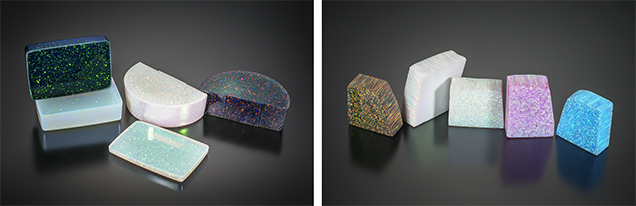
Recently, the Carlsbad laboratory examined an interesting new gem material manufactured by the Japanese company Kyocera that displayed a play-of-color phenomenon. In the trade, this material may be sold as an “opal-like product,” because of the play-of-color phenomenon observed (figure 1, left).
Standard gemological testing revealed a hydrostatic specific gravity (SG) of 1.35. The refractive index (RI) was measured as 1.49. According to GIA, an imitation is defined as a natural or manmade material that mimics the appearance of, and is used as a substitute for, another gem material. Likewise, a synthetic gem is defined by GIA as a laboratory-grown gem material with virtually the same chemical and physical properties as a natural gem. Because the gemological properties for this new material are out of range for natural opal (SG of 2.00 and RI between 1.37 and 1.47), it is best described as an imitation opal.
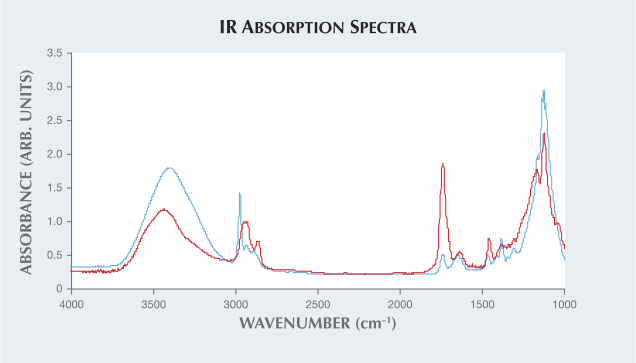
Further testing revealed that this material readily burns with a hot point and produces a strong acrid odor indicating that a significant amount of plastic is present. Additionally, advanced testing using energy-dispersive X-ray fluorescence (EDXRF) spectroscopy revealed the presence of silicon. Fourier-transform infrared (FTIR) testing revealed a spectrum that was quite similar to traditional polymer-impregnated synthetic opal (figure 1, right) except for a polymer peak that was nearly five times as strong (figure 2). These tests indicate that this material is composed of both plastic resin and silicon. When exposed to ultraviolet light, samples with a white bodycolor fluoresced a weak blue to short-wave and medium blue to long-wave UV. Samples with a black bodycolor fluoresced a weak orange to short-wave UV and were inert to long-wave UV.
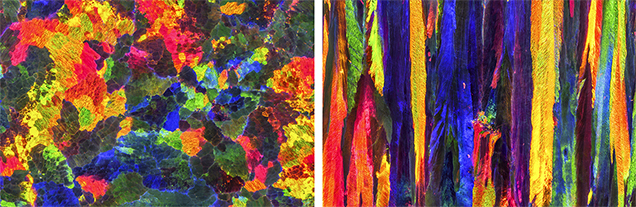
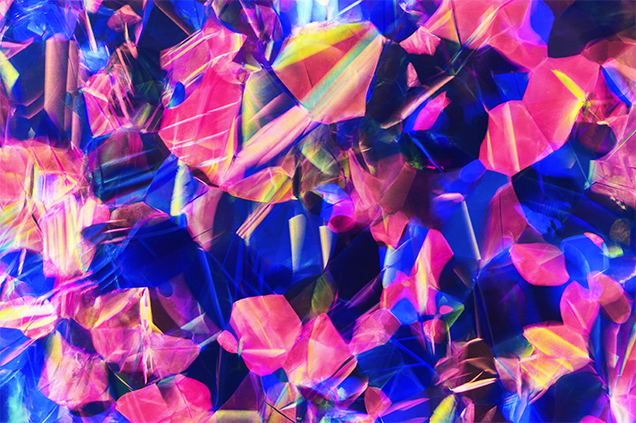
Microscopic examination revealed some interesting features. The pattern in the play-of-color was random and unlike traditional synthetic opal did not display any “snakeskin” or “chicken wire” pattern (figure 3, left), but instead showed colored polygonal patches about 2 mm in size uniformly distributed throughout (figure 4). Nor did the plastic imitation opal display the columnar structure one would expect to see in synthetic opal (figure 3, right).
Visually, this new material is a very good imitation of natural opal. Gemologically, it is easy to separate from natural opal due to the comparatively high refractive index and low specific gravity. There are other possible decorative applications for this plastic opal imitation material due to the large sizes that can be produced. This attractive material is a welcome addition to the gem trade and is easy to separate from natural opal with standard gemological testing.
Recently, the Carlsbad laboratory examined an interesting new gem material manufactured by the Japanese company Kyocera that displayed a play-of-color phenomenon. In the trade, this material may be sold as an “opal-like product,” because of the play-of-color phenomenon observed (figure 1, left).
Standard gemological testing revealed a hydrostatic specific gravity (SG) of 1.35. The refractive index (RI) was measured as 1.49. According to GIA, an imitation is defined as a natural or manmade material that mimics the appearance of, and is used as a substitute for, another gem material. Likewise, a synthetic gem is defined by GIA as a laboratory-grown gem material with virtually the same chemical and physical properties as a natural gem. Because the gemological properties for this new material are out of range for natural opal (SG of 2.00 and RI between 1.37 and 1.47), it is best described as an imitation opal.
Further testing revealed that this material readily burns with a hot point and produces a strong acrid odor indicating that a significant amount of plastic is present. Additionally, advanced testing using energy-dispersive X-ray fluorescence (EDXRF) spectroscopy revealed the presence of silicon. Fourier-transform infrared (FTIR) testing revealed a spectrum that was quite similar to traditional polymer-impregnated synthetic opal (figure 1, right) except for a polymer peak that was nearly five times as strong (figure 2). These tests indicate that this material is composed of both plastic resin and silicon. When exposed to ultraviolet light, samples with a white bodycolor fluoresced a weak blue to short-wave and medium blue to long-wave UV. Samples with a black bodycolor fluoresced a weak orange to short-wave UV and were inert to long-wave UV.
Microscopic examination revealed some interesting features. The pattern in the play-of-color was random and unlike traditional synthetic opal did not display any “snakeskin” or “chicken wire” pattern (figure 3, left), but instead showed colored polygonal patches about 2 mm in size uniformly distributed throughout (figure 4). Nor did the plastic imitation opal display the columnar structure one would expect to see in synthetic opal (figure 3, right).
Visually, this new material is a very good imitation of natural opal. Gemologically, it is easy to separate from natural opal due to the comparatively high refractive index and low specific gravity. There are other possible decorative applications for this plastic opal imitation material due to the large sizes that can be produced. This attractive material is a welcome addition to the gem trade and is easy to separate from natural opal with standard gemological testing.