
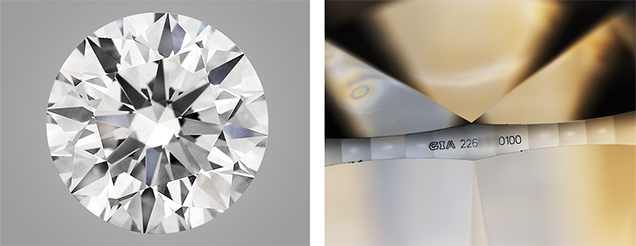
The Hong Kong lab recently encountered another instance of fraud: A natural but HPHT-treated round brilliant diamond (above left) weighing more than 6 carats submitted for verification service was found to be inconsistent with the claimed GIA report issued a few months prior for an untreated diamond. Moreover, the GIA report number and another inscription on the girdle, both supposedly laser-inscribed by GIA (above right), looked convincing but were also found to be fraudulent.
The HPHT-processed round brilliant was believed to have been carefully selected to match the original diamond—its color grade (F) matched, and only minor differences were observed in carat weight and measurements. The HPHT-processed diamond weighed 6.30402 ct and measured 11.73–11.82 × 7.32 mm, whereas the original one weighed slightly less (6.30216 ct), and measured 11.72–11.83 × 7.32 mm. Furthermore, the IF clarity of the HPHT-treated stone was an improvement over the VVS1 clarity of the natural stone.
Despite all the efforts put into those convincing features and measurements, spectroscopic testing easily revealed the stone’s true identity. Infrared absorption spectroscopy showed the HPHT-processed diamond was type IIa, but the original diamond was type Ia. Photoluminescence (PL) spectra were collected at liquid nitrogen temperature with various excitation wavelengths. The slight reversal in the ratio between the 575 and 637 nm peaks (NV centers), together with other spectroscopic features, confirmed the stone had gone through an HPHT treatment process for color improvement. A strain pattern observed under cross-polarized light ruled out the possibility of a synthetic diamond.
This case should raise awareness among the industry and the public that, although rarely encountered in larger stones, this kind of fraud does exist. Verification services at GIA confirm that an item is exactly the same as the one described on a previous report and has not been recut or treated—or, as in this case, replaced with a similar-looking stone. This provides a simple way to check for any type of fraudulent activity if there is doubt about the origin of a diamond.
Billie Law is a diamond grader at GIA in Hong Kong .
The Hong Kong lab recently encountered another instance of fraud: A natural but HPHT-treated round brilliant diamond (above left) weighing more than 6 carats submitted for verification service was found to be inconsistent with the claimed GIA report issued a few months prior for an untreated diamond. Moreover, the GIA report number and another inscription on the girdle, both supposedly laser-inscribed by GIA (above right), looked convincing but were also found to be fraudulent.
The HPHT-processed round brilliant was believed to have been carefully selected to match the original diamond—its color grade (F) matched, and only minor differences were observed in carat weight and measurements. The HPHT-processed diamond weighed 6.30402 ct and measured 11.73–11.82 × 7.32 mm, whereas the original one weighed slightly less (6.30216 ct), and measured 11.72–11.83 × 7.32 mm. Furthermore, the IF clarity of the HPHT-treated stone was an improvement over the VVS1 clarity of the natural stone.
Despite all the efforts put into those convincing features and measurements, spectroscopic testing easily revealed the stone’s true identity. Infrared absorption spectroscopy showed the HPHT-processed diamond was type IIa, but the original diamond was type Ia. Photoluminescence (PL) spectra were collected at liquid nitrogen temperature with various excitation wavelengths. The slight reversal in the ratio between the 575 and 637 nm peaks (NV centers), together with other spectroscopic features, confirmed the stone had gone through an HPHT treatment process for color improvement. A strain pattern observed under cross-polarized light ruled out the possibility of a synthetic diamond.
This case should raise awareness among the industry and the public that, although rarely encountered in larger stones, this kind of fraud does exist. Verification services at GIA confirm that an item is exactly the same as the one described on a previous report and has not been recut or treated—or, as in this case, replaced with a similar-looking stone. This provides a simple way to check for any type of fraudulent activity if there is doubt about the origin of a diamond.
Billie Law is a diamond grader at GIA in Hong Kong .