
GIA’s Bangkok laboratory recently received an 8.63 ct purplish red marquise double cabochon. The stone showed gemological properties consistent with ruby: a spot refractive index of 1.770 and a characteristic ruby spectrum using a handheld spectroscope. It was semitransparent and contained altered growth tubes, multiple fractures with flux residues, and some fractures with trapped flattened gas bubbles and areas of filled cavities. X-ray fluorescence revealed significant amounts of lead, mostly along fractures and filled cavities.
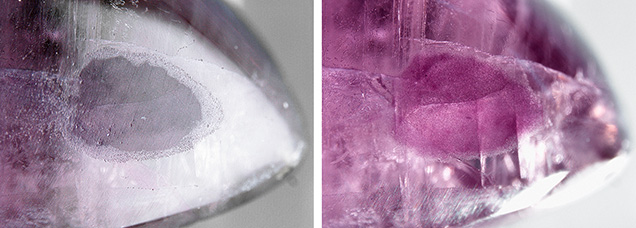
The author observed an unusual area of granular texture lining the filled cavity (areas of lower luster) (see above). This granular texture was caused by a reaction layer of synthetic overgrowth where surfaces were melted and recrystallized. This pattern can be found in any high-temperature heat-treated corundum. Synthetic overgrowth at the surface of a stone can sometimes be removed by repolishing.
Sudarat Saeseaw is senior manager of colored stone identification at GIA in Bangkok.
GIA’s Bangkok laboratory recently received an 8.63 ct purplish red marquise double cabochon. The stone showed gemological properties consistent with ruby: a spot refractive index of 1.770 and a characteristic ruby spectrum using a handheld spectroscope. It was semitransparent and contained altered growth tubes, multiple fractures with flux residues, and some fractures with trapped flattened gas bubbles and areas of filled cavities. X-ray fluorescence revealed significant amounts of lead, mostly along fractures and filled cavities.
The author observed an unusual area of granular texture lining the filled cavity (areas of lower luster) (see above). This granular texture was caused by a reaction layer of synthetic overgrowth where surfaces were melted and recrystallized. This pattern can be found in any high-temperature heat-treated corundum. Synthetic overgrowth at the surface of a stone can sometimes be removed by repolishing.
Sudarat Saeseaw is senior manager of colored stone identification at GIA in Bangkok.