

Recently, the Mumbai laboratory received a lot consisting of 101 variously shaped, white to cream saltwater nacreous loose pearls for identification services. When exposed to X-ray fluorescence (XRF), the pearls showed an inert to weak yellowish green reaction. Energy-dispersive X-ray fluorescence confirmed the saltwater origin of these pearls; however, an unusually high concentration of strontium was detected on the surface, which will be the subject of a separate study.
Real-time X-ray microradiography (RTX) imaging showed typical non-bead cultured pearl structures, mostly with central dense cores surrounded by concentric growth rings and associated light gray calcium carbonate (CaCO3) “seed” features, elongated linear structures, and sizeable spindle-shaped voids (A. Homkrajae et al., “Internal structures of known Pinctada maxima pearls: Cultured pearls from operated marine mollusks,” Fall 2021 G&G, pp. 186–205). Some of the pearls contained multiple nuclei that showed varied combinations of multicore structures. One of these was a light cream near-oval pearl weighing 1.69 ct and measuring 6.83 × 5.34 mm that exhibited a bumpy cluster-like formation (figure 1). Under long-wave ultraviolet radiation, the pearl displayed a moderate yellowish green reaction typical of white pearls from the Pinctada species.
The pearl showed an inert reaction when subjected to XRF, consistent with others in the group and characteristic of a saltwater environment. Raman spectroscopy using 514 nm laser excitation detected a doublet at 701 and 704 cm–1, along with a main peak at 1086 cm–1, indicating the presence of aragonite.
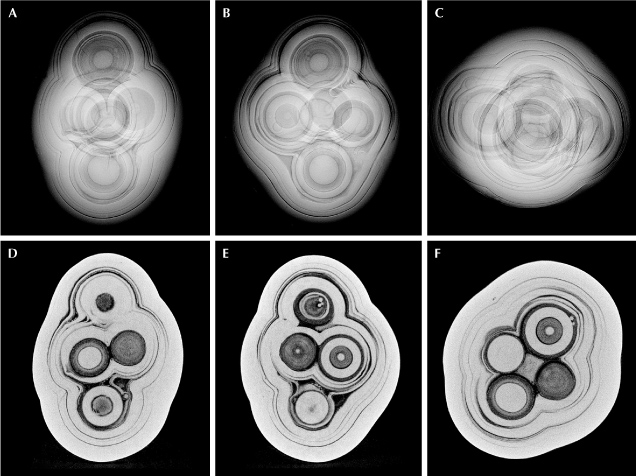
RTX imaging in three directions revealed a complex interconnected structure within the pearl, and several cores of varying sizes and radiopacities overlapped, making it difficult to count the number of cores (figure 2, A–C). X-ray computed microtomography (μ-CT) analysis displayed the structure more clearly, showing a total of six medium to large light gray dense cores engulfed by distinct conchiolin-rich layers (figure 2, D–F). Four cores exhibited prominent light gray calcium carbonate “seed” features in the organic-rich concentric growth rings. Such features are commonly observed in non-bead cultured pearls from the Pinctada maxima species (Homkrajae et al., 2021). Notably, two of the cores were encircled by thick alternating concentric growth rings with radiopacities of lighter and darker shades of gray. All the cores were surrounded by growth layers conforming to the pearl’s shape, and the “seed” features were also observed in between the layers, as shown in the video below.
Loading video player...
μ-CT of a Multicore NBC Pearl
Considering its external appearance, internal structure, and saltwater environment, the pearl was classified as a non-bead cultured pearl from the Pinctada maxima species.
Both natural and cultured pearls commonly exhibit multiple nuclei structures. Most natural pearls with multiple nuclei contain internal growth arc structures, and multicores of significant size inside the organic-rich concentric structures are generally related to non-bead cultured pearls. However, it is rare to encounter pearls with more than a couple of cores, making this pearl unique and noteworthy. Ongoing research is currently being conducted to further study the unusual chemistry readings recorded in the lot of pearls received.
Roxane Bhot Jain is manager of pearl, melee, and AGSI technical and market development, and Karan Rajguru is an analytics technician, at GIA in Mumbai. Abeer Al-Alawi is a consultant to GIA. Chunhui Zhou is senior manager of pearl identification at GIA in New York.
Recently, the Mumbai laboratory received a lot consisting of 101 variously shaped, white to cream saltwater nacreous loose pearls for identification services. When exposed to X-ray fluorescence (XRF), the pearls showed an inert to weak yellowish green reaction. Energy-dispersive X-ray fluorescence confirmed the saltwater origin of these pearls; however, an unusually high concentration of strontium was detected on the surface, which will be the subject of a separate study.
Real-time X-ray microradiography (RTX) imaging showed typical non-bead cultured pearl structures, mostly with central dense cores surrounded by concentric growth rings and associated light gray calcium carbonate (CaCO3) “seed” features, elongated linear structures, and sizeable spindle-shaped voids (A. Homkrajae et al., “Internal structures of known Pinctada maxima pearls: Cultured pearls from operated marine mollusks,” Fall 2021 G&G, pp. 186–205). Some of the pearls contained multiple nuclei that showed varied combinations of multicore structures. One of these was a light cream near-oval pearl weighing 1.69 ct and measuring 6.83 × 5.34 mm that exhibited a bumpy cluster-like formation (figure 1). Under long-wave ultraviolet radiation, the pearl displayed a moderate yellowish green reaction typical of white pearls from the Pinctada species.
The pearl showed an inert reaction when subjected to XRF, consistent with others in the group and characteristic of a saltwater environment. Raman spectroscopy using 514 nm laser excitation detected a doublet at 701 and 704 cm–1, along with a main peak at 1086 cm–1, indicating the presence of aragonite.
RTX imaging in three directions revealed a complex interconnected structure within the pearl, and several cores of varying sizes and radiopacities overlapped, making it difficult to count the number of cores (figure 2, A–C). X-ray computed microtomography (μ-CT) analysis displayed the structure more clearly, showing a total of six medium to large light gray dense cores engulfed by distinct conchiolin-rich layers (figure 2, D–F). Four cores exhibited prominent light gray calcium carbonate “seed” features in the organic-rich concentric growth rings. Such features are commonly observed in non-bead cultured pearls from the Pinctada maxima species (Homkrajae et al., 2021). Notably, two of the cores were encircled by thick alternating concentric growth rings with radiopacities of lighter and darker shades of gray. All the cores were surrounded by growth layers conforming to the pearl’s shape, and the “seed” features were also observed in between the layers, as shown in the video below.
Loading video player...
μ-CT of a Multicore NBC Pearl
Considering its external appearance, internal structure, and saltwater environment, the pearl was classified as a non-bead cultured pearl from the Pinctada maxima species.
Both natural and cultured pearls commonly exhibit multiple nuclei structures. Most natural pearls with multiple nuclei contain internal growth arc structures, and multicores of significant size inside the organic-rich concentric structures are generally related to non-bead cultured pearls. However, it is rare to encounter pearls with more than a couple of cores, making this pearl unique and noteworthy. Ongoing research is currently being conducted to further study the unusual chemistry readings recorded in the lot of pearls received.
Roxane Bhot Jain is manager of pearl, melee, and AGSI technical and market development, and Karan Rajguru is an analytics technician, at GIA in Mumbai. Abeer Al-Alawi is a consultant to GIA. Chunhui Zhou is senior manager of pearl identification at GIA in New York.