

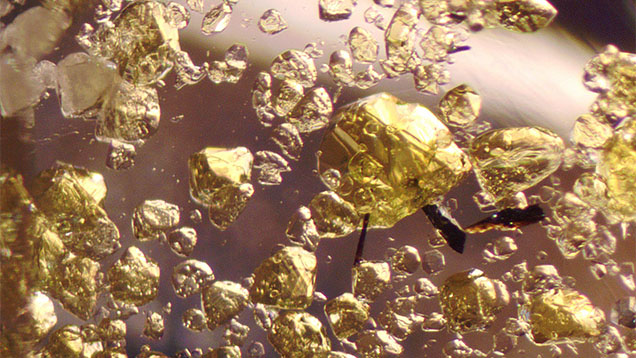
A group of remarkable bright yellow inclusions in a partially polished 2.43 ct orangy pink morganite from Madagascar (figure 1) recently caught our attention. The beryl was identified by a combination of classical gemology and spectroscopy. The partial hexagonal prism contained hundreds of yellow crystals aligned on a plane. Although it was difficult to evaluate their complex polyhedral morphology, many had triangular faces (figure 2). Using reflected light, several of the crystals were found to reach the surface of a polished face. In addition, a few very dark brown, somewhat elongated crystals were observed in the same plane.
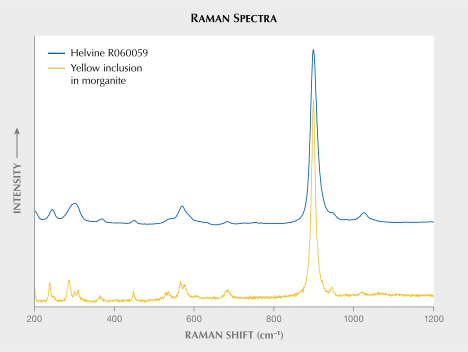
Raman spectra were obtained with a Jobin Yvon T6400 Raman spectrometer, with diode-pumped solid-state (DPSS) laser excitation at 458 and 561 nm, at 2 cm−1 resolution. Three major peaks at about 130, 180, and 890 cm−1 and smaller matching features were observed. These were identified as helvine using the RRUFF database (Lafuente et al., 2015, https://rruff.info/about/downloads/HMC1-30.pdf) and CrystalSleuth software (figure 3). Similar spectra were obtained on three different surface-reaching inclusions using both excitation wavelengths. The dark crystals were identified as hubnerite, Mn2+(WO4), also through Raman spectroscopy using the same software, with a dominant band around 882 cm−1.
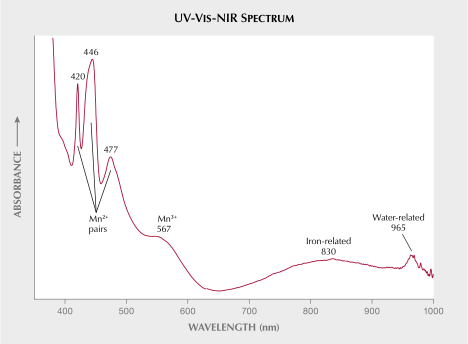
Because of the very bright color of the yellow inclusions, we attempted to detect their absorption with a visible absorption spectrum. Ultraviolet/visible/near-infrared (UV-Vis-NIR) spectra were acquired over 365–1000 nm using a mobile instrument with an integrating sphere (Magilabs GemmoSphere), with 0.1 seconds acquisition time, 50 accumulations, and spectral resolution of about 1.5 nm. The spectrum presents strong, relatively sharp absorption features at about 420, 446, and 477 nm, with broader bands at about 567 and 830 nm (figure 4). The absorptions at 420, 446, and 477 nm match those for the helvine-genthelvite series documented previously (U. Hålenius, “Absorption of light by exchange coupled pairs of tetrahedrally coordinated divalent manganese in the helvite-genthelvite solid solution,” Periodico di Mineralogia, Vol. 80, No. 1, 2011, pp. 105–111). Their strong violet and blue absorption induced the vivid yellow color. The features at about 567 nm (Mn3+), 830 nm (iron-related), and 965 nm (water-related) come from the beryl matrix (D.L. Wood and K. Nassau, “The characterization of beryl by visible and infrared absorption spectroscopy,” American Mineralogist, Vol. 53, No. 5-6, pp. 777–800).
Helvine is a cubic beryllosilicate with the chemical formula Be3Mn2+4(SiO4)3S. It belongs to the helvine group of minerals, where divalent manganese can be replaced by divalent iron or zinc. Its intrinsic saturated yellow color (the name comes from the Latin helvus, for “yellow”) is due to exchange-coupled pairs of tetrahedrally coordinated Mn2+ ions (Hålenius, 2011). This explains why the color remained strong even with a short optical path in the inclusions. Helvine crystals are usually tetrahedral, thus with only triangular faces, which is consistent with the preliminary visual observations. Yet the morphology was quite different from what is recorded in the Mindat database (https://www.mindat.org/min-40167.html), probably because these inclusions can be considered microcrystals. Small crystals often show fast-growing faces that are absent from larger ones (I. Sunagawa, Crystals: Growth, Morphology and Perfection, 2005, Cambridge University Press, Cambridge, UK). Helvine is known to occur in highly complex pegmatites, hence its association with beryl in the present specimen. Hubnerite may sometimes grow within pegmatites as well. Note that helvine and morganite beryl are beryllium-containing. Together with hubnerite, they accommodate manganese (as the coloring agent for morganite). The plane containing these unusual inclusions probably represents a manganese-rich growth spurt, also with tungsten and sulfur.
A group of remarkable bright yellow inclusions in a partially polished 2.43 ct orangy pink morganite from Madagascar (figure 1) recently caught our attention. The beryl was identified by a combination of classical gemology and spectroscopy. The partial hexagonal prism contained hundreds of yellow crystals aligned on a plane. Although it was difficult to evaluate their complex polyhedral morphology, many had triangular faces (figure 2). Using reflected light, several of the crystals were found to reach the surface of a polished face. In addition, a few very dark brown, somewhat elongated crystals were observed in the same plane.
Raman spectra were obtained with a Jobin Yvon T6400 Raman spectrometer, with diode-pumped solid-state (DPSS) laser excitation at 458 and 561 nm, at 2 cm−1 resolution. Three major peaks at about 130, 180, and 890 cm−1 and smaller matching features were observed. These were identified as helvine using the RRUFF database (Lafuente et al., 2015, https://rruff.info/about/downloads/HMC1-30.pdf) and CrystalSleuth software (figure 3). Similar spectra were obtained on three different surface-reaching inclusions using both excitation wavelengths. The dark crystals were identified as hubnerite, Mn2+(WO4), also through Raman spectroscopy using the same software, with a dominant band around 882 cm−1.
Because of the very bright color of the yellow inclusions, we attempted to detect their absorption with a visible absorption spectrum. Ultraviolet/visible/near-infrared (UV-Vis-NIR) spectra were acquired over 365–1000 nm using a mobile instrument with an integrating sphere (Magilabs GemmoSphere), with 0.1 seconds acquisition time, 50 accumulations, and spectral resolution of about 1.5 nm. The spectrum presents strong, relatively sharp absorption features at about 420, 446, and 477 nm, with broader bands at about 567 and 830 nm (figure 4). The absorptions at 420, 446, and 477 nm match those for the helvine-genthelvite series documented previously (U. Hålenius, “Absorption of light by exchange coupled pairs of tetrahedrally coordinated divalent manganese in the helvite-genthelvite solid solution,” Periodico di Mineralogia, Vol. 80, No. 1, 2011, pp. 105–111). Their strong violet and blue absorption induced the vivid yellow color. The features at about 567 nm (Mn3+), 830 nm (iron-related), and 965 nm (water-related) come from the beryl matrix (D.L. Wood and K. Nassau, “The characterization of beryl by visible and infrared absorption spectroscopy,” American Mineralogist, Vol. 53, No. 5-6, pp. 777–800).
Helvine is a cubic beryllosilicate with the chemical formula Be3Mn2+4(SiO4)3S. It belongs to the helvine group of minerals, where divalent manganese can be replaced by divalent iron or zinc. Its intrinsic saturated yellow color (the name comes from the Latin helvus, for “yellow”) is due to exchange-coupled pairs of tetrahedrally coordinated Mn2+ ions (Hålenius, 2011). This explains why the color remained strong even with a short optical path in the inclusions. Helvine crystals are usually tetrahedral, thus with only triangular faces, which is consistent with the preliminary visual observations. Yet the morphology was quite different from what is recorded in the Mindat database (https://www.mindat.org/min-40167.html), probably because these inclusions can be considered microcrystals. Small crystals often show fast-growing faces that are absent from larger ones (I. Sunagawa, Crystals: Growth, Morphology and Perfection, 2005, Cambridge University Press, Cambridge, UK). Helvine is known to occur in highly complex pegmatites, hence its association with beryl in the present specimen. Hubnerite may sometimes grow within pegmatites as well. Note that helvine and morganite beryl are beryllium-containing. Together with hubnerite, they accommodate manganese (as the coloring agent for morganite). The plane containing these unusual inclusions probably represents a manganese-rich growth spurt, also with tungsten and sulfur.