

Rubies with intense color and high transparency, such as those from the Mogok mining district in Myanmar, form in metamorphosed carbonate platforms during the retrograde metamorphism stage. This occurs at temperatures of ~620°–670°C and pressures of ~2.6–3.3 kbar (V. Garnier et al., “Marble-hosted ruby deposits from central and southeast Asia: Towards a new genetic model,” Ore Geology Reviews, Vol. 34, 2008, pp. 169–191). The protolith comprises carbonates enriched in detrital Fe-Cr-V-bearing clays, shales with organic matter, and intercalated evaporitic layers.
Previous studies of primary fluid inclusions trapped by ruby at Mogok (G. Giuliani et al., “Fluid inclusions in ruby from Asian marble deposits: Genetic implications,” European Journal of Mineralogy, Vol. 27, 2015, pp. 393–404) indicated the contemporary trapping of two carbonic immiscible fluid inclusions: mono- to two-phase fluid inclusions in the CO2-H2S ± COS ± S8 ± H2O system and multi-solid carbonic fluid inclusions in the Na-K-Ca-CO3-SO4-NO3-Cl-F-(CO2-H2S) system. The multiple solids are mainly mixtures of Na-Ca-Al-carbonates (such as shortite and dawsonite), sulfates, phosphates, nitrates, fluorides, and chlorides (such as halite). They are the trapped recrystallized residues of molten salts formed during the metamorphism of evaporitic lenses (chlorides and sulfates) intercalated in the carbonate-shale rocks. The carbon dioxide is released by devolatilization of the original limestones during metamorphism. H2S originated from the partial or total dissolution of evaporites and subsequent sulfate reduction by organic carbon, which produced graphite and pyrite. The formation of pyrite sequestered iron and led to the formation of iron-poor ruby.
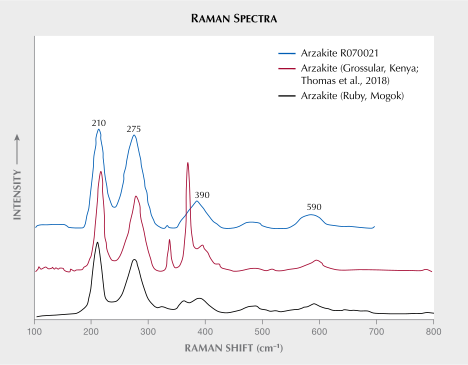
In 2018, American Gemological Laboratories examined a 33.98 ct freeform carved ruby cabochon from Mogok measuring 24.08 × 18.48 × 8.30 mm (figure 1, left). The medium-quality, semitransparent to translucent stone was heavily included with numerous small cavities and whitish fillers on the base (figure 1, right). Energy-dispersive X-ray fluorescence analysis (in wt.% oxide) revealed low trace concentrations of gallium (0.004), iron (0.020), and titanium (0.026), with higher vanadium (0.071) and chromium (0.607). A large and highly reflective, soft yellowish syngenetic inclusion, measuring about 0.5 × 0.2 mm, was evident on the base (figure 1, right). Raman analysis of the inclusion, taken with 514 nm laser excitation, gave a spectrum (figure 2) that we compared to a couple of samples from the RRUFF database and the Raman data of arzakite intimately associated with graphite in nodules of tsavorite from the Scorpion mine in Kenya (R. Thomas et al., “Genetic significance of the 867 cm−1 out-of-plane Raman mode in graphite associated with V-bearing green grossular,” Mineralogy and Petrology, Vol. 112, 2018, pp. 633–645). The best match identified it as arzakite, with Raman peaks at 210, 275, 390, and 590 cm−1. Fourier-transform infrared analysis also highlighted the presence of diaspore and kaolinite in the ruby.
Arzakite, the sulfohalogenide of mercury (Hg3S2(Br,Cl)2), forms a chemical series with lavrentievite (Hg3S2(Cl,Br)2), originally reported from the Arzakskoye deposit, Uyuk Range, in the eastern Siberia region of Russia (V.I. Vasil’ev et al., “Lavrentievite and arzakite, new natural mercury sulfohalides,” Geologiya i Geofizika, Vol. 25, 1984, pp. 54–63). It is a supergene mineral found in rhyolite-dacite porphyries and formed between 100°C and 200°C in relatively near-surface conditions.
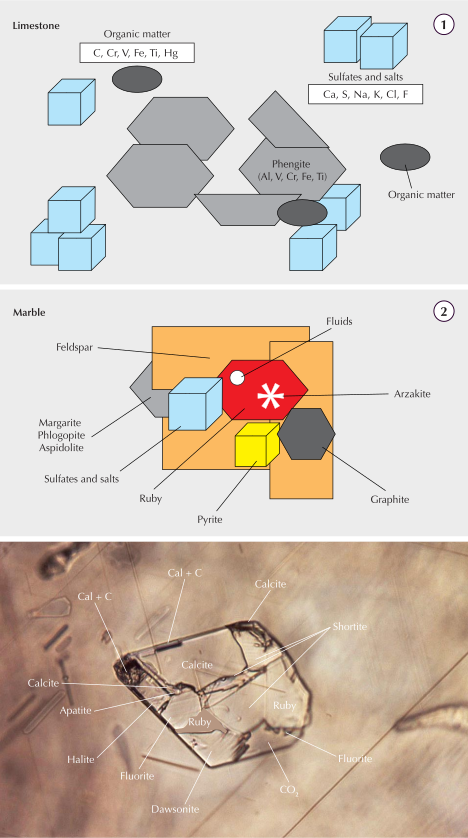
The nature and chemical composition of inclusions and fluids associated with ruby in marble from Mogok highlighted the formation of sulfurous fluids and/or molten salts in a closed system with low fluid mobility. The Na–K–Ca–Li–CO3–SO4–NO3–Cl–F fluid systems are powerful fluxes that lowered the temperature of chloride- and fluoride-rich ionic liquids. They provided transport over a very short distance of aluminum and/or silica and transition metals (Cr-V) contained in phengites and organic matter included in anhydrite and salts during prograde metamorphism. The presence of organic matter associated with evaporites is key for the formation of arzakite and sulfides. Evaporites played the role of fluxes, resulting in the formation of an alkaline saline magma in a closed system, much like a pressure cooker, where all the needed ingredients combined at high temperature to extract the chemical elements from the initial protoliths with their redistribution according to atomic and chemical compatibility. In these growth conditions, volatile elements such as mercury cannot escape from the system and (with sulfur) may preferentially form a new stable mineral. The halogens bromine and chlorine of arzakite, elements that are conservative in solution, originated from the evaporites, especially salts as halite (figure 3).
In nature, mercury is known to accumulate in sedimentary contexts (i.e., fluid mud and/or organic matter), especially with organic carbon. Some black shales present anomalous mercury concentrations associated with polymetallic sulfide-rich shales (R. Yin et al., “Anomalous mercury enrichment in Early Cambrian black shales of South China: Mercury isotopes indicate a seawater source,” Chemical Geology, Vol. 467, 2017, pp. 159–167). Mercury can be used as a proxy to understand the formation of sulfide-rich shales. In the case of South China, a seawater origin is advanced to explain the anomalous mercury contents observed in the black shales (178–505 ppb) and the polymetallic sulfide-rich samples (10900–20700 ppb). These contexts of mercury accumulation also match with arzakite’s sedimentary environment. However, mercury is very sensitive to temperature, and arzakite in the present case is a high-temperature metamorphic mineral. According to previous studies showing mercury contents in sedimentary rocks, all the mercury should be degassed by 650°C (B. Marie et al., “Determination of mercury in one hundred and sixteen geological and environmental reference materials using a direct mercury analyser,” Geostandards and Geoanalytical Research, Vol. 39, 2015, pp. 71–86). The only way to preserve mercury during such an amphibolite metamorphism event is to attain a closed system, in this case with the fusion of evaporites.
This is the first time a Hg-S-bearing inclusion has been described in ruby. The presence of arzakite is a product of the genesis of ruby in marbles, in which the metamorphism of the sedimentary protolith occurred at very high temperature in a closed system where fluids could not escape. The fusion of the mixture of the protolith nucleated an alkaline-salty magma where all the chemical elements combined, forming ruby and minerals such as arzakite. This finding underscores the importance of detailed inclusion studies offering critical insights into the formation of gems such as Mogok ruby.
Rubies with intense color and high transparency, such as those from the Mogok mining district in Myanmar, form in metamorphosed carbonate platforms during the retrograde metamorphism stage. This occurs at temperatures of ~620°–670°C and pressures of ~2.6–3.3 kbar (V. Garnier et al., “Marble-hosted ruby deposits from central and southeast Asia: Towards a new genetic model,” Ore Geology Reviews, Vol. 34, 2008, pp. 169–191). The protolith comprises carbonates enriched in detrital Fe-Cr-V-bearing clays, shales with organic matter, and intercalated evaporitic layers.
Previous studies of primary fluid inclusions trapped by ruby at Mogok (G. Giuliani et al., “Fluid inclusions in ruby from Asian marble deposits: Genetic implications,” European Journal of Mineralogy, Vol. 27, 2015, pp. 393–404) indicated the contemporary trapping of two carbonic immiscible fluid inclusions: mono- to two-phase fluid inclusions in the CO2-H2S ± COS ± S8 ± H2O system and multi-solid carbonic fluid inclusions in the Na-K-Ca-CO3-SO4-NO3-Cl-F-(CO2-H2S) system. The multiple solids are mainly mixtures of Na-Ca-Al-carbonates (such as shortite and dawsonite), sulfates, phosphates, nitrates, fluorides, and chlorides (such as halite). They are the trapped recrystallized residues of molten salts formed during the metamorphism of evaporitic lenses (chlorides and sulfates) intercalated in the carbonate-shale rocks. The carbon dioxide is released by devolatilization of the original limestones during metamorphism. H2S originated from the partial or total dissolution of evaporites and subsequent sulfate reduction by organic carbon, which produced graphite and pyrite. The formation of pyrite sequestered iron and led to the formation of iron-poor ruby.
In 2018, American Gemological Laboratories examined a 33.98 ct freeform carved ruby cabochon from Mogok measuring 24.08 × 18.48 × 8.30 mm (figure 1, left). The medium-quality, semitransparent to translucent stone was heavily included with numerous small cavities and whitish fillers on the base (figure 1, right). Energy-dispersive X-ray fluorescence analysis (in wt.% oxide) revealed low trace concentrations of gallium (0.004), iron (0.020), and titanium (0.026), with higher vanadium (0.071) and chromium (0.607). A large and highly reflective, soft yellowish syngenetic inclusion, measuring about 0.5 × 0.2 mm, was evident on the base (figure 1, right). Raman analysis of the inclusion, taken with 514 nm laser excitation, gave a spectrum (figure 2) that we compared to a couple of samples from the RRUFF database and the Raman data of arzakite intimately associated with graphite in nodules of tsavorite from the Scorpion mine in Kenya (R. Thomas et al., “Genetic significance of the 867 cm−1 out-of-plane Raman mode in graphite associated with V-bearing green grossular,” Mineralogy and Petrology, Vol. 112, 2018, pp. 633–645). The best match identified it as arzakite, with Raman peaks at 210, 275, 390, and 590 cm−1. Fourier-transform infrared analysis also highlighted the presence of diaspore and kaolinite in the ruby.
Arzakite, the sulfohalogenide of mercury (Hg3S2(Br,Cl)2), forms a chemical series with lavrentievite (Hg3S2(Cl,Br)2), originally reported from the Arzakskoye deposit, Uyuk Range, in the eastern Siberia region of Russia (V.I. Vasil’ev et al., “Lavrentievite and arzakite, new natural mercury sulfohalides,” Geologiya i Geofizika, Vol. 25, 1984, pp. 54–63). It is a supergene mineral found in rhyolite-dacite porphyries and formed between 100°C and 200°C in relatively near-surface conditions.
The nature and chemical composition of inclusions and fluids associated with ruby in marble from Mogok highlighted the formation of sulfurous fluids and/or molten salts in a closed system with low fluid mobility. The Na–K–Ca–Li–CO3–SO4–NO3–Cl–F fluid systems are powerful fluxes that lowered the temperature of chloride- and fluoride-rich ionic liquids. They provided transport over a very short distance of aluminum and/or silica and transition metals (Cr-V) contained in phengites and organic matter included in anhydrite and salts during prograde metamorphism. The presence of organic matter associated with evaporites is key for the formation of arzakite and sulfides. Evaporites played the role of fluxes, resulting in the formation of an alkaline saline magma in a closed system, much like a pressure cooker, where all the needed ingredients combined at high temperature to extract the chemical elements from the initial protoliths with their redistribution according to atomic and chemical compatibility. In these growth conditions, volatile elements such as mercury cannot escape from the system and (with sulfur) may preferentially form a new stable mineral. The halogens bromine and chlorine of arzakite, elements that are conservative in solution, originated from the evaporites, especially salts as halite (figure 3).
In nature, mercury is known to accumulate in sedimentary contexts (i.e., fluid mud and/or organic matter), especially with organic carbon. Some black shales present anomalous mercury concentrations associated with polymetallic sulfide-rich shales (R. Yin et al., “Anomalous mercury enrichment in Early Cambrian black shales of South China: Mercury isotopes indicate a seawater source,” Chemical Geology, Vol. 467, 2017, pp. 159–167). Mercury can be used as a proxy to understand the formation of sulfide-rich shales. In the case of South China, a seawater origin is advanced to explain the anomalous mercury contents observed in the black shales (178–505 ppb) and the polymetallic sulfide-rich samples (10900–20700 ppb). These contexts of mercury accumulation also match with arzakite’s sedimentary environment. However, mercury is very sensitive to temperature, and arzakite in the present case is a high-temperature metamorphic mineral. According to previous studies showing mercury contents in sedimentary rocks, all the mercury should be degassed by 650°C (B. Marie et al., “Determination of mercury in one hundred and sixteen geological and environmental reference materials using a direct mercury analyser,” Geostandards and Geoanalytical Research, Vol. 39, 2015, pp. 71–86). The only way to preserve mercury during such an amphibolite metamorphism event is to attain a closed system, in this case with the fusion of evaporites.
This is the first time a Hg-S-bearing inclusion has been described in ruby. The presence of arzakite is a product of the genesis of ruby in marbles, in which the metamorphism of the sedimentary protolith occurred at very high temperature in a closed system where fluids could not escape. The fusion of the mixture of the protolith nucleated an alkaline-salty magma where all the chemical elements combined, forming ruby and minerals such as arzakite. This finding underscores the importance of detailed inclusion studies offering critical insights into the formation of gems such as Mogok ruby.