
In June 2021, GIA’s Antwerp lab received a diamond treated by high pressure and high temperature (HPHT) that was falsely inscribed with a GIA report number referencing an untreated diamond originally graded by GIA in 2010. The diamond was submitted for Update service, in which a stone is matched to its previous report and regraded based on its current condition. Careful comparison of the diamond with its accompanying report number showed that the weight and grading parameters were very similar, but certain differences readily led to the conclusion that this was not the same stone.
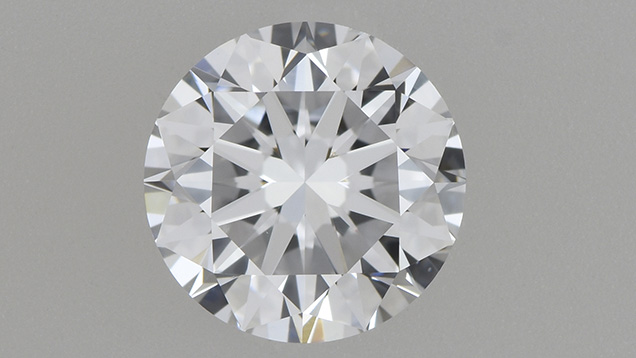
The HPHT-processed diamond was a round brilliant weighing 1.497 ct and measuring 7.30–7.34 × 4.50 mm (figure 1), while the original diamond weighed slightly more (1.502 ct) and measured 7.29–7.34 × 4.56 mm. They had the same clarity (IF) and fluorescence (none) but different color grades (D for the original diamond, E for the HPHT-processed diamond).
Additional conclusive differences were detected when the newly submitted stone was further analyzed with advanced spectroscopic techniques. Whereas the diamond from 2010 was type Ia, the submission from 2021 tested as type IIa. Photoluminescence (PL) spectroscopy using various laser excitation wavelengths confirmed a natural origin, but with color enhancement by HPHT treatment.
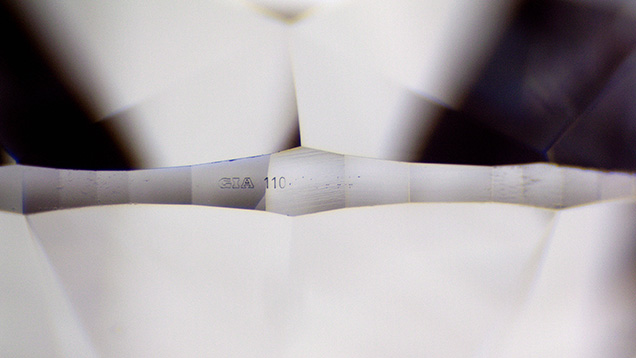
In addition to a clearly fraudulent inscription (not pictured), microscopic examination of the girdle revealed remnants of an original GIA inscription (figure 2). Based on this information, we found that this HPHT-processed stone had already been submitted to GIA in 2013 but was repolished afterward in an attempt to obscure the original inscription. Our records showed that in 2013, the diamond was also inscribed with “BELLATAIRE” (indicating HPHT treatment), but this information had been removed from the girdle and the remnants were even less visible than the original GIA inscription.
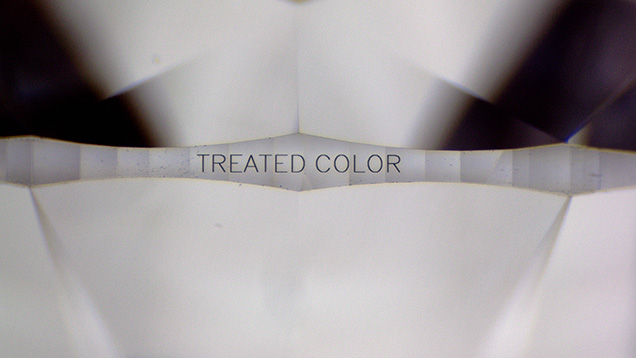
In addition to issuing a new report for this HPHT-treated diamond, GIA made the fraudulent inscription unreadable, according to standard procedure, and the stone was inscribed with “TREATED COLOR” (figure 3).
The Antwerp lab had recently reported a similar case of fraud, but that concerned a laboratory-grown diamond with a counterfeit inscription referencing a natural diamond (Summer 2021 Lab Notes, pp. 150–152). Both types of fraud are common in the marketplace and show the importance of careful verification of not only a diamond’s growth method (natural versus laboratory-grown) but also its color origin.
Ellen Barrie is supervisor of analytics, and Sander Teuthof is an analytics technician, at GIA in Antwerp, Belgium. Sally Eaton-Magaña is senior manager of diamond identification at GIA in Carlsbad, California.
In June 2021, GIA’s Antwerp lab received a diamond treated by high pressure and high temperature (HPHT) that was falsely inscribed with a GIA report number referencing an untreated diamond originally graded by GIA in 2010. The diamond was submitted for Update service, in which a stone is matched to its previous report and regraded based on its current condition. Careful comparison of the diamond with its accompanying report number showed that the weight and grading parameters were very similar, but certain differences readily led to the conclusion that this was not the same stone.
The HPHT-processed diamond was a round brilliant weighing 1.497 ct and measuring 7.30–7.34 × 4.50 mm (figure 1), while the original diamond weighed slightly more (1.502 ct) and measured 7.29–7.34 × 4.56 mm. They had the same clarity (IF) and fluorescence (none) but different color grades (D for the original diamond, E for the HPHT-processed diamond).
Additional conclusive differences were detected when the newly submitted stone was further analyzed with advanced spectroscopic techniques. Whereas the diamond from 2010 was type Ia, the submission from 2021 tested as type IIa. Photoluminescence (PL) spectroscopy using various laser excitation wavelengths confirmed a natural origin, but with color enhancement by HPHT treatment.
In addition to a clearly fraudulent inscription (not pictured), microscopic examination of the girdle revealed remnants of an original GIA inscription (figure 2). Based on this information, we found that this HPHT-processed stone had already been submitted to GIA in 2013 but was repolished afterward in an attempt to obscure the original inscription. Our records showed that in 2013, the diamond was also inscribed with “BELLATAIRE” (indicating HPHT treatment), but this information had been removed from the girdle and the remnants were even less visible than the original GIA inscription.
In addition to issuing a new report for this HPHT-treated diamond, GIA made the fraudulent inscription unreadable, according to standard procedure, and the stone was inscribed with “TREATED COLOR” (figure 3).
The Antwerp lab had recently reported a similar case of fraud, but that concerned a laboratory-grown diamond with a counterfeit inscription referencing a natural diamond (Summer 2021 Lab Notes, pp. 150–152). Both types of fraud are common in the marketplace and show the importance of careful verification of not only a diamond’s growth method (natural versus laboratory-grown) but also its color origin.
Ellen Barrie is supervisor of analytics, and Sander Teuthof is an analytics technician, at GIA in Antwerp, Belgium. Sally Eaton-Magaña is senior manager of diamond identification at GIA in Carlsbad, California.