2019 GSA Annual Meeting
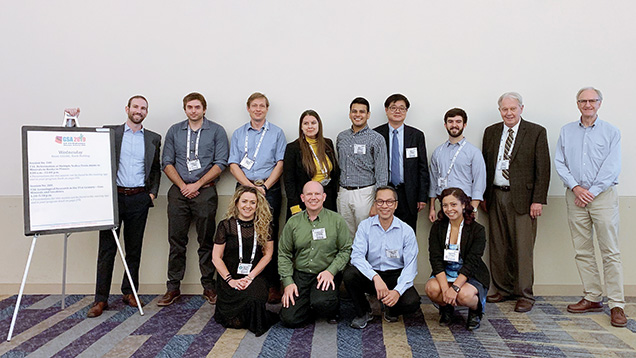
The Geological Society of America (GSA) annual meeting took place in Phoenix, Arizona, September 22–25. GIA participated in the exhibition and hosted speaker and poster sessions that attracted great attention on gemology among the geoscience community (figure 1).
The talks started with research by Dr. Tingting Gu (formerly with GIA) on lower-mantle inclusions trapped in a type IaB diamond. The study identified inclusions of hydrous ringwoodite, ferropericlase, and enstatite (a back-transformation product of bridgmanite). This was the first evidence of them occurring together at this depth of the earth, which will help to unravel the pyrolytic nature of the 660 km discontinuity. The study was presented by co-author Dr. Wuyi Wang (GIA). Dr. Sally Eaton-Magaña (GIA) presented a detailed study of natural radiation stains in diamonds. Temperature-controlled experiments revealed that the stains’ color changes from green to olive green at about 400°C and then to brown at about 550–600°C. Color-changing rates of different related defects were then carefully calculated. This study provides needed information about the reliability of using radiation stain color to identify diamond color as either natural or treated. Graduate student Roy Bassoo (Baylor University) put forward a source study of Guyana diamonds mined from alluvial gravels in the Amazon rainforest. Several possible primary diamond sources were proposed, and multiple advanced analytical methods were used on rough diamond crystals. Detrital zircon dating ruled out West Africa as a potential source. Inclusion and isotopic data suggest that these diamonds are of upper-mantle peridotite paragenesis, with a subpopulation of eclogite paragenesis and an undiscovered kimberlite source that still needs to be identified. Dr. Evan Smith (GIA) shared the characteristics of the newly discovered nickel sulfide mineral crowningshieldite (α-NiS). This mineral was found as inclusions in a so-called CLIPPIR diamond (Cullinan-like, Large, Inclusion-Poor, Pure, Irregular, and Resorbed) that came from 350–750 km below the earth’s surface. Crowningshieldite features one Ni atom connected to six sulfur atoms, while the known β-NiS features one connecting to five.
Dr. Christopher M. Breeding (GIA) discussed the rarity and color causes of orange diamonds. Orange diamonds account for only 2.4% of all colored diamonds, based on GIA’s intake database. Single substitutional nitrogen and the 480 nm band are the two major mechanisms responsible for this rare color. Of the two, the 480 nm absorption band is not well understood and has been proposed to be composed of substitutional oxygen atoms in the diamond lattice. At low concentration this defect causes yellow color, while at high concentration the color shifts to orange. Diamonds with this defect can also be heated to temporarily change their color to orange. Kyaw Soe Moe (GIA) continued the discussion on the 480 nm band using the study results of a bicolor diamond. The 480 nm band was detected only in the brown-orange portion of this diamond. An interesting find was that the fluorescence image and optical image of this color zone do not match, which indicates that the 480 nm band caused color zoning that does not align with growth zones. This observation suggests that the defect causing the 480 nm absorption formed or penetrated the diamond after its growth. The authors proposed that the defect consists of localized vacancy clusters, in addition to other previously proposed possibilities.
Following a series of diamond presentations, the talks continued with colored gemstone discussions. Graduate student Samuel Martin (Brigham Young University) presented a geochemical comparison study of sapphires from Bingham Canyon in Utah and from Yogo Gulch, Montana. Although the two sapphire populations were formed 10 million years apart, they do broadly share the same trace element signatures, and both contain silica melt inclusions. Oxygen isotope study of both suggests that they have different protoliths, with Bingham Canyon sapphires as a mixture of multiple populations in the Bingham magma system. The study proposed that sapphires from both sources have been produced through partial melting of Al-rich rocks. Graduate student Rachelle Turnier (University of Wisconsin–Madison) shared her research on the genesis of basalt-related gem corundum with zircon inclusions in samples from nine different sources around the globe. Through a combination of element mapping, growth texture imaging, zircon geochronology, apparent pressure estimation, oxygen isotope study, and in situ geochemical analyses, variations were revealed among these deposits, which have generally been grouped in a single category. PhD candidate William Aertker (Colorado School of Mines) discussed the genesis of metasomatic sapphire from the Whitehorn stock metamorphic aureole in central Colorado. Sapphires occur within a ductile shear zone that experienced contact metamorphism. Extensive evidence suggests that desilication was not the only process involved in corundum formation. Element exchange must have happened at the same time, and ductile shearing facilitated fluid channeling to facilitate this exchange process, known as metasomatism. Retired geologist Charles Breitsprecher (California State University, Sacramento) presented a self-funded field investigation of sunstone from three mines in southeast Oregon. The occurrence and regional geology were discussed. Gemologist and professional lapidary Sarah Steele talked about her archaeogemological and chemistry study on gem-quality jet, including its use since the Upper Paleolithic and the market for it today. The author’s analyses found 33 different hydrocarbons and biopolymers that are used as gems, which goes beyond the current commonly used definition for jet. Dr. Aaron Palke (GIA) closed the session with a presentation on the newly recognized mineral johnkoivulaite (Cs[Be2B]Mg2Si6O18), named in honor of renowned GIA researcher John Koivula. This new member of the beryl group was discovered in Mogok, an area full of opportunities to expand the mineral family. Due to its special structure, johnkoivulaite does not contain as much water as other members of the beryl group.
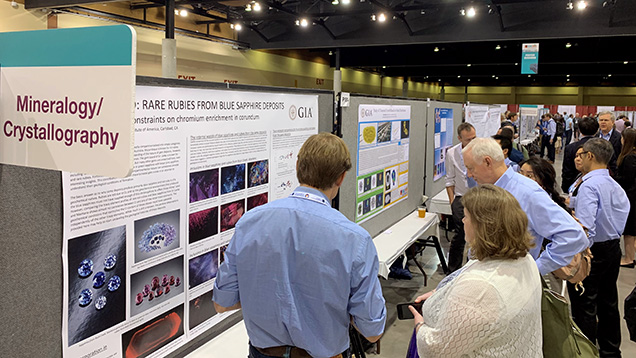
This year’s poster session featured five presenters (figure 2). Dr. Qishen Zhou (China University of Geosciences, Wuhan) presented two posters, on the results of colored diamond and sapphire auctions, respectively. Dr. Zhou and his team collected more than 50,000 auction results over the past decade. These results are representative of the global auction sector, including the Chinese domestic auction sector, which is not well known to the rest of the industry. The colored diamond study poster focused on pink and blue diamonds. Both studies explored the relationship between auction results and the quality factors of the stones. The authors found that color largely determines colored diamonds’ auction prices, while both color and carat weight have a high impact on sapphire. Dr. Aaron Palke (GIA) delivered research on rare rubies found in blue sapphire–dominant deposits. The study compared sapphires and rarely encountered rubies from four different sources. Geochemical results indicate that the trace element Cr, which causes the red color, behaves quite independently of the other trace elements. However, trace elements other than Cr share similarity between sapphires and rubies from the same deposit, which was also supported by inclusion scenes. Paul Johnson (GIA) displayed an interesting research project on melee-size HPHT lab-grown diamonds, which have a different crystal shape from large crystals made with the same method. The authors used element mapping of nickel to reveal the growth structure of these small diamonds. The results indicated multiple growth stages of the small lab-grown diamonds, which explained their elongated crystal shape. Garrett McElhenny (GIA) presented a study on type IIa pink diamonds. The author studied a suite of 30 samples with inclusions using Raman spectroscopy. The inclusions identified were mainly of sublithospheric origin. The existence of sublithospheric inclusions again proved that these diamonds came from the sublithospheric mantle.
The 2020 GSA annual meeting is scheduled for October 25–28 in Montreal.