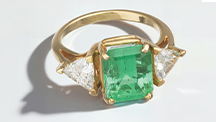
The “Glet Filling”: The Filling of the Cracks in Precious Stones Under Scrutiny
Several similar methods of filling cracks (“glets”) have been developed under such names as Yehuda and Koss (Israel) and Diascence, Genesis Enhanced, and Goldman Oved (New York). One of the filling methods discussed in more detail, the Koss system developed at least ten years ago, limits the rainbow or “flash” effect (the yellow-orange color flashing into electric blue under dark field microscopy) characteristic of many other filling methods, and useful for identifying the presence of a filler.
Regardless of method, the visual improvements achieved from filling cracks with oils or the more modern vitreous, high-RI materials is temporary; eventually the tears and cracks become visible after a few months or years. Fillers degrade with time and by environmental conditions. Some dry out to reveal noticeable residue; others deteriorate with exposures to ultrasound, ultraviolet, heat, acids, and chemical cleaners.
Several methods of detecting fillers are briefly mentioned. Gemologists commonly use magnification to observe bubbles, filler textures, the flash effect, and effects of deterioration. Advanced instruments such as the scanning electron microscope, X-ray fluorescence analysis, and Raman spectroscopy easily reveal the presence of filled glets.
Abstracted by Edward R. Blomgren