
Back to gem encyclopedia

Emerald

Emerald is the bluish green to green variety of beryl, a mineral species that includes aquamarine.

Responsive image
Color

Highly saturated green color defines high quality emerald.

Responsive image
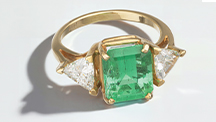
Beveled corners

Emerald cuts have concentric parallel rows of facets and beveled corners.

Responsive image
“jardin,” or garden.

Eye visible inclusions create an internal scene referred to as “jardin,” or garden.

Responsive image
Responsive image
Six-sided

Emerald crystals are commonly six-sided.

Responsive image
Flat-top

The tops of emerald crystals are typically rather flat.

Responsive image
Color direction

The best color is usually perpendicular to the top of the crystal.

Responsive image
Tools

Research

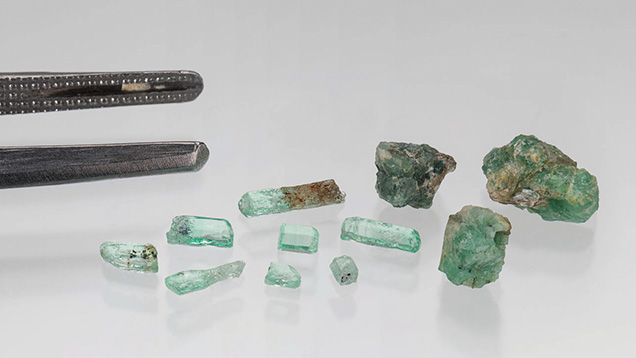
Figure 1. Eight Kazakhstani emeralds (left) and three Ukrainian beryl and emerald samples (right), with gemological tweezers shown for scale. The leftmost Ukrainian emerald has a chemistry between that of aquamarine and emerald. Photo by Emily Lane; courtesy of Gerhard Franz and Oleksii Vyshnevskyi.
Emeralds and Beryl from Kazakhstan and Ukraine

A report from GIA’s Carlsbad laboratory on emerald and beryl samples studied as part of an ongoing beryl characterization research project.
Read More

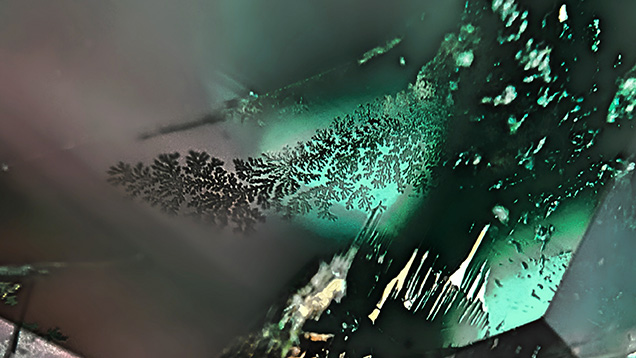
These dendritic patterns in a partially filled fissure in an emerald resemble natural foliage, also known as jardin. Photomicrograph by Sameer Din Faqir; field of view 2.50 mm.
Dendritic Patterns in Emerald

A partially filled fissure in an emerald exhibits patterns resembling natural foliage.
Read More

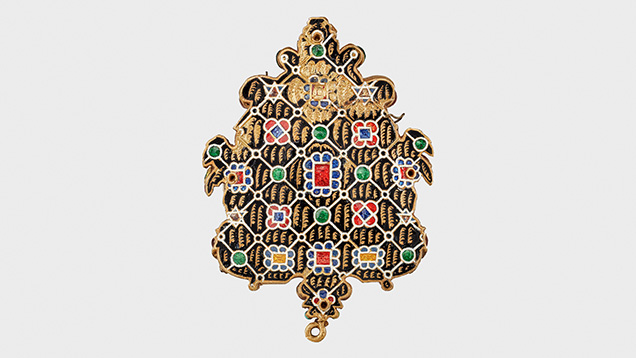
Figure 2. Catherine de’ Medici’s sixteenth-century pendant, measuring approximately 5.5 × 4.0 × 1.4 cm and weighing 52.35 g, in enameled gold with emeralds and four colorless gems (BnF collection no. 56.336). Photo by Serge Oboukhoff; courtesy of the Museum of the National Library of France.
Emeralds in Catherine de’ Medici’s Pendant: An Unexpected Geographic Origin

Archival research and gemological characterization reveal the geographic origin of two emeralds set in a pendant linked to Catherine de’ Medici, Queen of France from 1547 to 1559.

Read More

Interference thin films in Russian emerald resembling a sky filled with fireworks. Photomicrograph by Ungkhana Atikarnsakul; field of view 3.60 mm.
Fireworks Display in Russian Emerald

The inclusion scene in a Russian emerald resembles fireworks illuminating a night sky.

Read More

Figure 1. A 12.62 ct trapiche emerald with areas of near-colorless goshenite. Photo by Shunsuke Nagai.
Zoned Trapiche Emerald with Goshenite Overgrowth

A 12.62 ct trapiche emerald with areas of goshenite is analyzed in GIA’s Tokyo laboratory.

Read More

Figure 2. This gold and emerald pendant contains 61 Colombian emeralds with 33 stones missing, presumably lost during its residence on the seafloor for more than 300 years. The pendant is approximately 3.5 in. (8.9 cm) wide. Photo by Emily Lane.
Splendors from the Deep: Historic Treasures from a Spanish Shipwreck

An in-depth look at jewelry recently recovered from a 1715 Spanish shipwreck.
Read More

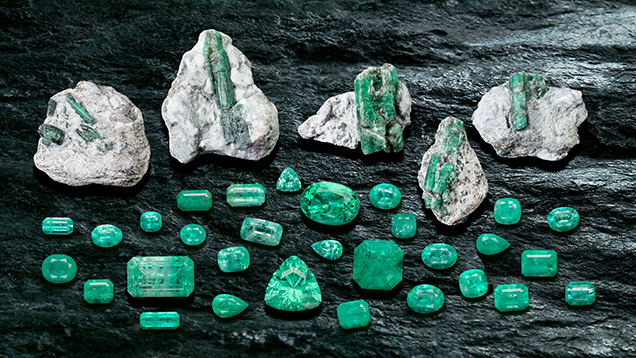
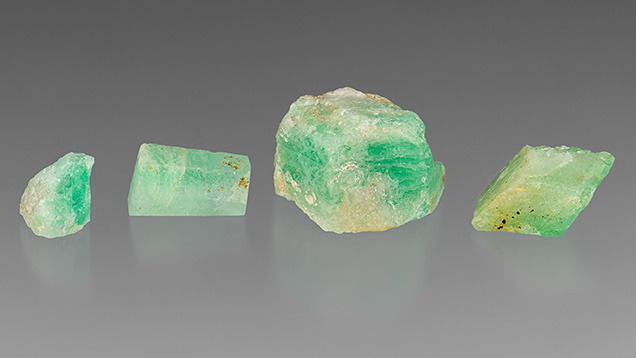
Figure 1. Emeralds in matrix and various cut stones from the Curlew mine in Western Australia. All stones were mined in 2023. The cut stones are untreated and range from 0.45 to 7.92 ct (triangular shape). Photo by Lhapsin Nillapat; courtesy of Matthew Allen (The Gemstone Trading Company).
New Emerald Production from the Curlew Mine, Western Australia

GIA’s Bangkok laboratory studies emeralds from the Curlew mine’s recently renewed production.
Read More

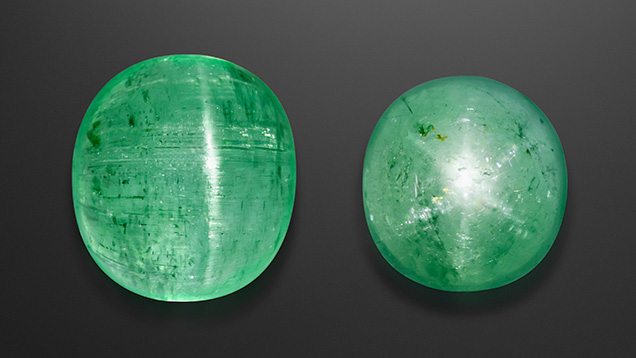
Cat’s-eye emerald (11.31 ct) and star emerald (4.99 ct) from Chitral, Pakistan. Photo by Lhapsin Nillapat; courtesy of Mohammed Ayub (Pretty Little Gem Co, Ltd, Bangkok).
Phenomenal Emeralds from Chitral, Pakistan

GIA’s Bangkok laboratory encounters two phenomenal gems while examining a parcel of emeralds from Pakistan.
Read More

Figure 1. Emerald and beryl specimens from Newfoundland, Canada. The chip on the right has a distinct green rim in this position, on its lower right edge. Photo by Emily Lane; courtesy of Art Gardner and Terry Russell.
Beryl from Newfoundland, Canada

Beryl and emerald specimens from a recent discovery in Newfoundland are examined at GIA.

Read More

Double cabochon cat’s-eye emerald weighing 5.11 ct and measuring 10.77 × 8.95 × 7.39 mm, from Goiás State, Brazil. Photo by Robert Weldon; courtesy of Douglas M. Liebman Estate Jeweler.
An Exceptional Cat’s-Eye Emerald

A double cabochon cat’s-eye emerald conjures fond memories for an estate dealer in Tucson.

Read More