
Back to gem encyclopedia

Diamond

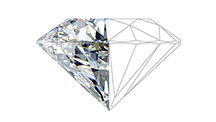
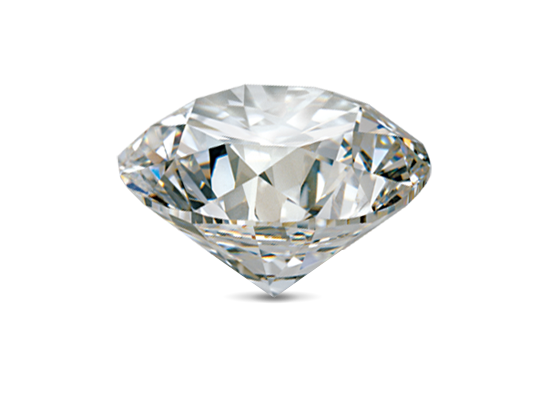
Diamonds are among nature’s most precious and beautiful creations.

Responsive image
Color

Colorless diamonds are scarce—most diamonds have tints of yellow or brown.

Responsive image
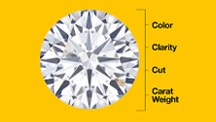
4Cs

Factors used to describe diamonds: Clarity, Color, Cut, Carat Weight

Responsive image
Rarity

The rarity of one or more of the 4Cs can affect value.

Responsive image
Responsive image
Octahedron

The crystal shape of a gem diamond is often the octahedron.

Responsive image
Trigons

Trigons—little triangular depressions—occur only on octahedral faces.

Responsive image
Growth marks

Diamond’s growth marks help experts separate diamonds from simulants.

Responsive image
Tools

Research

A new edition of Herbert Tillander’s book, updated by his daughter, Ulla Tillander-Godenhielm.
New Edition of Tillander’s Diamond Cuts in Historic Jewellery 1381–1910

An updated edition of Herbert Tillander’s book is now available.

Read More

Figure 1. A round brilliant-cut diamond set in the necklace exhibits the flash effect when tilted, a characteristic of fracture filling caused by the presence of a filler within a surface-reaching fracture. Photo by Gaurav Bera.
Fracture-Filled Diamonds Detected in Mounted Jewelry

The Mumbai laboratory reports on a jewelry submission containing fracture-filled diamonds.
Read More

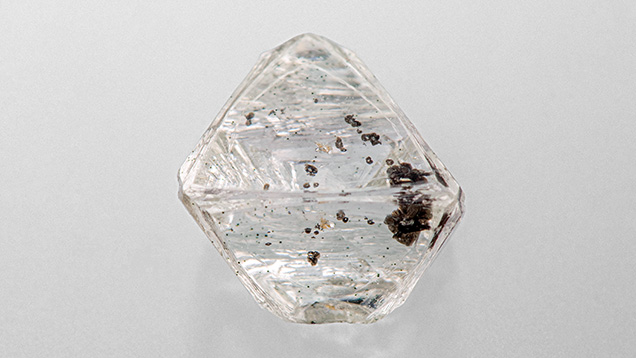
Figure 2. This yellow-orange transparent crystal of almandine-pyrope garnet is a very rare inclusion in diamond. The example shown here has a typical somewhat rounded habit. Photomicrograph by Nathan Renfro; field of view 3.84 mm.
Quarterly Crystal: Almandine-Pyrope Garnet in Diamond

A diamond octahedron from South Africa hosts a rare yellow-orange almandine-pyrope garnet crystal.
Read More

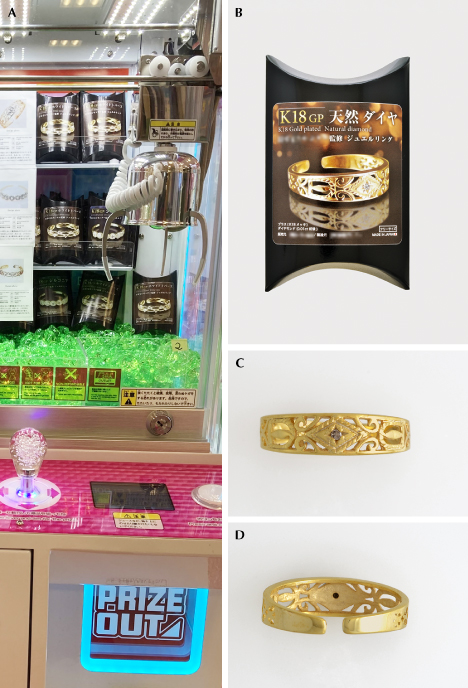
Figure 1. The diamond ring front view. Photo by Shunsuke Nagai
Diamond Ring Prize from an Arcade-Style Claw Game

A diamond ring from a claw game in Japan is analyzed.
Read More

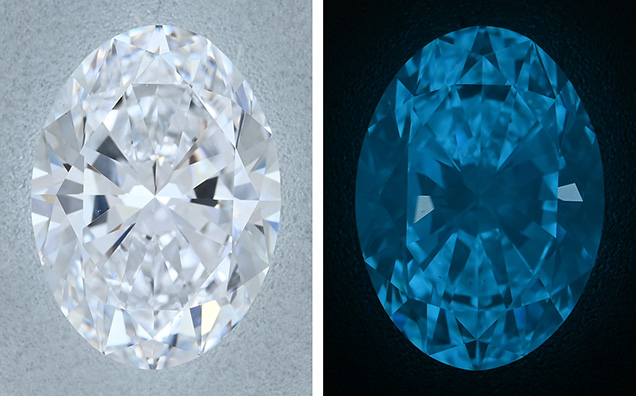
Figure 1. The 2.50 ct diamond in a dark environment around 10 s after deep-UV excitation to showcase its phosphorescence. Photo by Nick “Ka Chun” Chan.
Type IIa/IaB Diamond Showing Transient Type IIb Responses

A 2.50 ct natural type IIa/IaB diamond submitted to the Dubai laboratory shifts to type IIb after deep-UV excitation.
Read More

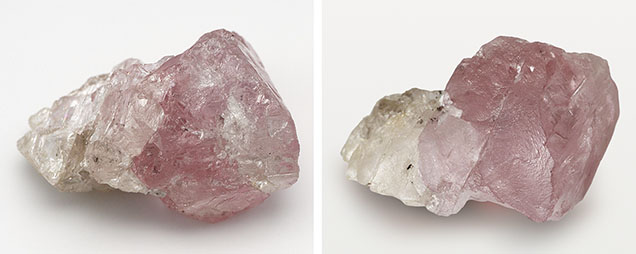
Figure 1. This 37.41 ct rough diamond has distinct pink and colorless zones. Photo by Tebogo Hambira.
Extraordinary Large Bicolor Natural Rough Diamond

A 37.41 ct natural rough diamond with distinct pink and colorless zones is examined at GIA’s Botswana laboratory.
Read More

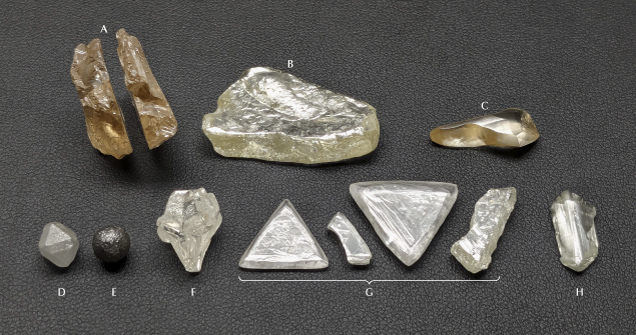
Figure 1. Examples of rough diamonds with shapes governed by various combinations of growth, breakage, and resorption. Specimens range from 1.08 to 28.08 ct, with the largest specimen measuring 27 mm in length. Photo by Evan M. Smith
Raw Brilliance: Nature’s Diamond Sculptures

Showcases the diverse natural shapes of rough diamonds and explores how geological processes create their unique forms.

Read More

Figure 1. Examples of contact-twinned macle diamond crystals from South Africa. Left to right: a flat triangular macle with limited resorption (sample 11; 0.357 ct); an extensively resorbed variant of a flat triangular macle (sample 12; 0.411 ct); a very elongated flat macle with stacking growth layers on the octahedral faces, showcasing sharp edges and pointed apex corners (sample 13; 0.553 ct); a six-pointed star-shaped, poorly resorbed flat macle (sample 14; 0.747 ct). Photo by Tetsuya Chikayama; courtesy of Suwa & Son, Inc.
External Morphology and Internal Zonal Structure of Macle Diamond

Investigates the morphological changes of macle diamonds during the growth process by exploring their three-dimensional internal zonal structure.

Read More

Figure 1. This 37.41 ct rough diamond has distinct pink and colorless zones. Photo by Tebogo Hambira.
Article
Extraordinary Large Bicolor Natural Rough Diamond

A 37.41 ct natural rough diamond with distinct pink and colorless zones is examined at GIA’s Botswana laboratory.

Read More

Figure 2. One of eight triangular limonitic faces in the 2.22 ct diamond crystal containing a phantom. Photomicrograph by Nathan Renfro; field of view 4.78 mm.
Quarterly Crystal: Unique Phantom in Diamond

A diamond octahedron contains a three-dimensional phantom visible through all eight octahedral faces.

Read More