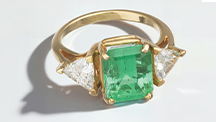
Book Review: Fine Jewelry Couture: Contemporary Heirlooms

Fine Jewelry Couture: Contemporary Heirlooms showcases the work of 37 jewelry designers from around the world. Author Olivier Dupon has pulled together a wide assortment of design styles, including the simple, almost calligraphic work of Cristina Ortiz; the historically inspired pieces of Silvia Furmanovich; the opulent baroque jewels designed by Opposite Jewels, Wendy Yue and Mauro Felter; the perfectly framed pearls of Autore; the mechanical precision of Elie Top; the gem-encrusted confections of Nam Cho and Morphée Joaillerie; the Art Deco-like and futuristic designs of Nikos Koulis; the delicate, exquisite enamels of Ilgiz Fazulzyanov; the playful, “insectiferous” pieces of Daniela Villegas; and the elegant, timeless work of Mana Matsuzaki. In short: There’s something here for all tastes.
Each designer’s work is accompanied by a single page of biography outlining some of their personal history, inspirations, and working philosophy, along with Dupon’s comments on the work. The text is separated into two columns by a thin, elegant line tipped with the initials of the designer’s name.
Almost all sections open with an example of the designer’s sketches, or occasionally, as in the case of Jasmine Alexander, a CAD rendering. It is always a pleasure to see the notes and thought processes of designers that are only visible in their sketch work; it’s an aspect of design that is too often overlooked. It is a shame that Villegas’ drawings, which were done on black paper and would have been striking in the original, did not reproduce well in the book.
As in any book about jewelry design, photos are paramount. Most of the photos in Fine Jewelry Couture, which appear to be largely supplied by the design houses, are excellent, showing well on mostly borderless white pages. However, there are some irregularities that, once noticed, sometimes overshadow the designs themselves and mar the overall presentation.
In some photos, reflections of varying strength or drop shadows have been added. While most images float on a white background, some remain framed as photos. Although the photos are still high quality, they are noticeably different from the others in the book. Occasional advertising-like model shots—such as the one with the cockatoo on the cover—are jarring elements in a book on design.
Sometimes the jewelry is used as a design element, with the image repeated in a radial pattern; or oriented upside down and joined, by a reflection, to a right-side-up version. Rather than enhancing the power of the jewelry, the technique minimizes the impact of the designs.
In some places, there could have been a much better use of enlargements and close-ups. Top’s work, which involves mechanisms that move and rotate, would have especially been served better by showing one series of good close-ups demonstrating how the mechanisms work, rather than distant shots described as being “open” or “closed.”
While the irregularities in the style and use of the images do not take away from the high quality of the work illustrated, they do detract from what is otherwise a delightful source book on the work of a wide range of designers. They’re unfortunate in a book on design.