Book Review: Graff
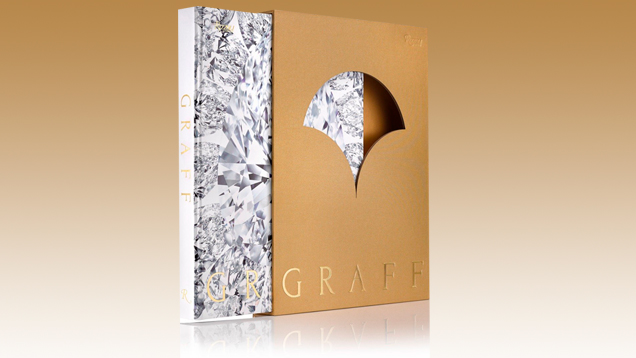
London-based jeweler Graff Diamonds was founded in 1960. Since that time, Graff has become an internationally known and important purveyor of large diamonds of historical renown. With stores around the globe, the Graff name has become synonymous with opulence and rarity in jewelry circles. Graff Diamonds has been awarded the Queen’s Award for International Trade multiple times, and Graff himself was awarded the Order of the British Empire in 2013. This luxurious, large-format book pays homage to the jewelry house in eight lavish chapters.
Chapter I, titled “Beginnings,” chronicles Laurence Graff’s humble origins. Born into a working-class family on London’s East End, Graff left school at age 15 to become an apprentice in a jewelry shop. After a scant three months, he was let go because he would “never make the grade.” Undeterred, Graff went on to found his own business, which continues to grow through hard work and solid ethics – values he credits to his mother. According to Mr. Graff, his mother continued to “check up” on him until she died at age 98, reminding him to always be “honest in his dealings with other people.”
Chapter II, called “Image,” shows the building of the Graff brand though reprints of many of their famous ads through the decades. The ads are visually stunning, and graphically bold. Of particular interest in this chapter are ads from the famous “Military Campaign” of the 80s and the “Green Campaign” of the 90s.
The authors recount the mineral aspects of diamond in chapter III, called “Miracles.” Here, diamond formation and origin is explained for the reader in the most generalized way, with photos showing the mining and sorting of rough crystals. There is also an outline of Graff’s vertically-integrated business, which starts at the mine and moves the diamond through cutting and finally to the creation of the jewelry that shows the stone at its best advantage.
The uniqueness of the Graff brand is vividly portrayed in chapters IV–VI. “Rarity” features fascinating discussions on some of the famous diamonds that Graff has owned. These include the Graff Pink, the Letseng Star, the Wittelsbach-Graff, and the Lesotho Promise. Chapters V and VI, “Artistry,” and “Craft,” respectively, depict the work of Graff atelier. Pieces of magnificent jewelry are shown moving from watercolor designs on paper through to the finished piece.
Chapter VII, called “Time,” showcases Graff’s gem-encrusted, horological masterpieces including the Graff Hallucination. The Hallucination is set with more than 110 carats of colored diamonds and is thought to be the most valuable watch ever created. Graff first started producing watches in 2008. The first of these were inspired by cut diamonds and as such, the watch bezels echo the facets of a round brilliant-cut gem. The style has since become a Graff signature, but they have also produced some exceedingly valuable and rare watches using different designs, such as the previously mentioned Hallucination. Finally, chapter VIII is called “Temptation.” In this chapter, author Joanne Harris recalls her first experience buying a Graff diamond with her husband, relating the magical experience and how the diamond, worn in a necklace, continues to symbolize the life she shares with her husband.
The volume is highlighted throughout with outstanding color photos, but unlike many books in this style, a unique insert is included. It shows, in full color and at actual size, a chronological overview, of over 100 significant colorless and fancy-colored diamonds purchased by Graff between 1974 and 2015. This underscores the impressive variety and very large number of important diamonds handled by this one firm.
Graff is highly recommended, not only for lovers of diamonds and stunning jewelry, but for those interested in the successful story of a “self-made” man.