
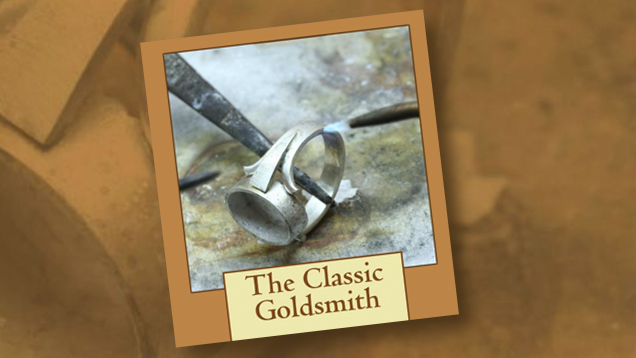
Benchie… Do you know that term? Well, this is a great little book, by a benchie, for benchies. That doesn’t mean you can’t appreciate it if you aren’t one, but it’s really geared to that demographic. By the way, benchie is an affectionate name for bench jewelers: the folks who take bits and pieces of precious metals and some gemstones and work their magic to create the wonderful delights of ornamentation we call jewelry. They’re also the ones who will take in a treasured jewelry heirloom that has seen better days, and they’ll either breathe life back into it or transform it into something completely new.
What this book is not: It is not quick and easy, comprehensive, exhaustive, encyclopedic, the beginner’s guide to anything, or a coffee table edition. So how can I call it a great little book? It’s a bit like the old-time baseball player with the high batting average whose motto was, “Hit ’em where they ain’t.” There are numerous books about jewelry that fit into the above categories, but the field is much more open for a book full of projects for intermediate to advanced jewelers, and this is where it shines.
The book is a collection of projects that were originally published by Mark Maxwell in MJSA Journal’s “At the Bench” column over a period of years. As a trade publication published by Manufacturing Jewelers and Suppliers of America, it is clearly aimed at insiders. This collection is not a simple reprint, though. This well-illustrated, self-published effort (available through Amazon.com) has expanded upon those articles and added more in-depth instructions and insights.
Organized into seven chapters of increasing complexity, from sawing and filing to metal inlay and even CAD, it is a guide to instruct you through a range of projects, and also a nudge to go beyond the project at hand. Thinking ahead, planning the work, and precision and accuracy are repeatedly emphasized, so that finished projects will show to their best advantage and function correctly. The assumption here is that as a bench jeweler, you already know how to use your tools, and these projects will broaden your horizons and stretch your abilities. There are no magical skills required, but you must set your standards high to succeed with these projects. There are also optional workflow suggestions, depending on the availability of some advanced tools such as a laser welder.
Some projects end up as finished jewelry—rings, pendants, earrings, bracelets, and so forth—while others are exquisitely contrived components such as latches, clasps and hinged mechanisms. Being able to fabricate specialized components such as these is another skill that sets apart a master goldsmith.
The only thing that would be disappointing would be to see a pristine copy of this book. Don’t get me wrong: I love and collect books of all stripes, but this book is meant to be used. It needs to have smudged margins, some gold and silver filings wedged in the spine, and even a few dog-eared pages.
Douglas Hall is a jewelry arts instructor at GIA in Carlsbad, California.
Benchie… Do you know that term? Well, this is a great little book, by a benchie, for benchies. That doesn’t mean you can’t appreciate it if you aren’t one, but it’s really geared to that demographic. By the way, benchie is an affectionate name for bench jewelers: the folks who take bits and pieces of precious metals and some gemstones and work their magic to create the wonderful delights of ornamentation we call jewelry. They’re also the ones who will take in a treasured jewelry heirloom that has seen better days, and they’ll either breathe life back into it or transform it into something completely new.
What this book is not: It is not quick and easy, comprehensive, exhaustive, encyclopedic, the beginner’s guide to anything, or a coffee table edition. So how can I call it a great little book? It’s a bit like the old-time baseball player with the high batting average whose motto was, “Hit ’em where they ain’t.” There are numerous books about jewelry that fit into the above categories, but the field is much more open for a book full of projects for intermediate to advanced jewelers, and this is where it shines.
The book is a collection of projects that were originally published by Mark Maxwell in MJSA Journal’s “At the Bench” column over a period of years. As a trade publication published by Manufacturing Jewelers and Suppliers of America, it is clearly aimed at insiders. This collection is not a simple reprint, though. This well-illustrated, self-published effort (available through Amazon.com) has expanded upon those articles and added more in-depth instructions and insights.
Organized into seven chapters of increasing complexity, from sawing and filing to metal inlay and even CAD, it is a guide to instruct you through a range of projects, and also a nudge to go beyond the project at hand. Thinking ahead, planning the work, and precision and accuracy are repeatedly emphasized, so that finished projects will show to their best advantage and function correctly. The assumption here is that as a bench jeweler, you already know how to use your tools, and these projects will broaden your horizons and stretch your abilities. There are no magical skills required, but you must set your standards high to succeed with these projects. There are also optional workflow suggestions, depending on the availability of some advanced tools such as a laser welder.
Some projects end up as finished jewelry—rings, pendants, earrings, bracelets, and so forth—while others are exquisitely contrived components such as latches, clasps and hinged mechanisms. Being able to fabricate specialized components such as these is another skill that sets apart a master goldsmith.
The only thing that would be disappointing would be to see a pristine copy of this book. Don’t get me wrong: I love and collect books of all stripes, but this book is meant to be used. It needs to have smudged margins, some gold and silver filings wedged in the spine, and even a few dog-eared pages.
Douglas Hall is a jewelry arts instructor at GIA in Carlsbad, California.