

A green stone mounted in a ring was recently submitted to the New York lab. The ring’s prongs prevented a full reading of the stone’s refractive index, but a maximum reading of 1.578 indicated the material was potentially beryl. Face-up, the even distribution of color made an identification of emerald appear likely (figure 1).
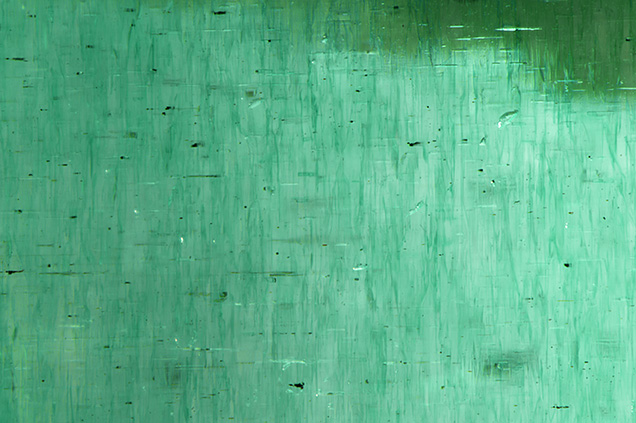
However, careful microscopic examination revealed an even distribution of thin green zoning resembling mica platelets typical of amazonite (figure 2).

Oblique fiber-optic lighting exposed a network of incipient basal cleavage perpendicular to the c-axis (figure 3). Using a handheld spectroscope, a characteristic of dyed green beryl was observed: a broad absorption band in the red region in the absence of chromium lines. Denser green color concentrations were also present in larger surface-reaching fissures.
While dyed beryl is occasionally submitted to GIA, it is mostly translucent and immediately identifiable due to its unnatural color. This impressive emerald imitation was the first of its kind submitted to the New York or Carlsbad labs. It serves as an important reminder that careful, methodical gemological testing is necessary to detect these subtler treatments.
A green stone mounted in a ring was recently submitted to the New York lab. The ring’s prongs prevented a full reading of the stone’s refractive index, but a maximum reading of 1.578 indicated the material was potentially beryl. Face-up, the even distribution of color made an identification of emerald appear likely (figure 1).
However, careful microscopic examination revealed an even distribution of thin green zoning resembling mica platelets typical of amazonite (figure 2).
Oblique fiber-optic lighting exposed a network of incipient basal cleavage perpendicular to the c-axis (figure 3). Using a handheld spectroscope, a characteristic of dyed green beryl was observed: a broad absorption band in the red region in the absence of chromium lines. Denser green color concentrations were also present in larger surface-reaching fissures.
While dyed beryl is occasionally submitted to GIA, it is mostly translucent and immediately identifiable due to its unnatural color. This impressive emerald imitation was the first of its kind submitted to the New York or Carlsbad labs. It serves as an important reminder that careful, methodical gemological testing is necessary to detect these subtler treatments.