

Flame structures are a surface characteristic of Melo pearls produced from mollusks belonging to the Melo species. The flame pattern is a result of the interaction of light with an interwoven aragonite lamellae microstructure of the pearl (H.A. Hänni, “Explaining the flame structure of non-nacreous pearls,” Australian Gemmologist, Vol. 24, No. 4, 2010, pp. 85–88). Melo pearls are valued for their rarity, large sizes, attractive yellowish orange to orange colors, and flame structures. Therefore, it is not surprising that there have been attempts to imitate these pearls (M.S. Krzemnicki, “A worked shell bead as an imitation of a melo pearl,” Gemmological Journal Hong Kong, Vol. 27, 2006, pp. 31–33; Summer 2006 Lab Notes, pp. 166–167; N. Sturman et al., “An imitation ‘Melo pearl,’” GIA Research News, January 21, 2011). Most imitations of Melo pearl are dyed fashioned shells from the Tridacna species. However, two recent samples submitted to GIA for pearl identification were unusual.
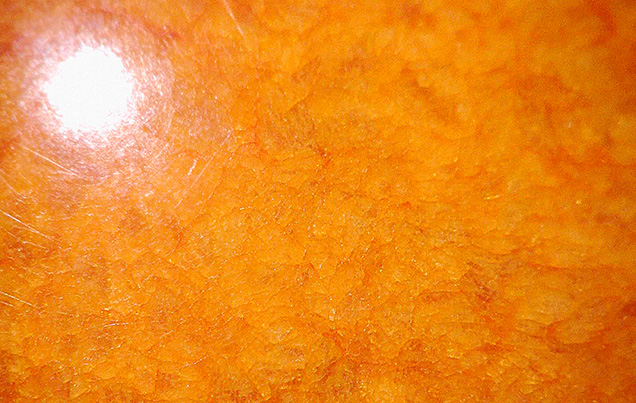
The Hong Kong laboratory received a 140.58 ct orange sphere measuring 27.23 mm. At first glance, its orange bodycolor and non-nacreous surface appearance with a blotchy pattern resembled the flame-like surface structure of a Melo pearl (figure 1, left). However, high magnification revealed a mosaic structure and concentrations of an orange dye substance (figure 2). While aragonite and polyenic pigments are commonly observed in naturally colored Melo pearls, Raman spectroscopy indicated a calcite composition with diagnostic peaks at 282, 713, and 1088 cm–1. Photoluminescence spectroscopy showed clear peaks at 552 and 560 nm, proving the presence of color treatment. This combined evidence confirmed the specimen was dyed calcite.
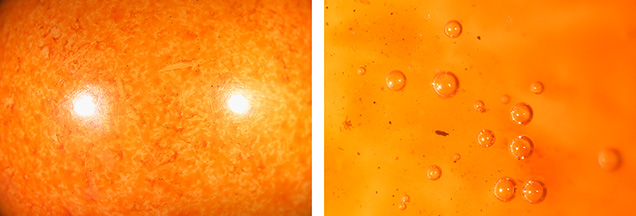
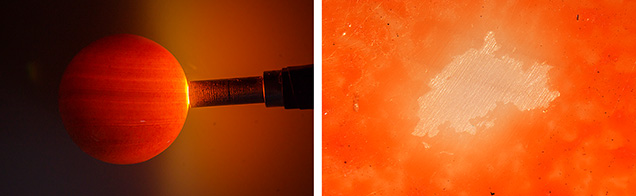
Meanwhile, another orange sphere (figure 1, right) weighing 89.81 ct and measuring 23.27 × 23.00 mm that appeared to be a Melo pearl was submitted to the Bangkok laboratory. The sample’s color and appearance were similar to that of the specimen tested in Hong Kong, but its surface texture was mottled. Magnification revealed a patchy structure of unnatural orange coloration and a lack of flame patterns (figure 3, left). The sample possessed a resinous luster, and gas bubbles and trapped dirt suggested a colorless coating on the outermost surface (figure 3, right). The Raman spectroscopy of the coated surface showed distinct peaks around 1582, 1602, 2945, 3004, and 3065 cm–1, indicative of an artificial resin (L. Kiefert et al., “Identification of filler substances in emeralds by infrared and Raman spectroscopy,” Journal of Gemmology, Vol. 26, No. 8, 1999, pp. 501–520; Fall 2005 Gem News International, pp. 272–273). Under strong fiber-optic illumination, the item exhibited obvious banding typical of shell-related materials (figure 4, left). Furthermore, one area seemed to have been ground down, revealing a white material underneath the coated and dyed layers (figure 4, right). Raman analysis on the area showed peaks at 703, 1085, and 1460 cm–1, identifying the material as aragonite. All the data obtained led to the conclusion that this was a Melo pearl imitation made of a dyed and coated shell.
While pearl imitations are not new to the market, these two samples appear strikingly similar to natural Melo pearls. Careful inspection under high magnification and advanced analytical procedures employed by gemological laboratories are sometimes needed to provide accurate and comprehensive results.
Wing Kiu Fan is a staff gemologist at GIA in Hong Kong. Ravenya Atchalak is a staff gemologist at GIA in Bangkok.
Flame structures are a surface characteristic of Melo pearls produced from mollusks belonging to the Melo species. The flame pattern is a result of the interaction of light with an interwoven aragonite lamellae microstructure of the pearl (H.A. Hänni, “Explaining the flame structure of non-nacreous pearls,” Australian Gemmologist, Vol. 24, No. 4, 2010, pp. 85–88). Melo pearls are valued for their rarity, large sizes, attractive yellowish orange to orange colors, and flame structures. Therefore, it is not surprising that there have been attempts to imitate these pearls (M.S. Krzemnicki, “A worked shell bead as an imitation of a melo pearl,” Gemmological Journal Hong Kong, Vol. 27, 2006, pp. 31–33; Summer 2006 Lab Notes, pp. 166–167; N. Sturman et al., “An imitation ‘Melo pearl,’” GIA Research News, January 21, 2011). Most imitations of Melo pearl are dyed fashioned shells from the Tridacna species. However, two recent samples submitted to GIA for pearl identification were unusual.
The Hong Kong laboratory received a 140.58 ct orange sphere measuring 27.23 mm. At first glance, its orange bodycolor and non-nacreous surface appearance with a blotchy pattern resembled the flame-like surface structure of a Melo pearl (figure 1, left). However, high magnification revealed a mosaic structure and concentrations of an orange dye substance (figure 2). While aragonite and polyenic pigments are commonly observed in naturally colored Melo pearls, Raman spectroscopy indicated a calcite composition with diagnostic peaks at 282, 713, and 1088 cm–1. Photoluminescence spectroscopy showed clear peaks at 552 and 560 nm, proving the presence of color treatment. This combined evidence confirmed the specimen was dyed calcite.
Meanwhile, another orange sphere (figure 1, right) weighing 89.81 ct and measuring 23.27 × 23.00 mm that appeared to be a Melo pearl was submitted to the Bangkok laboratory. The sample’s color and appearance were similar to that of the specimen tested in Hong Kong, but its surface texture was mottled. Magnification revealed a patchy structure of unnatural orange coloration and a lack of flame patterns (figure 3, left). The sample possessed a resinous luster, and gas bubbles and trapped dirt suggested a colorless coating on the outermost surface (figure 3, right). The Raman spectroscopy of the coated surface showed distinct peaks around 1582, 1602, 2945, 3004, and 3065 cm–1, indicative of an artificial resin (L. Kiefert et al., “Identification of filler substances in emeralds by infrared and Raman spectroscopy,” Journal of Gemmology, Vol. 26, No. 8, 1999, pp. 501–520; Fall 2005 Gem News International, pp. 272–273). Under strong fiber-optic illumination, the item exhibited obvious banding typical of shell-related materials (figure 4, left). Furthermore, one area seemed to have been ground down, revealing a white material underneath the coated and dyed layers (figure 4, right). Raman analysis on the area showed peaks at 703, 1085, and 1460 cm–1, identifying the material as aragonite. All the data obtained led to the conclusion that this was a Melo pearl imitation made of a dyed and coated shell.
While pearl imitations are not new to the market, these two samples appear strikingly similar to natural Melo pearls. Careful inspection under high magnification and advanced analytical procedures employed by gemological laboratories are sometimes needed to provide accurate and comprehensive results.
Wing Kiu Fan is a staff gemologist at GIA in Hong Kong. Ravenya Atchalak is a staff gemologist at GIA in Bangkok.