
Analysis of Melee Diamonds Using FTIR Spectroscopy
Operating the FTIR microscope in reflection mode allows for fine-tuned aligning of the beam within a sample, improving the detail of the infrared spectra. Once a faceted round brilliant melee is stationed on a slide, the microscope beam can be focused either through the pavilion (if the melee is table-down) or through the table at an angle to reflect off an inner pavilion facet (if the melee is resting on the pavilion). Many of the samples were so small that the position of the stone remained unknown until the microscope was focused. Nevertheless, spectral quality was independent of stone position.
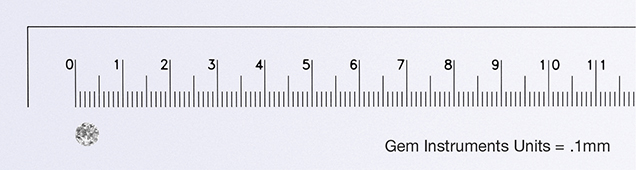
All 70 melee examined were natural round brilliants, the smallest a 0.00054 ct colorless sample identified as a type Ia diamond (figure 2). A few screening devices for treatment and synthetics have been introduced for diamonds over 0.01 ct. The FTIR microscope has proved very effective in analyzing melee smaller than this size, either loose or mounted.

Figure 2. This infrared spectrum of the 0.00054 ct diamond in figure 4, obtained using an
FTIR microscope, shows the detail that can be captured from very small melee sizes.
The knowledge that GIA can type such small stones and determine their origin, either loose or mounted, apart from being an impressive test of FTIR microscopy, will increase consumer confidence in these remarkable melee diamonds. FTIR microscope, shows the detail that can be captured from very small melee sizes.
.jpg "YMAL GIA Ed")


