
Synthetic Moissanite Melee in a Colored Diamond Bracelet
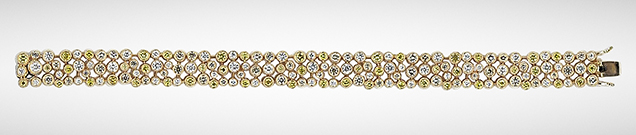
Testing was first performed on the 60 near-colorless round brilliants with the DTC DiamondSure. Several samples were referred and sent for further testing using Raman spectroscopy. Of these, two round brilliants were suspected as imitation. Close examination under the optical microscope revealed obvious doubling on the facet junctions, a key identification feature for synthetic moissanites (K. Nassau et al., “Synthetic moissanite: A new diamond substitute,” Winter 1997 G&G, pp. 260–275). Further testing with Raman spectroscopy confirmed this identification with three peaks at 768, 789, and 966 cm–1 (figure 2).
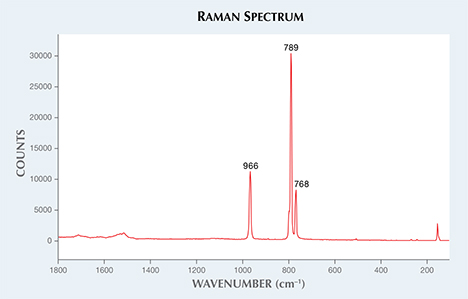
Figure 2. Raman spectroscopy confirmed the identification of two colorless round
brilliants as synthetic moissanite with peaks at 768, 789, and 966 cm–1.
FTIR spectroscopy performed on the other referred near-colorless and colored melee identified them as natural. One melee was found to be type IaB, while the others were type IaA.brilliants as synthetic moissanite with peaks at 768, 789, and 966 cm–1.
This analysis showed that melee-sized diamond imitations are being mixed with natural diamond parcels and set into fine jewelry without proper disclosure. Therefore, proper identification by a gemological laboratory is an essential tool to maintaining the integrity of the industry.
.jpg "YMAL GIA Ed")


