When mineral-rich fluids become trapped in open cracks and evaporate, they can leave behind epigenetic mineral precipitates. These epigenetic mineral deposits are fairly common in gem materials, usually taking the form of brownish iron oxide staining in cracks. These deposits are often a nuisance, impairing the potential beauty of the finished gem, but occasionally they contribute vibrant colors with interesting geometric shapes, such as inclusions of pyrite trapped in cracks in quartz.
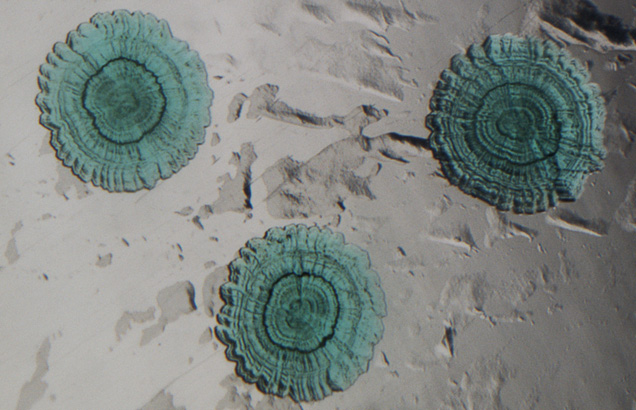
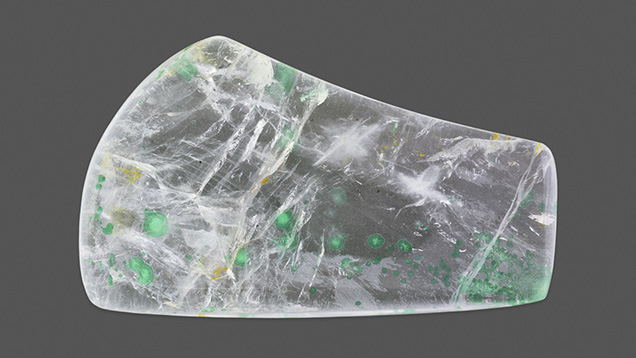
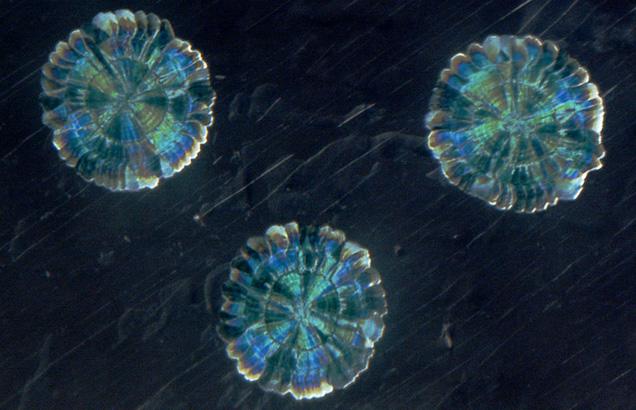
An unusual freeform cabochon of rock crystal quartz (figure 1), obtained from Leonardo Silva Souto (Cosmos Gems, Teófilo Otoni, Brazil) and reportedly of Brazilian origin, was examined at GIA’s Carlsbad laboratory. The 52.99 ct stone contained several interesting inclusions of malachite (figure 2). These inclusions were obviously epigenetic, as they were confined within secondary cracks in the quartz host. This planar confinement caused the inclusions to grow outward after nucleating. The flattened discs were particularly interesting due to the vibrant interference colors visible in polarized light (figure 3), as well as their uniform structure. The identification of the inclusions and the host was confirmed by Raman spectroscopy.
Malachite has been previously reported as a syngenetic inclusion in chalcedony and gypsum (e.g., E.J. Gübelin and J.I. Koivula, Photoatlas of Inclusions in Gemstones , ABC Edition, Zurich, 1986), but epigenetic malachite in quartz is rather uncommon. In this stone, the resulting vivid green color is an improvement over the otherwise ordinary, colorless quartz.
When mineral-rich fluids become trapped in open cracks and evaporate, they can leave behind epigenetic mineral precipitates. These epigenetic mineral deposits are fairly common in gem materials, usually taking the form of brownish iron oxide staining in cracks. These deposits are often a nuisance, impairing the potential beauty of the finished gem, but occasionally they contribute vibrant colors with interesting geometric shapes, such as inclusions of pyrite trapped in cracks in quartz.
An unusual freeform cabochon of rock crystal quartz (figure 1), obtained from Leonardo Silva Souto (Cosmos Gems, Teófilo Otoni, Brazil) and reportedly of Brazilian origin, was examined at GIA’s Carlsbad laboratory. The 52.99 ct stone contained several interesting inclusions of malachite (figure 2). These inclusions were obviously epigenetic, as they were confined within secondary cracks in the quartz host. This planar confinement caused the inclusions to grow outward after nucleating. The flattened discs were particularly interesting due to the vibrant interference colors visible in polarized light (figure 3), as well as their uniform structure. The identification of the inclusions and the host was confirmed by Raman spectroscopy.
Malachite has been previously reported as a syngenetic inclusion in chalcedony and gypsum (e.g., E.J. Gübelin and J.I. Koivula, Photoatlas of Inclusions in Gemstones , ABC Edition, Zurich, 1986), but epigenetic malachite in quartz is rather uncommon. In this stone, the resulting vivid green color is an improvement over the otherwise ordinary, colorless quartz.