
Alexandrite
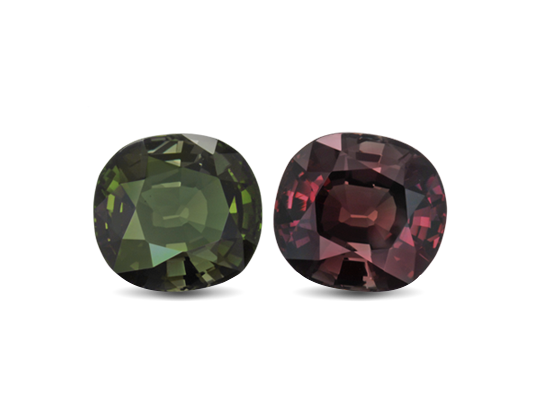
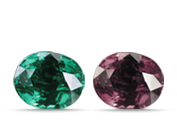
Green in sunlight. Red in lamplight. Color-changing alexandrite is nature’s magic trick.
Overview
ABOUT ALEXANDRITE
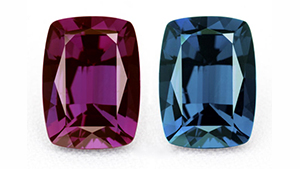
Often described by gem aficionados as “emerald by day, ruby by night,” alexandrite is the very rare color-change variety of the mineral chrysoberyl. Originally discovered in Russia’s Ural Mountains in the 1830s, it’s now found in Sri Lanka, East Africa, and Brazil, but fine material is exceptionally rare and valuable.
BIRTHSTONES AND ANNIVERSARIES
Alexandrite is a birthstone for June, along with pearl and moonstone. Alexandrite is also the gem for the 55th wedding anniversary.
1830
The year alexandrite was discovered in Russia’s Ural Mountains.
Czar Alexander II
Gem’s namesake who emancipated Russia’s serfs and was assassinated in 1881.
580nm
This absorption band allows alexandrite to shift from red to green when viewed under different light sources.
FACTS
TREATMENTS
There are a number of processes used to alter the color, apparent clarity, or improve the durability of gems.
SYNTHETICS
Some gemstones have synthetic counterparts that have essentially the same chemical, physical, and optical properties, but are grown by man in a laboratory.
IMITATIONS
Any gem can be imitated—sometimes by manmade materials or by natural materials chosen by man to impersonate a particular gem.
WHY WE LOVE THIS GEMSTONE

1
Color Change
Making alexandrite change color from green to red is the world’s most fun use of a penlight.
1
Color Change
Making alexandrite change color from green to red is the world’s most fun use of a penlight.
1
Color Change
Making alexandrite change color from green to red is the world’s most fun use of a penlight.
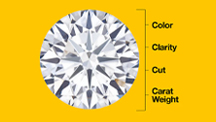
Quality Factors
Play-of-color, intensity, and pattern are important value factors.
COLOR

CLARITY
CUT
CARET WEIGHT
ALEXANDRITE QUALITY FACTORS: THE COMPREHENSIVE GUIDE
Research
Recommended Reading
Alexandrite
Russian Alexandrites